

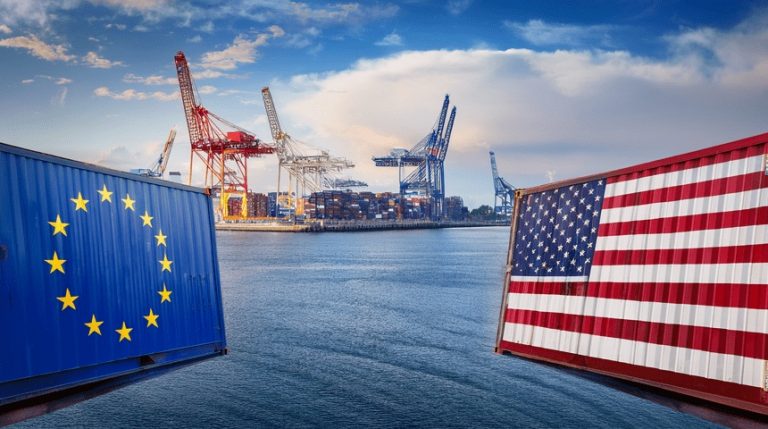
German Chancellor Friedrich Merz has cautioned the United States against underestimating the European Union’s readiness to retaliate if the U.S. imposes 30% tariffs on EU goods, which could severely impact Germany’s export-driven economy. Speaking on July 13, 2025, Merz emphasized the need for EU unity and open communication with U.S. President Donald Trump to find a swift solution.
He noted that while the EU is refraining from immediate countermeasures, it is prepared to respond if necessary, aligning with France’s stance on potential retaliatory measures. Merz highlighted that Trump’s previous tariff threats to other countries often served as negotiation tactics, suggesting a deal could still be reached before the August 1, 2025, deadline.
Germany, as the EU’s largest economy, relies heavily on exports, particularly to the U.S., with €157 billion in goods exported in 2024. A 30% U.S. tariff could disrupt key sectors like automotive (e.g., Volkswagen, BMW), machinery, and chemicals, leading to reduced trade volumes, job losses, and economic slowdown. Other EU nations with significant U.S. trade, like France and Italy, would also face economic strain.
The EU exported €472 billion in goods to the U.S. in 2024, and tariffs could disrupt supply chains, increase costs, and dampen growth across the bloc. Merz’s warning signals the EU’s readiness to impose counter-tariffs, potentially targeting U.S. goods like agricultural products, tech, or energy exports (e.g., liquefied natural gas). In 2018, the EU responded to U.S. steel tariffs with duties on $3 billion worth of U.S. goods, such as bourbon and motorcycles.
Register for Tekedia Mini-MBA edition 20 (June 8 – Sept 5, 2026).
Register for Tekedia AI in Business Masterclass.
Join Tekedia Capital Syndicate and co-invest in great global startups.
Register for Tekedia AI Lab.
A similar or larger response could escalate tensions into a full-blown trade war. A trade war would harm both economies, with the U.S. facing higher consumer prices and the EU grappling with export declines, potentially worsening global economic instability amid existing inflationary pressures.
Merz’s comments suggest the EU is using the threat of retaliation as leverage to negotiate a deal before the August 1, 2025, deadline. By highlighting Trump’s past use of tariff threats as a bargaining tactic, Merz indicates openness to dialogue, which could lead to exemptions or reduced tariffs if the EU offers concessions, such as increased U.S. imports or trade policy adjustments.
A U.S.-EU tariff dispute could push the EU to strengthen trade ties with other partners, like China or ASEAN, to offset losses. However, this risks further straining transatlantic relations and weakening the Western economic alliance at a time of geopolitical challenges, including competition with China and Russia’s ongoing influence. The dispute could also disrupt global supply chains, particularly in industries like automotive and tech, where U.S. and EU firms are deeply integrated.

Trump administration appears focused on protectionist policies to boost domestic manufacturing and reduce trade deficits. Trump’s proposed 30% tariffs on EU goods align with his broader agenda, which includes 60% tariffs on Chinese imports. This approach prioritizes U.S. interests but risks alienating allies. The EU, led by figures like Merz and French President Emmanuel Macron, views tariffs as a threat to its economic model and global trade principles.
The EU’s unified stance, as Merz emphasized, aims to counter U.S. pressure but reflects internal concerns about maintaining competitiveness and cohesion. While Merz calls for EU unity, member states have varying priorities. Export-heavy nations like Germany and the Netherlands are more vulnerable to U.S. tariffs, pushing for a strong response, while smaller or less trade-dependent states may prefer de-escalation to avoid economic fallout.
The tariff threat amplifies political divisions within the EU. Populist and protectionist parties in countries like Italy or Hungary may sympathize with Trump’s approach, complicating the EU’s ability to present a united front. The dispute exacerbates a broader divide between protectionist and free-trade advocates. The U.S. shift toward protectionism contrasts with the EU’s commitment to multilateral trade agreements, potentially weakening institutions like the World Trade Organization.

Emerging economies may exploit this divide, with countries like China or India positioning themselves as alternative trade partners, further reshaping global economic alliances. Merz’s warning underscores the high stakes of a potential U.S.-EU tariff dispute, with significant economic and geopolitical implications. The divide reflects differing U.S. and EU economic priorities, internal EU challenges, and a broader global shift toward protectionism.
While negotiation could avert escalation, failure to reach a deal by August 1, 2025, risks a damaging trade war, with ripple effects across global markets. The EU’s ability to maintain unity and leverage its collective economic weight will be critical in shaping the outcome.