

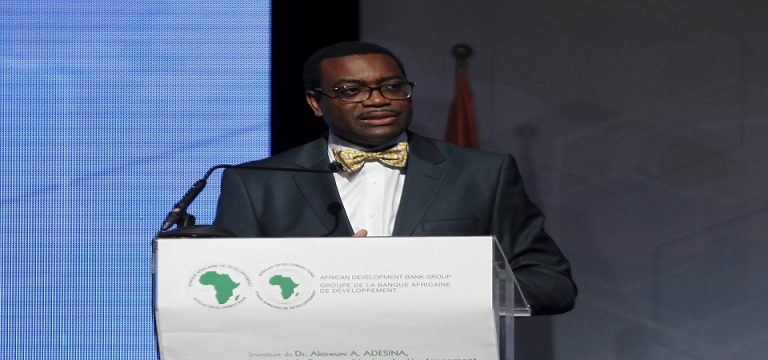
The President of the African Development Bank (AfDB), Dr. Akinwumi Adesina, has issued a stark warning that Nigeria is in the grips of an economic regression deeper than many realize, declaring that the average Nigerian today is poorer than at the dawn of independence in 1960.
Speaking during the 20th-anniversary dinner of investment firm Chapel Hill Denham in Lagos, Adesina laid bare Nigeria’s economic contradictions, drawing attention to the country’s low GDP per capita, which now stands at $824 — less than half the $1,847 recorded in 1960, when Nigeria gained independence from Britain.
“Our GDP per capita in 1960 was $1,847. Today, it stands at $824. Nigerians are worse off than 64 years ago,” Adesina said in a statement released on Thursday following his keynote address. “Underdevelopment should not be accepted as our destiny. We must break free from this pattern.”
Register for Tekedia Mini-MBA edition 20 (June 8 – Sept 5, 2026).
Register for Tekedia AI in Business Masterclass.
Join Tekedia Capital Syndicate and co-invest in great global startups.
Register for Tekedia AI Lab.
Despite claims by the federal government that its economic reforms will yield a $1 trillion economy by 2030, Adesina warned that Nigeria’s economic structure remains “deeply flawed and unsustainable.” The AfDB chief blamed the country’s economic slide on decades of policy failures, institutional decay, over-dependence on crude oil exports, and an inability to invest meaningfully in critical sectors.
A Country of Wasted Potential
Adesina contrasted Nigeria’s stagnant growth with the meteoric rise of South Korea, a country that had a lower GDP per capita than Nigeria in 1960 but has since industrialized to become a global economic power, with a per capita income of more than $36,000. South Korea’s success, he noted, was driven by a deliberate policy shift that prioritized manufacturing, innovation, and education — areas Nigeria continues to neglect.
“Nigeria belongs in the league of developed nations. To get there, we must shift our mindset and pursue rapid economic growth,” Adesina said. “We must become Africa’s industrial powerhouse.”

The former Nigerian agriculture minister said the current state of Nigeria’s economy — one plagued by deindustrialization, extreme poverty, unreliable power supply, and widespread youth unemployment — is not the result of fate, but of years of neglect and poor leadership.
“The Nigeria of 2050 must be deliberately shaped, developed, corruption-free, and lead the rest of Africa,” he said.
Five Pillars for Economic Redemption
In his speech, Adesina laid out five urgent priorities to pull Nigeria out of its current trajectory and place it on a path to inclusive, sustainable growth:

- Universal access to electricity, which he described as non-negotiable for industrialization and innovation
- Development of world-class infrastructure, especially in transportation and digital networks
- Rapid industrialization that shifts Nigeria’s economy away from primary commodity dependence
- Innovation-driven growth, with significant investment in education, research, and technology
- Competitive agriculture, not just for food security but as a strategic export sector.
Adesina stressed that these reforms cannot be superficial or cosmetic but must involve deep structural changes supported by effective governance and institutional strength.
“Without credible reforms, Nigeria will continue to miss out on global opportunities and fail its growing population,” he warned.
He cited the Dangote Refinery, Africa’s largest oil refinery, as an example of the kind of private sector-led industrial project that represents a step in the right direction. He urged policymakers to see such projects not as exceptions but as models to replicate and scale up across different sectors.
Funding Transformation Through Domestic Capital
To finance Nigeria’s transformation, Adesina urged the government and private sector leaders to harness the country’s domestic resources, including its massive pension fund assets, which now exceed N19 trillion, its capital markets, and the global Nigerian diaspora. These, he said, should be leveraged to fund large-scale industrial and infrastructure projects, rather than relying excessively on foreign debt or aid.
“There is no shortage of capital. What is missing is the confidence in governance and the consistency of policy that gives investors the courage to commit,” Adesina said.
Governance Still the Elephant in the Room
Adesina was unequivocal in stating that structural reforms alone would not be enough. He emphasized that the success of any economic agenda would depend on the strength of institutions, the rule of law, and the eradication of corruption. Without these, he warned, reforms risk being undermined or reversed.
“This is not just about economic plans. It’s about leadership, integrity, and the political will to do what is right, even when it is hard,” he said.
Adesina’s sobering remarks come on the heels of the World Bank’s April 2025 Africa’s Pulse report, which paints an even grimmer picture of Nigeria’s development path. According to the report, Nigeria is home to 19% of sub-Saharan Africa’s extremely poor population, the highest share in the region. That means roughly one in every seven of the world’s poorest people now lives in Nigeria.
The World Bank noted that sub-Saharan Africa accounted for 80% of the world’s 695 million extremely poor people in 2024, with Nigeria contributing the largest share. The statistics directly challenge claims by Nigerian officials who often tout GDP growth without addressing its failure to reduce poverty and improve human development outcomes.
The collapse of real incomes, double-digit inflation, and currency instability have eroded living standards for millions of Nigerians, many of whom now struggle to afford basic necessities. Despite being a major oil producer, Nigeria remains one of the most energy-poor countries in the world, with over 90 million people lacking reliable electricity.
Adesina’s message, that Nigeria is poorer today than it was 64 years ago, directly contradicts decades of government rhetoric celebrating nominal economic expansion. Amid growing public disillusionment with the political and economic elite, he urged the Nigerian leadership to up the ante.
“We cannot continue to squander our potential. The time to act is now,” he said.