

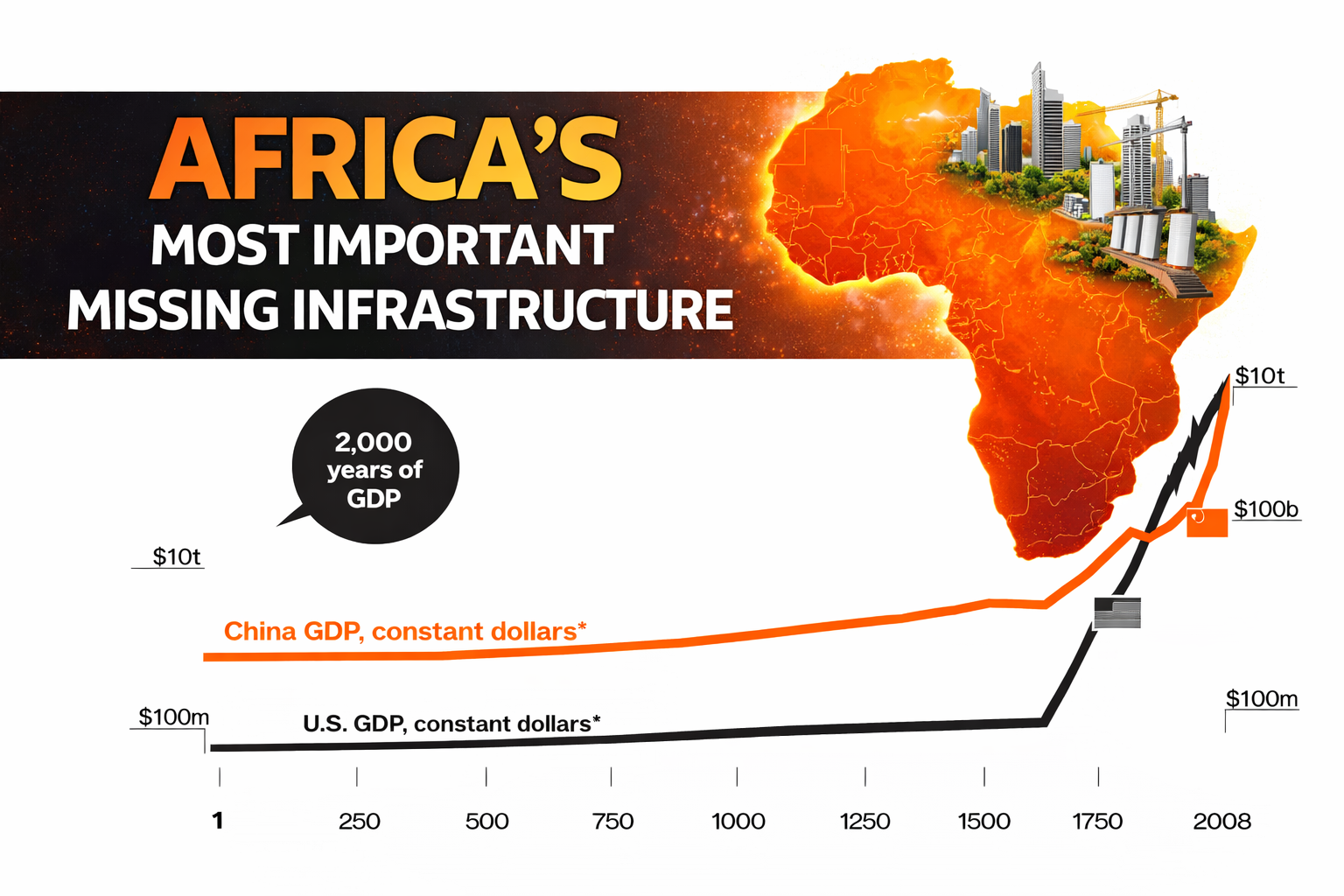
Looking at more than 2,000 years of Gross World Product, three great epochs of human progress emerge. I describe them as the Invention Society Era, the Innovation Society Era, and the Acceleration Society Era. In the Invention Era, humanity generated ideas and established the foundations of natural philosophy, but lacked the commercial and institutional mechanisms to turn ideas into usable products.
In the Innovation Era, those dormant ideas were translated into vaccines, electricity, engines, and industrial systems because policy frameworks and property-rights structures enabled wealthy merchants to fund chemists, engineers, and scientists. Polio, tuberculosis, and many diseases were defeated because compounds discovered in the Invention Era were commercialized in the Innovation Era. And the knowledge of thermodynamics, calculus and understanding of forces enabled designs of industrial systems.
Today, the world has crossed into the Acceleration Era, propelled by autonomous systems, artificial intelligence, and self-orchestrating digital platforms.
Register for Tekedia Mini-MBA edition 20 (June 8 – Sept 5, 2026).
Register for Tekedia AI in Business Masterclass.
Join Tekedia Capital Syndicate and co-invest in great global startups.
Register for Tekedia AI Lab.
China, Europe, and North America built the physical infrastructure of the Innovation Era: roads, electricity grids, water systems, and industrial rail. They now require a new kind of infrastructure to thrive: hyperscale data centers, energy-intensive GPU clusters, and global compute constellations. As Nvidia’s Jensen Huang said at the World Economic Forum, data centers represent “the largest infrastructure buildout in human history.” That is the new scaffolding of prosperity, for them.
But Africa stands at a different junction. The continent has not fully institutionalized the Innovation Era. Without strong, functional property-rights systems, the bedrock upon which money transmutes into capital, innovation stalls. Capital cannot form, scale cannot emerge, and ideas cannot compound. AI, autonomous systems, and data centers cannot catalyze economic emancipation where the rule of law is weak. Until property rights become the bloodstream of the continent’s economic architecture, Africa cannot harness the full promise of the Acceleration Era others will be experiencing.
The message is unmistakable: nations do not rise merely because they adopt new technologies; they rise when they build the institutions that give technology the power to compound wealth. For Africa, the most critical infrastructure at this moment is not the data center or the AI hub, it is the rule of law, framed by strong property rights at the very nucleus of economic life.

These eras are:
- The Invention Society: This era focused on discovering the foundational building blocks of science and knowledge, such as gravity, electromagnetism, and calculus. While brilliant, this period lacked the widespread ability to commercialize these discoveries into products.
- The Innovation Society: Beginning towards the end of the 18th century, this era took the foundational inventions and converted them into products and services that shaped modern commerce, such as vaccines, light bulbs, and transistors.
- The Accelerated Society (Current Era): Our present era, where technology, automation, and AI are compounding at a breakneck speed. This era is characterized by:
- AI and Automation: A shift from just inventing to using intelligent systems.
- New Competition: Performance differences between the deployed and non-deployed are increasing by orders of 1000s.
---
Connect via my
LinkedIn |
Facebook |
X |
TikTok |
Instagram |
YouTube
Systems are product of laws, if the rules are weak, the systems will be weak or nonexistent. Why are we even uncomfortable with property rights, because our communal lifestyle or something unexplained? We will need to figure out, one way or another.