

Artificial intelligence (AI) has become the dominant narrative in discussions about the future of transport. Across aviation, logistics, maritime shipping, autonomous vehicles, road safety and even space transportation, AI is portrayed as the technology that will optimise routes, predict maintenance, improve safety, automate decisions and redefine mobility. This narrative is particularly visible on professional social media, where industry experts, executives, engineers and researchers increasingly use thought leadership posts to shape how organisations understand AI and its future.
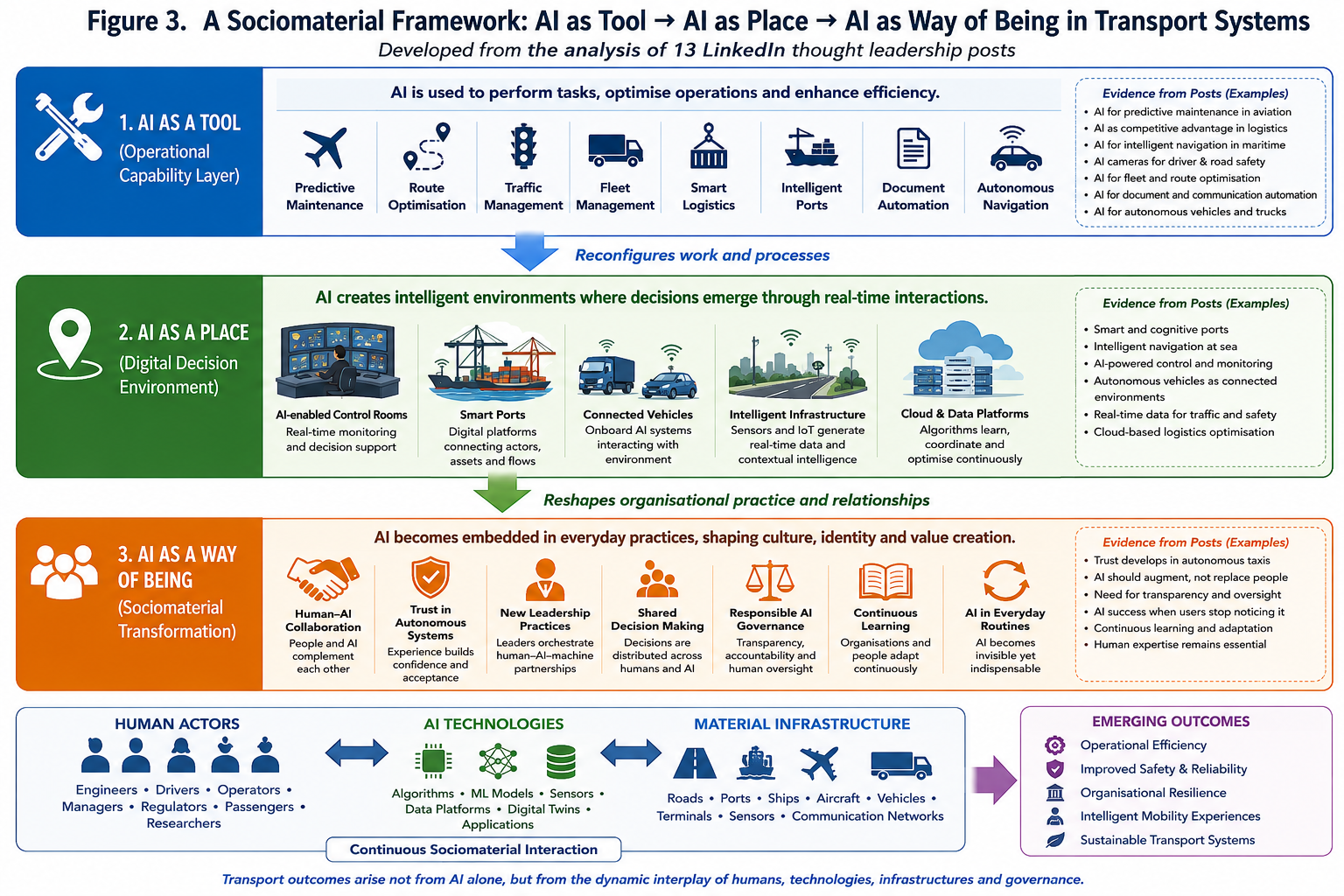
Drawing on an analysis of thirteen thought leadership posts published on LinkedIn, this article argues that while AI is consistently framed as a catalyst for efficiency, automation and innovation, an important part of the story is missing. Most discussions present AI as a technological solution to operational problems. While this perspective captures AI’s practical value, it overlooks a deeper transformation already underway across transport systems. AI is not simply becoming another digital tool. It is emerging as a place where transport decisions are produced and a way of being that reshapes how transport organisations work, collaborate and govern themselves. Recognising these three dimensions is essential if transport leaders are to move beyond technology-centred thinking.
The first misconception is viewing AI solely as a tool. Much of the current conversation celebrates AI’s ability to automate routine tasks, reduce costs and improve operational performance. Airlines use AI to predict equipment failures before they occur. Logistics firms optimise delivery routes through machine learning. Maritime operators deploy intelligent systems to improve port efficiency and supply chain visibility. Autonomous vehicles promise safer and more efficient mobility, while AI-powered fleet management and document processing reduce administrative burdens. These developments are significant, but they also reinforce an instrumental view of AI as something organisations simply deploy to improve performance.
Register for the next Tekedia Mini-MBA.
Register for Tekedia AI in Business Masterclass.
Join Tekedia Capital Syndicate and co-invest in great global startups.
This perspective underestimates the reciprocal relationship between AI and organisational practice. AI does not merely support existing work. It changes how work itself is organised. Predictive maintenance reshapes how engineers schedule inspections. Intelligent routing alters the role of dispatchers. AI-assisted communication changes how logistics professionals coordinate complex supply chains. Human expertise does not disappear. Instead, it is redistributed across people, algorithms, sensors and digital platforms. AI becomes part of organisational practice rather than an external assistant.
The second dimension receiving insufficient attention is AI as a place. This idea may initially seem abstract, yet it reflects one of the most significant shifts taking place in transport systems. Increasingly, operational decisions no longer originate exclusively in control rooms, offices or boardrooms. They emerge within digital environments where algorithms continuously interact with sensors, infrastructure, vehicles and people.
The autonomous vehicle provides a useful example. Its ability to navigate safely depends not only on sophisticated software but also on cameras, radar, high-definition maps, cloud infrastructure, traffic conditions, road regulations and passenger behaviour. Likewise, intelligent ports are no longer simply physical locations where cargo is loaded and unloaded. They are becoming digital environments where information flows alongside goods and where operational intelligence is generated continuously. AI therefore functions as a place where transport systems are monitored, coordinated and optimised in real time.

Perhaps the most overlooked dimension is AI as a way of being. Every technological transformation eventually changes organisational culture, professional identity and human expectations. This transition is already visible in the dataset.
One contributor reflects on riding in a fully autonomous taxi. The first journey felt extraordinary. The second quickly became routine. The observation was simple yet profound. AI succeeds not when people continue to admire the technology but when they stop noticing it. Trust replaces novelty. Routine replaces excitement. The technology becomes embedded in everyday experience.
This insight extends well beyond autonomous vehicles. Organisations often evaluate AI through technical indicators such as speed, efficiency and accuracy. These measures matter, but they do not explain whether AI has become part of everyday organisational life. AI becomes a way of being when transport professionals instinctively incorporate intelligent systems into how they think, decide and collaborate. It becomes woven into organisational routines, relationships and professional identities rather than remaining a visible technological intervention.

This shift also challenges conventional ideas of leadership. Future transport leaders will not simply oversee fleets, ports or infrastructure. They will manage relationships between human judgement and machine intelligence. Their role will increasingly involve creating organisational environments where AI complements human expertise instead of competing with it. Success will depend not only on technological capability but also on the ability to cultivate trust, adaptability and collaboration across increasingly intelligent transport ecosystems.
Encouragingly, the analysis shows that the conversation is beginning to evolve. Several contributors move beyond celebrating innovation to raise questions about transparency, explainability, accountability and human oversight. This suggests growing recognition that successful AI adoption depends as much on trust as it does on technical sophistication.
Yet governance is still treated largely as a compliance issue rather than an organisational capability. Too often, governance is presented as something applied after AI systems have been implemented. A sociomaterial perspective offers a different understanding. Responsibility is not located solely within algorithms or human operators. It emerges through the ongoing interaction among software developers, engineers, regulators, transport professionals, passengers, digital infrastructure and physical assets. Governance is therefore embedded within everyday organisational practice rather than added as a final layer of oversight.
Perhaps the greatest omission in current thought leadership is its limited attention to people. While automation dominates the conversation, relatively little consideration is given to how engineers, drivers, dispatchers, maintenance personnel and logistics professionals adapt alongside intelligent systems. AI does not eliminate human agency. It redistributes it. Understanding this redistribution is essential because transport systems are not simply technological networks. They are sociomaterial systems in which people and technologies continuously shape one another.
This insight is particularly important for organisations seeking to develop responsible AI strategies. Investment in algorithms alone will not deliver transformation if organisations neglect workforce development, organisational learning and institutional trust. The future of intelligent transport depends as much on how people engage with AI as on the sophistication of the technology itself.
The future of transport will not be determined solely by more powerful algorithms or larger datasets. It will be shaped by how effectively organisations integrate AI into the social and material fabric of transport. AI is simultaneously a tool that augments capability, a place where operational intelligence is created and a way of being that reshapes organisational identity, decision making and collaboration.
Thought leaders who continue to frame AI only as a technological innovation risk overlooking the more profound transformation already underway. The transport organisations that lead the next decade will not necessarily be those with the most advanced AI systems. They will be those that recognise AI as a sociomaterial ecosystem where technology, infrastructure, governance and people continuously shape one another. In the age of intelligent mobility, competitive advantage will come not from deploying AI faster than everyone else but from embedding it more thoughtfully into the everyday practices that define how transport systems operate.