

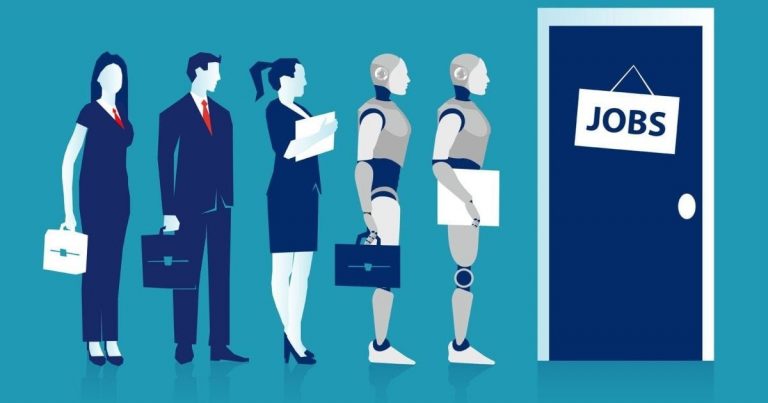
The technology industry is discovering an uncomfortable contradiction at the heart of its AI revolution: while companies race to build machines that could transform the future of work.
Some of the people protecting their physical infrastructure are preparing to walk off the job, while former researchers are warning that the technology itself could become an existential threat.
A looming strike by security guards at major technology companies brings the first contradiction into sharp focus.
Register for the next Tekedia Mini-MBA.
Register for Tekedia AI in Business Masterclass.
Join Tekedia Capital Syndicate and co-invest in great global startups.
Behind the glass offices, artificial-intelligence laboratories and enormous data centers that symbolize Silicon Valley’s technological ambitions is a less glamorous workforce responsible for keeping those facilities secure.
Their potential strike is a reminder that even the most automated companies remain dependent on human labor. The dispute also exposes a broader question about the economics of technological progress.
Technology companies can spend billions of dollars on chips, data centers and AI research, yet the workers maintaining the physical environment around those investments can still find themselves in conflict with their employers.

Automation may reduce certain forms of labor, but it does not eliminate the social and economic relationships that make large technological systems possible.
At the same time, the resignation of a former Google DeepMind researcher introduces a very different kind of warning. The researcher reportedly said he left because he “earnestly believes that AI has the potential to kill us all.”
Such a statement is deliberately stark, but it reflects a serious debate within the AI community over whether increasingly capable systems could eventually create risks that existing institutions are not equipped to control.

The significance of the warning is not that catastrophe is inevitable. It is that some people who have worked directly on frontier AI believe the possibility deserves extraordinary attention.
Their concerns range from autonomous systems behaving in unintended ways to increasingly capable models being deployed faster than safety mechanisms can develop.
That debate creates a difficult governance problem. Companies have powerful incentives to move quickly because the commercial rewards for leadership in AI could be enormous.
Governments, meanwhile, must consider not only innovation but also national security, labor markets, privacy, competition and public safety. Researchers are caught between advancing the technology and determining how much risk society should tolerate.
The security-guard dispute and the researcher’s resignation therefore appear unrelated, but they reveal the same underlying tension: technological power does not remove human vulnerability.
A data center may be filled with sophisticated machines, but it still requires people to operate, maintain and protect it.
An AI model may demonstrate remarkable reasoning abilities, but humans remain responsible for deciding where it can be deployed, what authority it receives and what safeguards surround it. That makes the future of AI less about machines replacing humans than about how humans organize themselves around increasingly powerful machines.
The critical question is not simply whether AI can become more capable. It is whether institutions, companies and workers can adapt quickly enough to manage the consequences. The next phase of the AI race will therefore be measured not only in model benchmarks, revenue and computing capacity.
It will be measured by whether the people building and protecting this infrastructure believe they have a meaningful voice in its direction—and whether society can establish credible mechanisms for controlling the risks that its own technological ambitions create.