

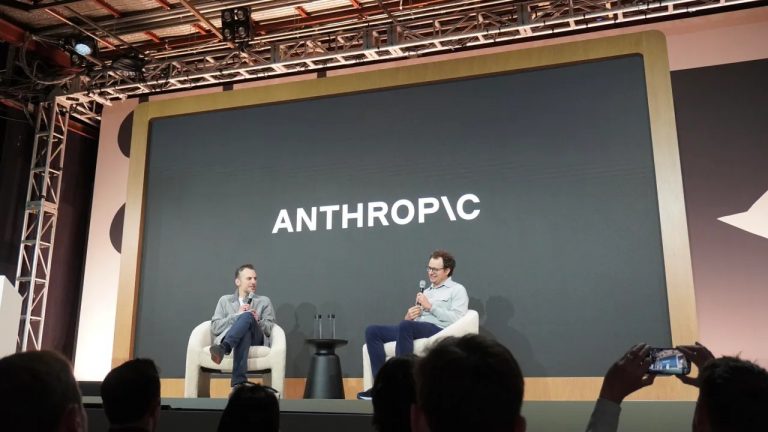
A senior executive at Anthropic warned on Monday that artificial intelligence development is moving too quickly and carries risks too profound to be left solely in the hands of technology companies, calling for stronger oversight from governments, religious institutions, and civil society groups.
Speaking at the Vatican during the presentation of Pope Leo XIV’s first encyclical on artificial intelligence, Anthropic co-founder Chris Olah said the world faces a “real possibility” that AI systems could displace human labor on a massive scale, creating economic and moral pressures unlike previous technological transitions.
“If that happens, supporting those displaced will be a moral imperative of historic proportions,” Olah said during the event, which brought together religious leaders, academics, and technology figures at the Vatican.
Register for the next Tekedia Mini-MBA.
Register for Tekedia AI in Business Masterclass.
Join Tekedia Capital Syndicate and co-invest in great global startups.
The remarks reflected growing unease inside parts of the AI industry itself, where even executives building advanced systems are increasingly warning about the societal consequences of the technology’s rapid acceleration.
Olah acknowledged that companies developing frontier AI models operate under intense commercial and geopolitical pressure, conditions he said can conflict with broader public interests.
“Every frontier AI lab operates inside a set of incentives and constraints that can sometimes conflict with doing the right thing,” he said, arguing that external scrutiny is necessary precisely because market incentives alone cannot reliably govern systems with potentially transformative social consequences.

The appearance marked a striking moment in the widening debate over AI governance, bringing together one of Silicon Valley’s leading AI safety advocates and the Catholic Church, which has increasingly positioned itself as a moral counterweight to the speed-driven culture of the technology sector.
The Vatican has emerged as an unusually active voice in ethical debates surrounding AI, automation, and human dignity, particularly around concerns that advanced systems could deepen inequality, weaken social cohesion, and concentrate power in a small number of corporations and governments.
Anthropic’s presence at the event also highlighted the company’s evolving role within the global AI policy debate. Founded in 2021 by former employees of OpenAI, including Olah, the company was created partly out of concerns that AI systems were being commercialized faster than adequate safeguards could be developed.

Anthropic has since tried to distinguish itself as a safety-focused AI developer, frequently advocating tighter controls and testing standards for powerful models. The company has also resisted pressure from parts of President Donald Trump’s administration to loosen restrictions around military applications of AI, particularly in areas such as autonomous targeting and domestic surveillance.
Olah said the ethical implications of AI now extend far beyond software engineering and should be treated as a broader societal issue involving philosophy, labor, economics, and human rights.
“I think this is a scary moment. Things are moving fast. It’s a really powerful technology,” he told Reuters after the event.
“There’s a risk that things could go badly, and it’s incumbent on all of us to push this in a good direction.”
His warning comes as governments around the world struggle to build coherent regulatory frameworks for increasingly capable AI systems, while companies race to deploy models that can code, reason, generate media, and automate complex workflows at unprecedented scale.
The debate has intensified in recent months following the release of more advanced AI systems from firms including Anthropic, OpenAI, and others, prompting concerns over cyber risks, labor disruption, and concentration of technological power.
Olah identified three areas he believes require urgent global attention: large-scale labor displacement, unequal access to AI benefits between wealthy and developing nations, and the growing opacity of advanced AI systems whose internal decision-making processes are becoming harder even for developers to interpret.
“AI development is concentrated in a handful of wealthy nations,” he told the Vatican audience. “How can we ensure the gains of AI are shared globally?”
That concern increasingly resonates beyond religious institutions. Policymakers in Europe, parts of Asia, and even sections of the US political establishment are debating whether frontier AI models should face stricter oversight before public deployment.
The Vatican event also indicates that the AI debate is shifting. What was once largely a technical discussion among engineers and venture capitalists is becoming a wider societal argument involving ethics, labor rights, geopolitics, and institutional trust.
Olah’s role as the only major Big Tech representative invited to the gathering underpins his longstanding focus on AI safety research and his outreach to religious communities. He said he had engaged with more than 15 faith traditions on the moral and philosophical implications of advanced AI systems.