

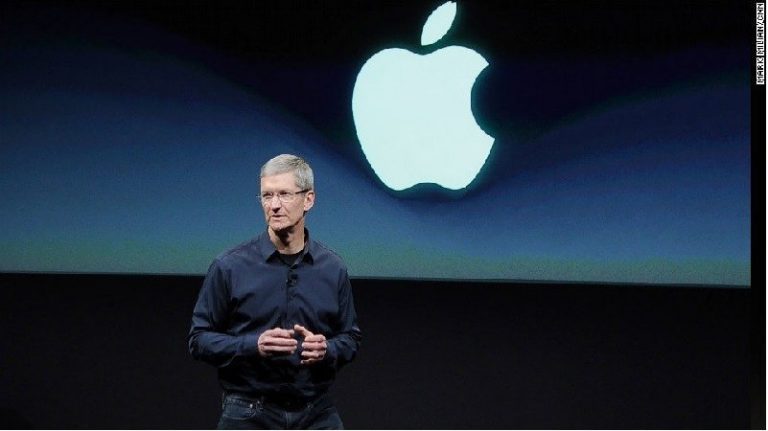
Apple’s sweeping pledge to invest $600 billion in U.S. manufacturing over the next four years is positioning the iPhone maker as one of the largest forces behind Washington’s campaign to onshore critical technology production.
In an interview with CNBC’s Jim Cramer on Friday, CEO Tim Cook underscored that the centerpiece of Apple’s plan is semiconductors, saying the goal is to “stitch together the end-to-end supply chain” at home.
“You can add a lot by making it global and then stitching together the end-to-end supply chain in semiconductors,” Cook said. “I can’t stress how important this is and how much that will add to what we’re doing.”
Register for Tekedia Mini-MBA edition 20 (June 8 – Sept 5, 2026).
Register for Tekedia AI in Business Masterclass.
Join Tekedia Capital Syndicate and co-invest in great global startups.
Register for Tekedia AI Lab.
The effort includes a $2.5 billion expansion of Apple’s long-standing partnership with Corning, whose Kentucky facility makes the glass used in iPhones and Apple Watches. Corning CEO Wendell Weeks told Cramer that Apple’s fresh injection of capital would allow the company to triple production, increase the factory’s workforce by 50%, and transform it into the “world-leading manufacturing site for highly-specialized glass.”
Cook, pointing to Corning’s durable “ceramic shield” technology — 50% stronger than earlier versions — said the investment reflects Apple’s confidence in Kentucky’s manufacturing base and Corning’s decades of innovation.
“This is the place to put it,” Cook said, praising Corning’s quality and track record. “I feel very confident in that, because when you look at innovation, when you look at the cost, when you look at the quality, these are all things that are factor into our decisions — this is a great place.”

Weeks added that the Kentucky plant represents a “social contract” with the community, noting that it has employed three generations of Corning workers since opening in 1952, though today’s work is far removed from what their grandparents once did.
Apple’s commitment already spans all 50 states, involving 9,000 partners and supporting around 450,000 jobs. The company recently launched a “Manufacturing Academy” in Detroit to train more workers and help small and medium-sized businesses adopt advanced manufacturing techniques, including artificial intelligence and smart automation.
Cook also acknowledged the political tailwinds bolstering Apple’s plan. President Donald Trump announced last month that his administration would impose a 100% tariff on imported semiconductors and chips — with exemptions for companies building inside the United States.

“The president has said that he wants more in the United States,” Cook said. “And we want more in the United States.”
How Apple Compares in the U.S. Chip Race
Apple’s vast spending commitment places it in rare company among global chipmakers reshaping their U.S. footprint. Taiwan Semiconductor Manufacturing Company (TSMC), Apple’s critical chip supplier, is building a $40 billion complex in Arizona, though delays and workforce shortages have slowed progress. Samsung is investing $17 billion in a Texas facility aimed at high-end chips. Intel, once America’s flagship chipmaker, has announced more than $100 billion in U.S. investments across Ohio, Arizona, and New Mexico, supported by Chips Act subsidies.
What sets Apple apart is its direct tie to consumer products. Whereas Intel and TSMC are chasing high-performance computing and server chips, Apple’s push is anchored to iPhones, iPads, and wearables — devices that require not only advanced semiconductors but also the specialized glass and materials that Corning provides. Apple is attempting to build a more insulated supply chain than its peers by integrating both upstream chip production and downstream component manufacturing in the U.S.
Impact on U.S. Chip Production
Apple’s $600 billion bet is expected to redefine U.S. advanced manufacturing. Analysts have predicted that Apple would catalyze an ecosystem where suppliers, from chipmakers to component specialists, scale up operations domestically. In that setting, Corning’s Kentucky facility could serve as a blueprint for regional hubs where factories create jobs, foster innovation, and sustain local economies.
However, protectionist tariffs, while boosting Apple’s near-term advantage, are expected to intensify trade disputes with Asia and strain relationships with critical partners like TSMC. In addition, workforce shortages in high-tech manufacturing remain a constraint, despite Apple’s new training initiatives. Analysts warn that heavy reliance on government incentives also ties Apple’s strategy to political cycles, leaving it vulnerable to policy reversals.
Still, Apple’s alignment with the Trump administration and its sheer financial scale distinguish its approach. Cook believes the effort is about more than products.
“Factories create hubs of economic activity,” he said, noting that manufacturing jobs ripple outward into local communities.
With Intel battling execution issues, TSMC navigating U.S. expansion hurdles, and Samsung working to prove its Texas project can deliver, Apple’s unprecedented $600 billion commitment may become the defining test of whether America can once again anchor the world’s most advanced supply chains.