

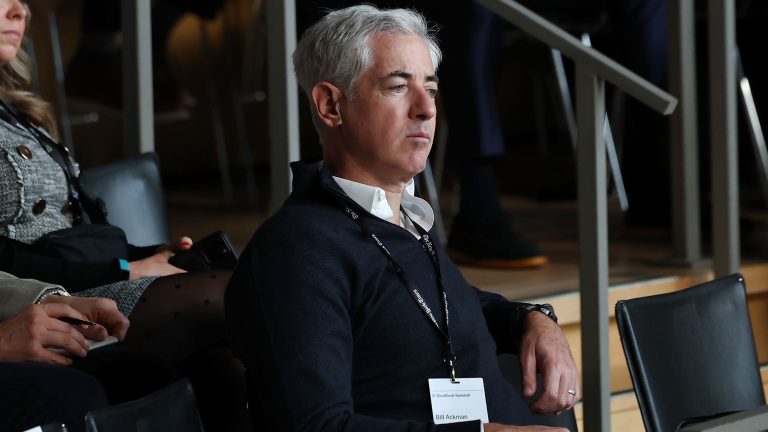
Billionaire investor Bill Ackman, who once backed U.S. President Donald Trump’s economic vision, has issued a scathing warning over the administration’s sweeping new tariff policy, calling it a “self-induced, economic nuclear winter” and accusing the president of destroying global confidence in the U.S. as a trading partner.
Trump’s latest executive order, signed Wednesday, slaps a flat 10 percent levy on all imports from over 180 countries, regardless of their economic standing or trade relationship with the United States. The blanket approach has jolted global financial markets, worsened recession fears, and sparked outrage not just from longtime critics, but from some of Trump’s most vocal supporters and economic allies.
Ackman took to social media platform X to express alarm, writing: “By placing massive and disproportionate tariffs on our friends and our enemies alike, and thereby launching a global economic war against the whole world at once, we are in the process of destroying confidence in our country as a trading partner.”
Register for Tekedia Mini-MBA edition 20 (June 8 – Sept 5, 2026).
Register for Tekedia AI in Business Masterclass.
Join Tekedia Capital Syndicate and co-invest in great global startups.
Register for Tekedia AI Lab.
The hedge fund manager, who previously applauded Trump’s America-first rhetoric, said the decision will end up hurting the very voters who helped bring Trump to power.
“The consequences for our country and the millions of our citizens who have supported the president — in particular low-income consumers who are already under a huge amount of economic stress — are going to be severely negative. This is not what we voted for,” he said.
Ackman’s warning follows a brutal week for investors. The S&P 500 fell more than 9% last week, and J.P. Morgan hiked the probability of a U.S. and global recession to 60% by year-end, up from 40%.

“Business is a confidence game,” Ackman said. “The president is losing the confidence of business leaders around the globe.”
No Diligence, No Discretion
Beyond the global market reaction, economists say the rollout was haphazard and lacked critical due diligence. In one striking example, the Trump administration imposed a 50 percent tariff, one of the highest levies in the package, on imports from Lesotho, a small, landlocked African nation where the average citizen earns less than $5 a day.
Lesotho exports about $237 million in goods to the U.S. annually, primarily diamonds and textiles. Yet it imports very little from the U.S., meaning that its citizens, already among the world’s poorest, will see their key exports taxed heavily with no real retaliatory capacity.

Supporters Now Sound the Alarm
The discontent isn’t just coming from elite financiers. Shay Boloor, a conservative financial commentator and host of Boys Invest, posted an open letter addressed to Trump on Sunday, expressing deep frustration over what he called the president’s “scattershot retaliation” and lack of a coherent economic strategy.
“We couldn’t keep pretending that a consumption-led economy held together by zero-interest rates and global fragility was a long-term solution,” Boloor wrote. “I welcomed the idea of a harder, smarter America-first policy that pushed for fair treatment, reciprocal agreements, and a real industrial strategy rooted in technological superiority, national security, and capital formation.”
“But that’s not what this is,” he said. “What you’ve rolled out isn’t detox — it’s whiplash.”
Boloor criticized the administration’s failure to produce a roadmap or operational framework, saying the policy appears to be improvised and reactionary.
“You can’t replace a fragile supply chain with chaos and call it resilience. You talk about bringing jobs home, but the U.S. doesn’t have the labor force, permitting structure, or wage flexibility to stand up full-scale manufacturing at speed.”
He warned that investors and CEOs are now more likely to hold off on major projects. “Capital isn’t going to rush to fill that void just because you raised tariffs,” he said. “It’s going to sit on the sidelines and preserve optionality.”
Boloor concluded by accusing the administration of launching a campaign of brute-force disruption with no viable alternatives in place. “And in the absence of credible structure, capital is retreating — not realigning.”
Lutnick Not Spared By Ackman
Ackman also leveled criticism at Commerce Secretary Howard Lutnick, alleging a glaring conflict of interest.
“He profits when our economy implodes. It’s a bad idea to pick a Secretary of Commerce whose firm is levered long fixed income,” Ackman said, referencing Lutnick’s role at Cantor Fitzgerald. “It’s an irreconcilable conflict of interest.”
Lutnick, appearing on CBS’s Face the Nation, defended the administration’s approach, insisting that reciprocal tariffs were necessary to rebalance decades of trade imbalances.
“We’re not backing down,” he said.
Trump Not Backing Down
Despite the growing opposition, Trump has remained defiant. The president, sources say, believes that the early signs of foreign capitulation are vindication enough. Vietnam and Taiwan have both agreed to zero tariffs on U.S. imports following the new policy rollout. India, too, has signaled its intention to lower tariffs to zero on a range of American goods.
These developments appear to have emboldened the Trump administration, which now believes that other nations, including EU member states, will be forced to follow suit. However, critics believe that Trump’s administration is conflating short-term diplomatic concessions with long-term economic stability, and confusing coercion for negotiation.