

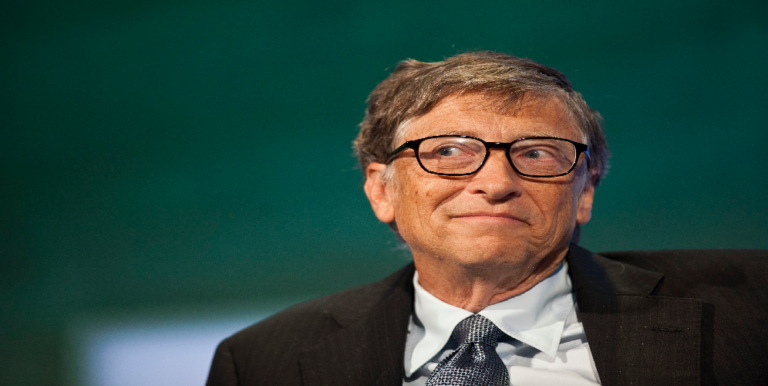
American tech billionaire and philanthropist Bill Gates has disclosed he will channel most of the $200 billion he intends to give away over the next two decades into Africa, focusing on health, education, and partnerships with governments that prioritize citizen welfare.
The Microsoft co-founder made the declaration on Monday while addressing a gathering at the Nelson Mandela Hall of the African Union headquarters in Addis Ababa, Ethiopia, where he spoke to an audience of more than 12,000 people — including government officials, diplomats, health workers, development partners, and youth leaders.
The announcement marks a significant shift in global philanthropy at a time when U.S. foreign aid has declined, particularly under President Donald Trump, whose administration has scaled back humanitarian funding and gutted staffing at the U.S. Agency for International Development (USAID). Gates’ vow to step into that void underscores what he sees as the urgency to invest in Africa’s future, especially as the continent faces persistent challenges in health, poverty, education, and climate vulnerability.
Register for Tekedia Mini-MBA edition 20 (June 8 – Sept 5, 2026).
Register for Tekedia AI in Business Masterclass.
Join Tekedia Capital Syndicate and co-invest in great global startups.
Register for Tekedia AI Lab.
“I recently made a commitment that my wealth will be given away over the next 20 years. The majority of that funding will be spent on helping you address challenges here in Africa,” Gates said at the event, according to a statement from the Gates Foundation.
The 68-year-old philanthropist, who is currently worth about $108 billion, says his net worth will fall by 99% by 2060, in line with his goal of distributing nearly all of his fortune through the Bill & Melinda Gates Foundation.
In a recent interview with CBS Mornings, Gates explained that his decision was inspired by Andrew Carnegie’s 1889 essay, “The Gospel of Wealth,” which asserts that the wealthy have a moral obligation to give away their riches during their lifetimes. The essay’s core idea — that “the man who dies thus rich dies disgraced” — has become a guiding principle for Gates, who has spent the past two decades trying to reallocate wealth to fight disease and inequality.

This isn’t Gates’ first act of philanthropic ambition. In 2010, he co-founded The Giving Pledge alongside Warren Buffett and Melinda French Gates, urging billionaires to commit at least half their fortunes to causes aimed at improving the human condition. But this new plan takes that ambition further by setting a firm 20-year horizon and a regional priority.
Africa as the Central Focus
While Gates has always had global ambitions through his foundation — funding vaccine development, eradicating diseases like malaria and polio, and strengthening health systems — his current announcement centers on Africa as the primary beneficiary. This includes support for health infrastructure, educational access, agriculture resilience, and innovation hubs across the continent.
“By unleashing human potential through health and education, every country in Africa should be on a path to prosperity — and that path is an exciting thing to be part of,” Gates said at the AU event.

His remarks highlighted the belief that investing in people, especially in developing nations, is the most effective way to lift entire regions out of poverty. Gates emphasized that this funding would not just be about charitable giveaways, but about partnering with African governments that show a commitment to reform and long-term impact.
In recent years, Gates and his foundation have ramped up involvement in African countries through initiatives like the Africa Health Diagnostics Platform (AHDP), support for vaccine manufacturing in Senegal and South Africa, and climate-resilient crop programs.
Filling the Void of U.S. Foreign Aid Cuts
Under the Trump administration, funding for USAID — historically one of the world’s largest conduits for humanitarian and health aid — was slashed significantly, and staffing levels fell. That retreat has left a vacuum in many low-income countries, particularly in sub-Saharan Africa, where programs once supported by American aid have stalled or been abandoned.
Gates’ expanded commitment signals an attempt to fill that void. With governments under fiscal pressure and private foreign aid plateauing, philanthropy may now carry more weight than ever before in shaping the future of public health and education in developing countries.
Initial reactions to Gates’ pledge have been mixed. African governments and health leaders welcomed the announcement, seeing it as a needed intervention during a time of global economic uncertainty. Many stressed that the funding must not only be generous but sustainable and equitably distributed, with an emphasis on African ownership of development programs.