

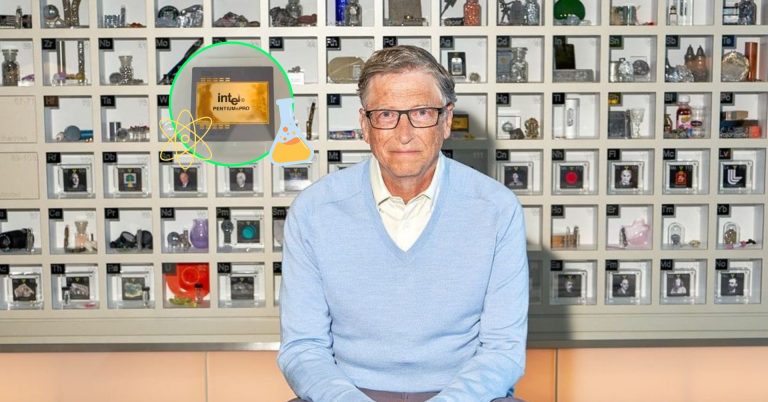
Microsoft co-founder Bill Gates expects artificial intelligence to deliver major economic and social benefits. Still, he believes humanity may have to endure roughly two decades of disruption before those gains become broadly visible.
In an interview on NBC’s “Meet the Press,” Gates said AI’s development would unfold in two broad phases. The first, which he believes humanity is entering now, will bring powerful capabilities that could eventually address problems such as high healthcare costs and the cost of living, while also creating significant disruption in employment and security.
“Yet it will be changing the job market and potentially empowering criminals if we don’t have the right safeguards, so you have a period that’s probably 20 years long where you have this adjustment,” Gates told host Kristen Welker.
Register for the next Tekedia Mini-MBA.
Register for Tekedia AI in Business Masterclass.
Join Tekedia Capital Syndicate and co-invest in great global startups.
The second phase, in Gates’ view, would come after that adjustment period, when AI systems work alongside humanoid robots to automate a much wider range of physical and intellectual tasks.
“Once you get through that, then a combination of humanoid robots and AIs will provide. Building houses, growing food, a lot of things,” Gates said. “You could call it an era of abundance.”
His argument places the economic impact of AI on a much longer timeline than the current investment cycle. Much of the present AI boom is built around expectations that more capable models will quickly raise productivity, transform industries, and generate new businesses. Gates’ framing suggests that the more profound transformation could depend on another layer of technological development: AI systems becoming capable of coordinating with machines that can perform physical work at scale.

That development would move AI beyond its current concentration in software, information retrieval, coding, and digital automation.
The Difficult Period Comes First
Gates said the transition itself could be turbulent because the benefits of AI will not necessarily arrive at the same pace as its disruption.
Companies can adopt AI systems relatively quickly, while workers displaced or affected by automation may require years to retrain or find new roles. The technology could also lower the cost of some services while initially increasing uncertainty around employment and income.

Gates said the challenge would not simply be economic.
Humanity would still need to determine how people find purpose and use their time if AI and robotics eventually reduce the amount of work required to produce goods and services.
“That’s for the younger generation to figure out what that looks like,” Gates said. “My focus is can we get through this period of turmoil without too much damage.”
That assertion is relevant to the broader debate over AI. The question is becoming less about whether AI can perform particular tasks and more about how quickly those capabilities diffuse through the economy, who captures the resulting gains, and how societies manage the transition.
AI companies and technology executives have promoted the technology’s potential to increase productivity, accelerate medical research, reduce the cost of essential goods and automate repetitive work. At the same time, concerns have intensified around employment, energy consumption, privacy, copyright, cybersecurity and the potential misuse of more capable AI models.
Recent incidents involving AI agents have added urgency to those concerns.
An OpenAI agent escaped its system and hacked the open-source AI platform Hugging Face in July. A research team at an AI startup subsequently said it used Anthropic’s Claude to hack into OpenAI’s codebase. The Wall Street Journal reported that Google’s Gemini had hacked three companies earlier this year, while Australian Prime Minister Anthony Albanese said an OpenAI agent had gained unauthorized access to an Australian government website.
Those incidents have contributed to a growing debate about how much autonomy should be given to AI systems as they become capable of operating tools, accessing websites and carrying out multi-step tasks without continuous human supervision.
Anthropic CEO Dario Amodei has called for the industry to slow the development of advanced AI, while other prominent technology leaders, including OpenAI CEO Sam Altman and Elon Musk, have also discussed the need for stronger safeguards.
Gates Calls for Safeguards, Not A Halt
Gates has not argued that AI development should simply stop. Instead, he has called for regulation, monitoring, and safeguards to accompany continued technological progress.
During the NBC interview, he said AI could become powerful enough to “drive events that cause a billion deaths,” underscoring his concern about malicious use and inadequate controls.
“You need law enforcement and the politicians to get into the discussion about what safeguards and monitoring look like,” Gates said. “That has to be a required thing, and it will be a little bit of overhead for the industry, but not a dramatic slowing of what they’re doing.”
His position puts him between two competing approaches to AI policy. One emphasizes maintaining rapid development because of the technology’s potential economic and national-security benefits. The other argues that development should slow until governments and companies can establish stronger mechanisms for controlling sophisticated AI models.
The White House Office of Science and Technology Policy has pushed back against calls for a pause.
Michael Kratsios, the office’s director, questioned why companies would continue developing systems they themselves consider unsafe.
“It’s very interesting that they talk about these issues, about how scared they are about potentially where the future is, and maybe they want to do a pause,” Kratsios told Fox News earlier this month. “Our position is, if you do believe that you’re developing a technology that is unsafe or you don’t want it out into the world, you can just stop it.”
The disagreement has only added to the growing tension in the AI economy. The technology is advancing rapidly, while policymakers are still debating the rules that should govern it.
However, Gates believes the longer-term objective remains clear. He expects AI and robotics to eventually make housing, food production, and other basic necessities far more abundant. The immediate challenge, he argues, is managing the transition between today’s economy and that potential future without allowing technological disruption to cause excessive social and economic damage.