

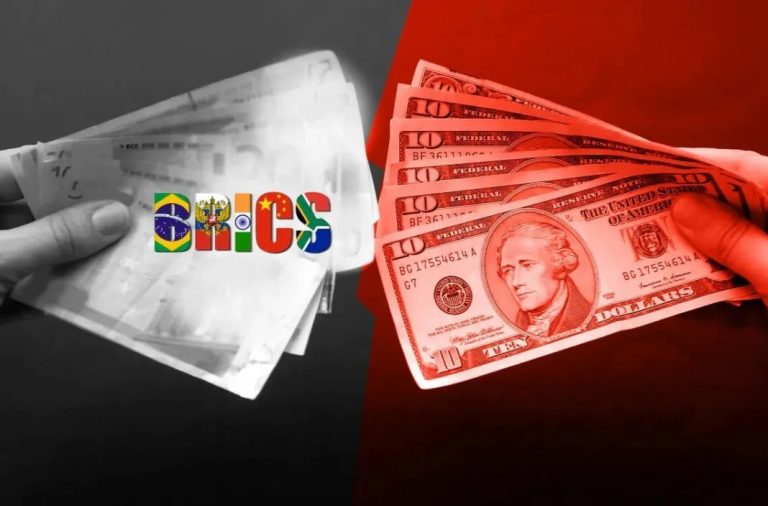
Brazil, which currently holds the presidency of BRICS, has decided not to push forward with discussions on creating a common currency for the bloc in 2025, according to sources who spoke to Reuters.
Instead, the focus will be on reducing dependence on the U.S. dollar by improving cross-border payment systems that facilitate trade in local currencies. While this shift may seem like a neutral economic policy, it has already drawn strong opposition from U.S. President Donald Trump, who has twice in recent months warned BRICS nations against undermining the dollar’s global dominance.
Trump’s latest warning, issued in January, came with a direct threat of 100% tariffs on BRICS nations if they attempt to replace the dollar in international trade. In a fiery post on social media, Trump declared, “There is no chance that BRICS will replace the U.S. dollar in international trade, or anywhere else, and any country that tries should say hello to tariffs, and goodbye to America!”
Register for Tekedia Mini-MBA edition 20 (June 8 – Sept 5, 2026).
Register for Tekedia AI in Business Masterclass.
Join Tekedia Capital Syndicate and co-invest in great global startups.
Register for Tekedia AI Lab.
The aggressive rhetoric highlights Washington’s growing concerns about the bloc’s moves toward financial independence from Western-dominated monetary systems.
However, the sources insist that BRICS’ monetary discussions are not meant to challenge the United States. One of the sources explained that the goal is to “reduce friction in global trade” by making transactions between BRICS nations more efficient. Another echoed the sentiment, saying, “No one wants to create trouble, but BRICS countries also don’t want to abandon the idea of exploring this possibility.”
Experts: A BRICS Currency Is a Long Shot
While leaders like Brazilian President Luiz Inácio Lula da Silva have championed the idea of a shared BRICS currency in the past, financial experts widely agree that such a project would be incredibly difficult to implement. The BRICS bloc includes economies with vastly different monetary policies, inflation rates, and levels of financial stability. Creating a common currency that could be effectively managed across these nations would require years—if not decades—of coordination.

Anil Sooklal, South Africa’s ambassador to BRICS, has previously pointed out that the idea of a BRICS currency remains a distant goal rather than an immediate priority.
“There is no clear consensus on key issues like governance, reserve allocations, and macroeconomic policy alignment. Until those challenges are addressed, any talk of a single currency is purely theoretical,” he stated.
The United Nations Development Program (UNDP) has also raised concerns about the feasibility of a BRICS currency. A 2023 UNDP report found that African and Latin American economies within BRICS already struggle with structural economic weaknesses, making the prospect of a shared currency even more complex.

Brazil Moves to Strengthen Trade in Local Currencies Instead
Since a single currency is off the table for now, Brazil’s BRICS presidency is focusing on enhancing trade mechanisms that allow transactions in local currencies, reducing the need for the U.S. dollar as an intermediary. Officials say the initiative will involve integrating payment systems using advanced technologies such as blockchain, following standards set by international bodies like the Bank for International Settlements (BIS).
Brazil is taking lessons from its own domestic success with digital payments. The country’s instant payment system, Pix, launched in 2020, has revolutionized transactions, surpassing cash, credit, and debit card payments. Now, Brazilian officials are looking to use similar technology to facilitate cross-border trade among BRICS members.
Another model under consideration is Brazil’s Local Currency Payment System (SML), which already allows transactions to be settled directly in Brazilian reais between Argentina, Uruguay, and Paraguay. However, SML has struggled with adoption due to long settlement times—transactions currently take up to three business days to clear. Brazilian officials believe integrating instant payment technology could make these transactions faster, more secure, and cost-effective, ultimately increasing trade within BRICS nations without the need for a common currency.
Brazil will formally present its agenda for BRICS at the upcoming July 2025 summit, with key discussions set to take place in South Africa later this month on the sidelines of the G20 meetings. The BRICS bloc, which has expanded in recent years to include Egypt, Ethiopia, Indonesia, Iran, Saudi Arabia, and the United Arab Emirates, is positioning itself as an alternative economic powerhouse to traditional Western financial institutions.
For now, the focus is on strengthening financial cooperation without directly challenging the U.S. dollar’s role. However, Trump’s threats of 100% tariffs on BRICS nations suggest that even small steps toward financial independence could provoke economic retaliation from the U.S.