

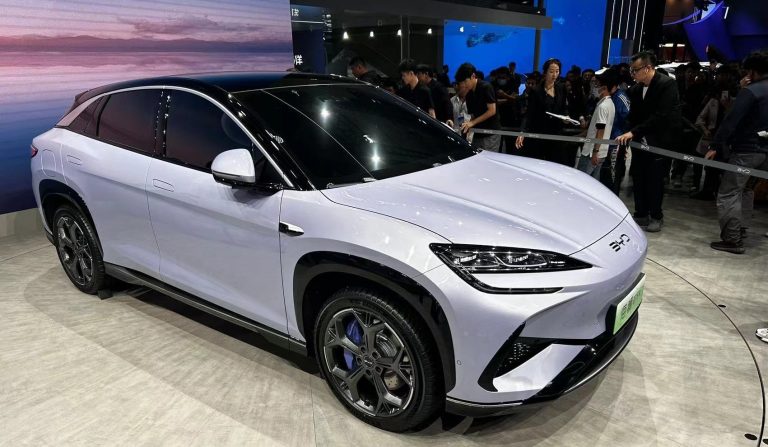
The dominance of Chinese electric vehicle giant BYD in its home market is facing increasing pressure after the company lost ground to domestic competitors during the first two months of 2026, reflecting both a slowdown in overall demand and intensifying competition across China’s rapidly evolving EV industry.
Sales data for January and February, reported by CNBC, show that BYD’s combined deliveries dropped about 36% year on year after adjusting for seasonal disruptions linked to the two-week Lunar New Year holiday in mid-February. The decline contrasts sharply with strong sales growth reported by several rival automakers, underscoring how the once-wide gap between the market leader and its competitors is beginning to narrow.
While BYD still commands the largest share of China’s new energy vehicle market, analysts say the sector is entering a new phase marked by fierce competition, thinner margins, and an expanding field of challengers ranging from traditional carmakers to technology companies moving aggressively into electric mobility.
Register for Tekedia Mini-MBA edition 19 (Feb 9 – May 2, 2026).
Register for Tekedia AI in Business Masterclass.
Join Tekedia Capital Syndicate and co-invest in great global startups.
Register for Tekedia AI Lab.
Rivals gain traction in a crowded market
Several Chinese EV manufacturers posted strong sales gains early this year, capitalizing on consumer appetite for new models and aggressive pricing strategies.
Startup automaker Leapmotor reported 60,126 deliveries across January and February, representing a 19% year-on-year increase. Meanwhile, technology conglomerate Xiaomi sold more than 59,000 vehicles during the same period, marking a 48% surge compared with a year earlier.
Other players recorded even stronger growth. Deliveries at Nio jumped 77% year on year, while premium EV brand Zeekr — owned by Geely — saw sales climb roughly 84%.

The surge highlights how China’s EV ecosystem has broadened rapidly. Companies are targeting different consumer segments, from budget urban commuters to premium high-performance models, making the market far more competitive than it was just a few years ago.
For BYD, the pressure is particularly visible in the mid-range segment, where rivals are launching vehicles with increasingly sophisticated features at comparable price points.
“BYD’s lead is real but narrowing… A full reversal is unlikely near-term, but domestic share compression is the direction of travel,” said Leon Cheng, head of mobility practice at consulting firm YCP.

One of the most significant developments in China’s EV market has been the arrival of major technology companies that are leveraging their expertise in software, connectivity, and consumer electronics.
Xiaomi’s rapid success illustrates this shift. The company’s YU7 SUV emerged as China’s best-selling passenger vehicle in January, selling more than twice the number of units as the Tesla Model Y, which had been the country’s top-selling model just a month earlier.
Tech-driven automakers are positioning their vehicles as smart devices on wheels, integrating advanced infotainment systems, autonomous driving features, and seamless connectivity with smartphones and home devices.
For consumers in China’s highly digitalized society, these features can be just as important as traditional automotive metrics such as horsepower or range.
Industry analysts say this shift toward software-centric vehicles is raising the bar for established carmakers.
Not all companies have benefited from the competitive reshuffle. Deliveries at Xpeng fell sharply, with combined January and February sales totaling 35,267 vehicles — a drop of roughly 42% from the same period a year earlier. Li Auto also reported weaker performance, with deliveries slipping nearly 4% to 54,089 units.
The divergence in results highlights a growing divide within China’s EV sector. Companies able to rapidly innovate or aggressively price their vehicles are capturing market share, while others risk falling behind in a market where product cycles are accelerating.
“I think it’s becoming more challenging for companies to differentiate,” said Abby Tu, principal research analyst at S&P Global Mobility.
Policy shifts begin to reshape demand
The cooling demand seen early this year also reflects policy changes by Chinese regulators. For years, the government offered generous tax breaks and subsidies to accelerate the adoption of electric vehicles. Those incentives helped transform China into the world’s largest EV market.
But authorities began scaling back those benefits at the end of 2025, reinstating a 5% purchase tax on new energy vehicles after previously exempting them from the full 10% levy applied to gasoline cars.
Analysts say the policy change likely distorted sales patterns, as consumers rushed to buy vehicles before the tax took effect.
“Demand may have been pulled forward into late 2025, leaving a temporary vacuum in early 2026,” Cheng said.
Even a partial tax can significantly raise the cost of purchasing higher-priced models. For example, Tu noted that a 5% levy on a $200,000 vehicle adds roughly $10,000 to the purchase price. While still lower than the standard tax rate for conventional vehicles, the added cost may prompt some buyers to delay purchases or opt for cheaper alternatives.
The scaling back of subsidies is part of a broader strategic shift by Chinese policymakers. Rather than relying heavily on government support, authorities want the EV industry to become self-sustaining and globally competitive.
Lawrence Loh, professor at the National University of Singapore Business School, described the policy change as a “purposeful normalization” of the EV market.
By reducing incentives, regulators are effectively forcing automakers to compete on innovation, cost efficiency, and brand strength. The strategy aligns with Beijing’s broader industrial policy, which aims to build globally dominant technology companies capable of competing with Western manufacturers.
To offset the impact of reduced government support, automakers are increasingly turning to financial incentives to stimulate demand. Tesla has introduced five-year loans with zero interest as well as seven-year financing options with ultra-low rates. Xiaomi has rolled out similar offers, including long-term low-interest financing packages promoted through its social media channels.
These programs effectively reduce the upfront cost of EV ownership and may become a key competitive tool as the market matures.
BYD turns outward for growth
While competition intensifies at home, BYD is increasingly focusing on international expansion. In February, the company’s exports exceeded domestic sales for the first time — a milestone that underscores how critical overseas markets have become to its growth strategy.
BYD’s global deliveries surpassed one million units in 2025, giving it a scale advantage that many domestic rivals lack.
“BYD’s hedge is exports — overseas sales crossed one million units in 2025 for the first time, a buffer purely domestic rivals can’t match,” Cheng said.
International expansion has taken BYD into markets across Southeast Asia, Europe, Latin America, and the Middle East, positioning the company as one of the few Chinese automakers capable of challenging global brands on a large scale.
New technology could reignite domestic demand
Even as it expands abroad, BYD is preparing a new wave of technologies aimed at strengthening its position in China.
The company is expected to launch upgraded battery systems, including Blade Battery 2.0 and second-generation flash-charging technology designed to significantly shorten charging times and extend driving range.
Last year, BYD successfully boosted demand by introducing its “God’s Eye” advanced driver-assistance system across multiple models without triggering a destructive price war.
Analysts say a similar innovation-led strategy could help the company maintain its leadership as competition intensifies.
China’s EV market is still the largest in the world, but it is gradually transitioning from a subsidy-driven growth phase to a mature, highly competitive industry.
As government support fades and dozens of companies compete for market share, only the most technologically advanced and financially resilient manufacturers are likely to thrive.