

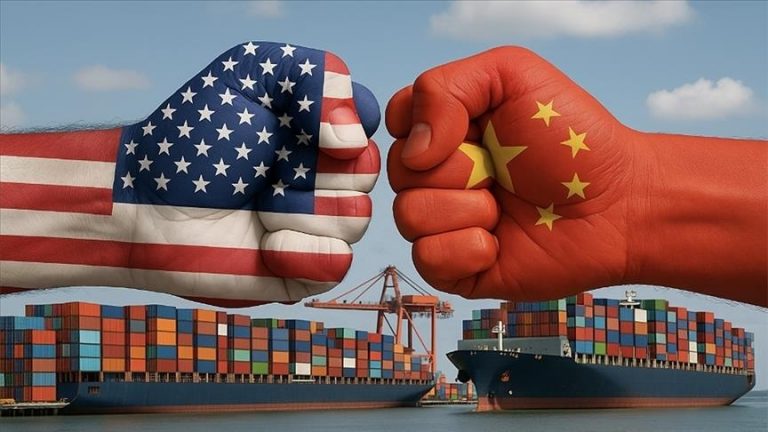
China has called for greater cooperation with the United States on artificial intelligence, noting that AI should not become a technology controlled by a handful of major powers and warning against turning competition over the industry into a zero-sum contest.
The comments, published Wednesday by the People’s Daily, the ruling Communist Party’s flagship newspaper, come as Beijing and Washington prepare for bilateral talks next week in which artificial intelligence is expected to be a significant issue. The two countries are the leading forces behind frontier AI development and its global adoption, but they remain sharply divided over technology policy, intellectual property, access to advanced computing and the use of AI models.
The People’s Daily commentary said China was prepared to work with the United States to manage the risks associated with AI and create what it described as an open and non-discriminatory environment for the technology’s development.
Register for the next Tekedia Mini-MBA.
Register for Tekedia AI in Business Masterclass.
Join Tekedia Capital Syndicate and co-invest in great global startups.
“Artificial intelligence is a new domain for human development, not a monopoly of great powers, and must not become an arena for zero-sum competition,” the commentary said.
The article was published under the pen name “Zhong Sheng,” meaning “Voice of China,” a byline frequently used by the People’s Daily to express views on foreign policy.
The intervention highlights a central tension in the emerging U.S.-China AI relationship. Both countries want to establish technological leadership, but restrictive controls on advanced chips, AI systems, and technology transfers have made access itself a major component of the competition.

Beijing Challenges Washington’s Distillation Claims
The People’s Daily also directly challenged U.S. accusations that Chinese companies have improperly extracted capabilities from American AI models through a process known as distillation.
Distillation involves training a smaller or more specialized model using outputs generated by a larger model, allowing developers to reproduce some of the larger system’s capabilities without bearing the full cost of training a frontier model from scratch.
The commentary argued that U.S. companies also use the technique and accused Washington of applying different standards depending on who is using it.

“According to U.S. logic, when American enterprises use distillation it is an ‘industry standard practice,’ while when Chinese enterprises apply it, it constitutes an ‘attack.’ This is naked double standards,” the paper said.
The accusation follows growing disputes over the extent to which Chinese AI developers have used outputs from leading U.S. models to improve their own systems. Washington has increasingly treated such activity as part of a broader technology-security challenge, while Beijing argues that the restrictions amount to an effort to preserve U.S. dominance.
The People’s Daily said elevating distillation into a national-security issue amounted to using security concerns as a pretext for seeking an AI monopoly.
The competing interpretations expose a bold fault line in the AI industry. Distillation itself is a widely used technical approach, but its legality and acceptability can depend on how it is conducted, the terms governing access to a model, the provenance of the training data, and whether developers are attempting to replicate proprietary capabilities in ways that violate contractual or other restrictions.
That makes the dispute broader than a disagreement over a single machine-learning technique. It is increasingly about who gets to participate in the development of advanced AI and what forms of technology transfer are considered legitimate.
AI Competition Moves Into a Diplomatic Arena
Washington and Beijing have been treating AI as both an economic technology and a national-security capability. The United States has imposed restrictions designed to limit China’s access to advanced semiconductor technology and computing infrastructure, while China has retaliated and pushed domestic companies to develop alternatives and expand the use of open-weight AI models.
The White House earlier this year accused China of stealing intellectual property from U.S. artificial intelligence laboratories on an industrial scale. Beijing has rejected such characterizations and has repeatedly presented open development and broader access to AI technology as alternatives to what it views as U.S. efforts to preserve technological advantages.
The People’s Daily commentary therefore serves two purposes. It defends China’s AI industry against accusations of unfair technology acquisition while positioning Beijing as willing to discuss common rules for managing the technology’s risks.
China said it was willing to engage in “constructive and professional” discussions with the United States to promote what it called the open, inclusive, universal and beneficial development of AI.
The language is notable because the two countries are competing intensely for influence over the next generation of AI infrastructure and applications. The competition now extends from foundation models and semiconductors to cloud computing, data centers, robotics and AI agents capable of taking actions with limited human intervention.
At the same time, the risks associated with capable AI systems are becoming an area where the interests of the two countries overlap, even if their regulatory philosophies differ. Questions around cybersecurity, autonomous agents, model misuse, intellectual property and the potential loss of human control cannot be contained neatly within national borders.
Greater openness, for U.S. companies, could provide access to a much larger pool of researchers, developers and markets. But Washington also faces concerns that technologies developed or shared with Chinese companies could strengthen capabilities with military or strategic applications. Beijing, meanwhile, wants access to global AI markets and technology while developing a domestic ecosystem that is less dependent on U.S. suppliers.
That push has created a difficult balance between cooperation and technological containment.
The People’s Daily’s argument that AI should not become a “monopoly of great powers” is therefore as much a statement about the international rules governing the technology as it is about China-U.S. relations. Beijing is seeking a framework in which Chinese companies can participate in global AI development without being excluded by export controls, intellectual-property restrictions or national-security rules.
Washington accepting that premise will depend on how it distinguishes legitimate technological competition from activities it considers threats to U.S. security or intellectual property. The talks next week could provide an early indication of whether the two sides can establish areas of cooperation around AI safety and development while continuing to compete over the underlying technology.