

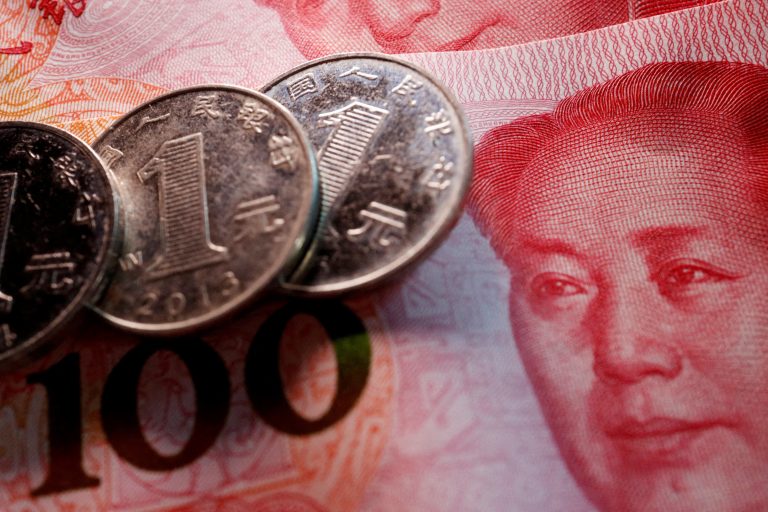
China is widely expected to leave its benchmark lending rates unchanged for a 14th consecutive month in July, signaling that policymakers remain reluctant to deploy broad-based monetary stimulus even as economic growth slows and domestic demand remains weak.
A Reuters survey of 23 market participants found unanimous expectations that the People’s Bank of China (PBOC) will keep both the one-year and five-year loan prime rates (LPRs) unchanged when they are announced on Monday.
The one-year LPR, which serves as the benchmark for most new corporate and household loans, is expected to remain at 3.00%, while the five-year LPR, the reference rate for most mortgages, is forecast to stay at 3.50%.
Register for the next Tekedia Mini-MBA.
Register for Tekedia AI in Business Masterclass.
Join Tekedia Capital Syndicate and co-invest in great global startups.
The decision would mark the 14th straight month without a change in China’s benchmark lending rates, underscoring Beijing’s preference for targeted policy measures rather than aggressive monetary easing.
The LPR is calculated monthly after 20 designated commercial banks submit proposed lending rates to the central bank, making it China’s primary benchmark for commercial lending.
The market consensus comes shortly after data showed China’s economy expanded at its slowest pace in more than three years during the second quarter, missing analysts’ forecasts despite resilient exports and manufacturing.

The latest figures reinforced concerns that the world’s second-largest economy remains characterized by a “K-shaped” recovery, where export-oriented manufacturers and advanced technology sectors continue to perform relatively well while households, property markets and consumer-facing industries struggle.
Weak consumer spending remains one of the biggest drags on the economy, reflecting persistent concerns over employment, falling property values and subdued household confidence. The prolonged property downturn has eroded household wealth and continues to suppress borrowing and consumption, limiting the effectiveness of monetary easing.
Although manufacturing output and exports have remained relatively resilient, helped by strong overseas demand for electric vehicles, batteries, solar equipment and other advanced industrial products, economists are questioning whether export-led growth alone can sustain the broader economy amid rising global trade tensions.

The divergence between external strength and domestic weakness has prompted calls for additional policy support. However, most economists believe Beijing is unlikely to respond with sweeping interest rate cuts. Instead, policymakers appear to be prioritizing fiscal measures and targeted liquidity support while preserving monetary policy flexibility.
Goldman Sachs economists said the weaker-than-expected GDP figures have modestly increased the probability of additional monetary easing later this year, but stopped short of changing their baseline outlook.
“In our view, the weaker-than-expected Q2 GDP data have increased somewhat the likelihood of further monetary easing, although rate and reserve requirement ratio (RRR) cuts this year are still not in our baseline,” Goldman Sachs economist Xinquan Chen said.
He added that policymakers are more likely to accelerate the implementation of existing fiscal measures while the PBOC continues providing ample liquidity to the banking system.
That approach underpins Beijing’s growing emphasis on fiscal policy rather than interest rate reductions to support growth. Recent measures have included increased infrastructure investment, consumer subsidy programmes and support for strategic sectors such as artificial intelligence, advanced manufacturing and semiconductors.
Attention is now shifting to China’s upcoming Politburo meeting, one of the country’s most closely watched policy gatherings, where senior Communist Party leaders are expected to outline economic priorities for the second half of the year.
Investors will look for signals on whether authorities intend to introduce additional stimulus to support consumption, stabilize the property market, and sustain economic growth amid mounting external uncertainties.
While the consensus points to unchanged lending rates, some economists continue to expect modest easing.
Analysts at Citi forecast that the PBOC could cut benchmark rates by 10 basis points as early as this month alongside faster deployment of fiscal stimulus.
“We expect incremental policies to drive a mild rebound ahead, including a potential 10-basis-point rate cut from the PBOC as soon as this July and an acceleration in fiscal policy deployment,” Citi said in a research note.
Banks Remain Cautious Despite Central Bank Pressure
Even if the PBOC eventually lowers benchmark rates, economists caution that monetary policy alone is unlikely to revive borrowing demand.
Chinese banks continue to face a weak appetite for loans from households and businesses despite repeated calls from regulators to increase lending. Financial institutions have instead become more selective as rising consumer loan defaults and persistent weakness in the property sector increase credit risks.
Recent data showed new bank lending remained weaker than expected, while short-term household loans continued to contract, highlighting the limited effectiveness of lower borrowing costs when consumer confidence remains subdued.
The central bank has also sought to stabilize financial conditions through targeted liquidity operations rather than aggressive interest rate reductions. Earlier this week, regulators instructed some banks to avoid conducting bill re-discount operations below 0.5% after unusually low rates reflected excess liquidity and weak credit demand.
That move indicates that the PBOC is working on a broader strategy of maintaining orderly financial markets while avoiding the kind of large-scale monetary easing that could further weaken the yuan or inflate financial risks.
With inflation remaining subdued, economic growth slowing, and external uncertainties, including ongoing trade frictions with the United States, continuing to weigh on the outlook, economists expect Beijing to maintain a measured policy approach. This means relying on a combination of targeted monetary support and expanded fiscal spending rather than broad interest rate cuts to steer the economy through the remainder of the year.