

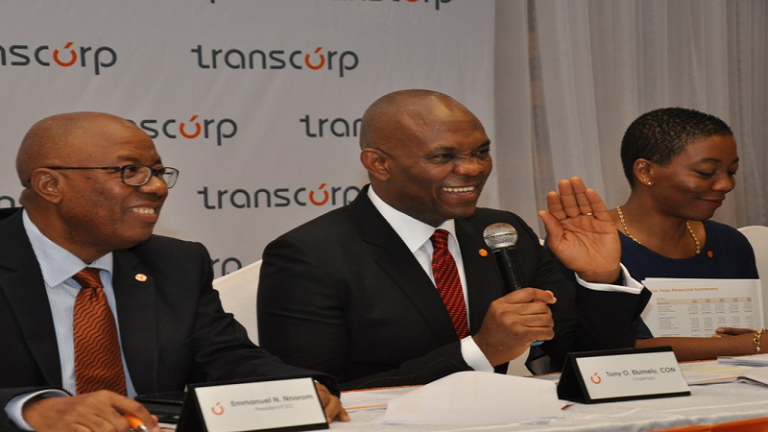
Transcorp Power Plc reported a weaker first half of 2026 as recurring transmission infrastructure challenges and lower electricity sales weighed on revenue and profitability, although improved cost discipline helped cushion the impact and enabled the company to maintain margins.
The power generation company posted a pre-tax profit of N54.99 billion for the six months ended June 30, 2026, representing a 6.37% year-on-year decline from N58.73 billion recorded in the corresponding period of 2025.
The earnings slowdown was largely driven by a softer second quarter. Pre-tax profit fell 61.1% quarter-on-quarter to N15.40 billion from N39.59 billion in the first quarter and was marginally below the N15.44 billion posted in the second quarter of 2025, highlighting how operational constraints intensified during the period.
Register for the next Tekedia Mini-MBA.
Register for Tekedia AI in Business Masterclass.
Join Tekedia Capital Syndicate and co-invest in great global startups.
Even with the weaker earnings, the company declared an interim dividend of N1.50 per ordinary share, reaffirming confidence in its cash generation and long-term outlook. The dividend will be paid electronically on July 23, 2026, to shareholders on the register as of July 20, subject to the appropriate withholding tax and completion of e-dividend registration.
Revenue Declines As Transmission Bottlenecks Persist
Revenue declined across Transcorp Power’s major operating segments as the company generated less income from both electricity supplied to the grid and capacity payments.
Second-quarter revenue fell 12.95% to N87.37 billion from N100.37 billion a year earlier.

For the first half, revenue from energy delivered, the company’s largest source of income, declined to N138.94 billion from N150.80 billion, while capacity charge revenue fell to N43.02 billion from N55.00 billion.
Energy sales accounted for approximately 76.4% of total revenue during the period, while capacity payments contributed the remaining 23.6%, underscoring the company’s continued reliance on electricity generation volumes.
Domestic sales experienced the sharpest decline, with revenue from local customers falling to N116.66 billion from N146.77 billion. By contrast, international revenue increased to N65.30 billion from N59.04 billion, partly offsetting the weakness in the domestic market and demonstrating growing export opportunities through regional electricity trade.

Management attributed much of the pressure to recurring vandalism of transmission infrastructure, which limited the evacuation of available generation capacity. The issue illustrates a persistent structural challenge within Nigeria’s electricity value chain, where generation companies are often unable to fully monetize available capacity because transmission infrastructure cannot carry all the electricity produced.
The company indicated that while generating capacity remained available, damaged transmission lines prevented optimal dispatch, reducing energy sales and revenue despite steady operational capability.
Margins Improve Despite Lower Sales
One of the standout features of the results was the improvement in profitability margins despite declining revenue, suggesting stronger cost management.
Cost of sales declined 12.5% to N112.15 billion from N128.18 billion, broadly matching the pace of revenue decline.
The biggest cost savings came from:
- Natural gas and fuel expenses, which declined to N102.33 billion from N109.17 billion
- Repairs and maintenance costs, which fell sharply to N4.52 billion from N13.99 billion
These reductions limited the decline in gross profit to 11.95%, allowing gross margin to improve.
Administrative expenses, however, increased to N16.71 billion from N14.75 billion, including N8.07 billion in operating, maintenance, and commercial costs.
Even with higher overheads, operating profit in the second quarter increased 31.66% year-on-year to N19.13 billion, reflecting the company’s ability to preserve profitability through operational efficiencies.
Management noted that:
- Gross margin improved to 38.4%
- Operating margin rose to 30.6%
- Pre-tax margin increased to 30.2%
Chief Financial Officer Evans Okpogoro attributed the stronger margins to cost optimization initiatives and disciplined financial management, demonstrating that management has focused on profitability rather than simply pursuing revenue growth.
Lower Finance Costs Provide Support
Another positive feature of the results was a substantial reduction in financing costs.
Finance costs fell to N1.36 billion from N6.41 billion, reducing pressure on earnings.
Finance income also declined, dropping to N1.34 billion from N3.45 billion, reflecting lower returns on cash balances and investments.
Although the reduction in borrowing costs supported profitability, it was insufficient to offset weaker operating performance.
Profit after tax for the first half declined 12.6% to N38.50 billion from N44.05 billion, while earnings per share fell to N5.13 from N5.87.
For the second quarter alone:
- Profit after tax dropped 24.01% year-on-year to N8.80 billion
- Earnings per share fell 46.1% to N0.83 from N1.54, highlighting the weaker quarterly performance.
Balance sheet reflects growing working capital pressure
The results also point to increasing working capital challenges facing Nigeria’s electricity generation companies.
Trade and other receivables climbed to N529.42 billion from N468.57 billion, indicating that larger amounts of revenue remain unpaid.
The increase reflects the persistent liquidity issues across Nigeria’s electricity market, where generation companies often wait extended periods before receiving payments from market participants.
Borrowings also increased significantly.
Total interest-bearing debt rose to N63.63 billion, more than doubling from N30.69 billion at the end of 2025.
Meanwhile, cash and cash equivalents declined sharply to just N667.93 million, compared with N2.22 billion six months earlier.
The combination of rising receivables, higher debt, and lower cash suggests the company has relied more heavily on borrowing to finance operations while awaiting payment for electricity already supplied.
Although the lower finance costs indicate favorable financing terms or debt restructuring, sustained growth in receivables remains an important area for investors to monitor, as delayed collections continue to strain liquidity across Nigeria’s power sector.
Total assets nevertheless expanded 9.86% to N619.02 billion, reflecting continued investment and growth in the company’s asset base.
Management Expects Stronger Second Half
Managing Director and Chief Executive Officer Peter Ikenga said the company remained profitable and operationally efficient despite the transmission challenges experienced during the first half.
He expressed confidence that Transcorp Power would recover lost ground during the remainder of the year and deliver a stronger full-year performance than in 2025.
That outlook will depend largely on improvements in transmission network reliability, which remains outside the direct control of generation companies.
If transmission constraints ease, the company could increase electricity dispatched from existing generation assets without requiring significant new capacity investments, providing an avenue for earnings recovery.
Transcorp Power currently has a market capitalization of approximately N1.84 trillion.
Its shares have declined about 20% year-to-date, falling from N307.00 at the start of 2026 to N245.50 as of July 17. The decline reflects broader investor caution toward Nigerian equities as well as concerns over operational headwinds affecting the power sector.
Nevertheless, the interim dividend announcement may provide support for investor sentiment, particularly among income-focused shareholders, while the improvement in operating margins demonstrates that management continues to exercise tight cost control even as sector-wide infrastructure bottlenecks constrain revenue growth.
Looking ahead, investors are likely to focus on three key issues: the pace of receivables collection, progress in addressing transmission constraints across the national grid, and whether management can translate stronger operating efficiency into renewed earnings growth during the second half of the year.