

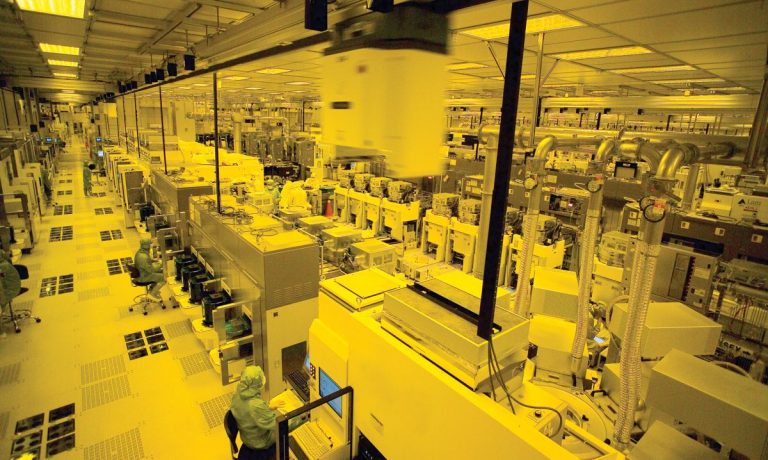
China has begun mass-producing domestically developed immersion deep-ultraviolet (DUV) lithography machines, marking one of its most significant advances yet in semiconductor manufacturing.
The move is part of Beijing’s accelerating efforts to reduce reliance on foreign technology amid escalating U.S.-led export restrictions.
The production effort is being led by Shanghai Aishengna Electronic Technology Group, a little-known state-owned company established specifically to advance China’s lithography ambitions, according to a source who spoke to Reuters.
Register for the next Tekedia Mini-MBA.
Register for Tekedia AI in Business Masterclass.
Join Tekedia Capital Syndicate and co-invest in great global startups.
The company has assembled engineering teams from several of China’s leading lithography developers, including Shanghai Micro Electronics Equipment (SMEE) and Yuliangsheng, in an attempt to narrow the technology gap with Dutch industry leader ASML.
The development represents another milestone in President Xi Jinping’s campaign to build a self-sufficient semiconductor supply chain, a national priority that has intensified since Washington and its allies tightened restrictions on China’s access to advanced chipmaking equipment.
While the breakthrough is strategically significant, industry analysts caution that it does not pose an immediate commercial threat to ASML, whose decades-long technological lead remains substantial.

Technology publication The Information first reported on Monday that a state-backed company in Shanghai had begun manufacturing immersion DUV systems and planned to produce around five units this year before increasing output to approximately 20 machines in 2027. Reuters is the first to identify the company behind the project as Shanghai Aishengna Electronic Technology Group.
According to the source, the new Chinese-developed equipment still requires extensive validation and remains well behind ASML’s commercial systems in terms of performance, reliability and manufacturing maturity.
Nevertheless, successful deployment would provide China’s largest semiconductor manufacturers with an alternative source of lithography equipment should Western governments impose additional restrictions on exports or servicing of foreign-made tools.

The machines are expected to be delivered later this year to leading Chinese chipmakers, including Semiconductor Manufacturing International Corp. (SMIC), Hua Hong Semiconductor and memory manufacturer ChangXin Memory Technologies (CXMT), according to The Information.
Immersion DUV lithography is one of the most critical technologies used in semiconductor manufacturing. By placing a thin layer of water between the projection lens and the silicon wafer, the systems achieve finer circuit patterns than conventional dry lithography machines.
Although DUV systems cannot match the capabilities of extreme ultraviolet (EUV) lithography for manufacturing the world’s most advanced chips, they remain indispensable for producing a broad range of semiconductors. Through multiple-patterning techniques, immersion DUV tools can also manufacture relatively advanced processors, albeit at higher cost and with greater production complexity than EUV.
The emergence of a domestic alternative carries strategic importance because ASML has long dominated the global market for both DUV and EUV lithography equipment.
China has been barred from purchasing ASML’s most advanced EUV systems under U.S.-led export controls, while Dutch authorities have also restricted exports of several advanced immersion DUV machines. Those measures were designed to slow China’s progress in producing cutting-edge semiconductors for applications including artificial intelligence, advanced computing and military systems.
Ironically, export restrictions have also accelerated Beijing’s determination to develop indigenous alternatives.
Aishengna itself illustrates the scale of that national effort. The company was established in August 2023 with registered capital of 7 billion yuan ($1 billion), backed by Shanghai Electric Holding and a subsidiary of Shanghai International Trust, according to corporate records.
Despite its strategic role, the company has maintained an exceptionally low public profile. It has no public website and has disclosed virtually no information about its operations.
The source said Aishengna has integrated personnel from Yuliangsheng, which reportedly began testing a DUV prototype last year, and SMEE, China’s best-known lithography equipment manufacturer. Corporate filings and recruitment records also show that Aishengna and Yuliangsheng share the same address in Shanghai.
Yuliangsheng is affiliated with Huawei-backed semiconductor equipment company SiCarrier, another key participant in China’s broader semiconductor self-reliance strategy.
The development also demonstrates how China’s semiconductor industry is becoming increasingly coordinated, with state capital, equipment manufacturers and major technology firms pooling expertise to overcome Western technology restrictions.
Even so, analysts argue investors may be overestimating the immediate commercial implications for ASML.
The report initially triggered an 8% sell-off in ASML shares on Monday before the stock stabilized, falling a further 1.6% on Tuesday. Analysts noted that the decline was broadly in line with weakness across European semiconductor stocks, although ASML underperformed the wider STOXX 600 index.
Market observers caution that building a functioning lithography machine is only the beginning.
For semiconductor manufacturers, the true benchmark is whether the equipment can consistently deliver high-volume commercial production with competitive yields, precision and reliability over thousands of production cycles.
“Producing a handful of immersion DUV tools is not the same as producing tools that can be used for high-volume manufacturing, where yield, overlay, throughput and reliability over thousands of wafer runs are what matter,” JPMorgan analysts wrote in a note.
Those engineering challenges help explain why ASML has maintained its dominance for decades. The Dutch company has spent billions of dollars on research and development while building an ecosystem of highly specialized suppliers spanning optics, precision mechanics, laser systems and software. Replicating that manufacturing expertise is widely viewed as far more difficult than assembling a working prototype.
China’s longer-term ambitions extend beyond DUV. Reuters reported in December that Chinese researchers had completed a prototype EUV lithography system, although commercial production remains years away. EUV technology represents a substantially greater engineering challenge, relying on ultra-short wavelengths, highly complex optics and precision components that ASML spent more than two decades developing alongside partners such as Intel, TSMC and Samsung.
Despite Beijing’s rapid progress, China remains an important market for ASML. Chinese customers accounted for roughly 16% of the company’s net system sales during the first half of the year, largely through purchases of less advanced DUV equipment that remains permissible under current export rules.
Ultimately, China’s new DUV machines are unlikely to undermine ASML’s global leadership in the near term as they represent an insurance policy for Beijing, reducing dependence on foreign suppliers.