

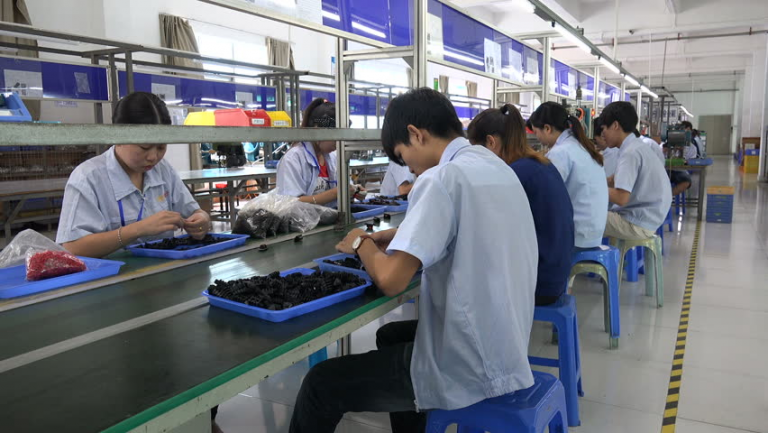
Chinese manufacturers are pausing production and turning to new markets as the impact of U.S. tariffs sets in, CNBC reports, citing companies and analysts.
The lost orders are also hitting jobs.
“I know several factories that have told half of their employees to go home for a few weeks and stopped most of their production,” said Cameron Johnson, Shanghai-based senior partner at consulting firm Tidalwave Solutions. He said factories making toys, sporting goods, and low-cost Dollar Store-type goods are the most affected right now.
Register for Tekedia Mini-MBA edition 20 (June 8 – Sept 5, 2026).
Register for Tekedia AI in Business Masterclass.
Join Tekedia Capital Syndicate and co-invest in great global startups.
Register for Tekedia AI Lab.
“While not large-scale yet, it is happening in the key [export] hubs of Yiwu and Dongguan and there is concern that it will grow,” Johnson said. “There is a hope that tariffs will be lowered so orders can resume, but in the meantime companies are furloughing employees and idling some production.”
Around 10 million to 20 million workers in China are involved with U.S.-bound export businesses, according to Goldman Sachs estimates. The official number of workers in China’s cities last year was 473.45 million.
Over a series of swift announcements this month, the U.S. added more than 100% in tariffs on Chinese goods, to which China retaliated with reciprocal duties. While U.S. President Donald Trump on Thursday asserted trade talks with Beijing were underway, the Chinese side has denied any negotiations are ongoing.

The impact of the recent doubling in tariffs is “way bigger” than that of the Covid-19 pandemic, said Ash Monga, founder and CEO of Guangzhou-based Imex Sourcing Services, a supply chain management company. He noted that for small businesses with only several million dollars in resources, the sudden increase in tariffs might be unbearable and could put them out of business.
He said there’s so much demand from clients and other importers of Chinese products that he’s launching a new “Tariff Help” website on Friday to help small businesses find suppliers based outside China.
The Challenge of Consumer Spending Power
One of the deeper challenges for China as it seeks new markets is the issue of consumer spending power. The United States has long been China’s most lucrative export destination because American consumers possess a rare combination of high disposable income, a vast middle class, and a deep-rooted culture of mass consumption. No other country offers a comparable population with the financial ability to absorb such volumes of goods, particularly non-essentials like toys, apparel, electronics, and household items.

Although China is attempting to pivot toward Europe, Latin America, and its domestic market, none of these regions can match America’s scale of consumer demand. Europe’s markets are more cautious, and focused on sustainability and quality over quantity, while Latin American economies are limited by smaller middle classes and currency volatility. At home, China’s consumer economy remains constrained by widening income inequality and slowing growth, restricting its ability to fully replace the lost American demand.
This means China’s shift cannot simply be about finding alternative buyers. It will require a complete decoupling from the economic model it has relied on for decades — one built on mass-producing cheap goods for a wealthy, consumption-driven U.S. market. Manufacturers now face the daunting task of redesigning products to fit new consumer preferences, coping with lower average spending per customer, investing in unfamiliar supply chains, and ramping up marketing efforts in territories where brand loyalty to Chinese products is minimal.
In short, without a market matching the United States in both size and financial power, China’s transition is likely to be slow and painful, involving fundamental restructuring across its export economy.
Livestreaming and Domestic Efforts
In the meantime, business disruption is forcing Chinese exporters to try new sales strategies.
Woodswool, an athleticwear manufacturer based in Ningbo, near Shanghai, quickly turned to selling online in China via livestreaming. After launching about a week ago, the company said it received more than 30 orders with a gross merchandise value of over 5,000 yuan ($690).
“All our U.S. orders have been canceled,” said Li Yan, factory manager and brand director of Woodswool. More than half of Woodswool’s production was once headed for the U.S. Now, some capacity will remain idle for two to three months as the company rebuilds new markets.
The push into livestreaming comes as major Chinese tech companies, encouraged by Beijing, seek to help exporters sell goods domestically. Woodswool now sells through Baidu’s e-commerce platform using a virtual human livestreaming option that allows quick setup without major investments.
Baidu said it has supported hundreds of Chinese businesses in launching domestic e-commerce channels, offering subsidies and artificial intelligence tools such as “Huiboxing” — digital avatars that simulate real sales pitches.
Domestic Market Challenges
Other tech giants are stepping in. JD.com pledged 200 billion yuan ($27.22 billion) to buy Chinese goods originally intended for export, while food delivery giant Meituan has also promised to help distribute these products internally. But even large pledges pale in comparison to the size of the U.S. market: $27.22 billion represents just about 5% of the $524.66 billion in Chinese goods exported to the U.S. last year.
Michael Hart, president of the American Chamber of Commerce in China, said some businesses have concluded their models are no longer viable under the new 125% tariffs. He also noted rising competition among Chinese firms struggling for domestic survival.
Products designed for American suburban consumers often do not fit the lifestyles of Chinese apartment dwellers. Manufacturers have turned to local platforms like Red Note and Douyin (the Chinese version of TikTok) to appeal directly to domestic buyers, but consumer fatigue is already evident, analysts warn.
Looking Beyond the U.S. Few Chinese companies now view rerouting exports to the U.S. through third countries as viable, given the heightened scrutiny of transshipments. Instead, many are shifting production to Southeast Asia or India, while some are focusing efforts on Europe and Latin America.
Some exporters are finding success. Liu Xu’s e-commerce company, Beijing Mingyuchu, sells bathroom products to Brazil. Although his business faces exchange rate volatility and high shipping costs, Liu is confident trade with Brazil will remain robust despite U.S.-China tensions.
Similarly, Ghana-based Cotrie Logistics, founded during the COVID-19 pandemic, has helped Chinese businesses manage sourcing and logistics in West Africa. CEO Bright Tordzroh said U.S.-China tensions have led more firms to consider building supply chains that bypass the U.S. altogether, creating opportunities in emerging markets like Ghana.
Still, these shifts underscore the immense challenge China faces. Building alternative markets is not just about rerouting goods; it demands a fundamental overhaul of its entire export-driven growth model — a task that will take years, not months.