

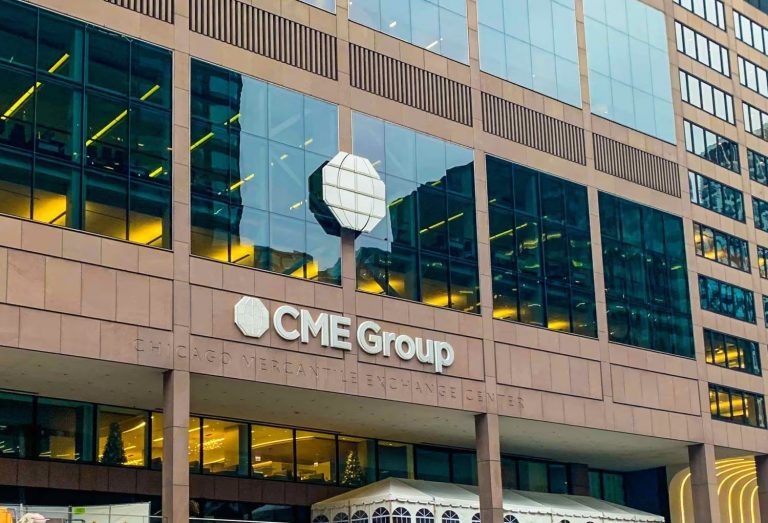
CME Group announced plans to launch futures contracts for Avalanche (AVAX) and Sui (SUI) on May 4, 2026 pending regulatory approval. This expands CME’s regulated crypto derivatives suite, which already includes Bitcoin, Ethereum, and more recent additions like Cardano, Chainlink, and Stellar.
Contracts will come in both standard and micro sizes: AVAX: Standard (5,000 AVAX) and Micro (500 AVAX) SUI: Standard (50,000 SUI) and Micro (5,000 SUI). Both will be cash-settled. This move aligns with CME’s broader push into crypto, including a shift to 24/7 trading for its crypto futures and options starting May 29.
CME cited growing institutional demand, with its crypto complex seeing strong volumes; March average daily volume up 19% YoY and nearly $8B in notional value traded daily. Zcash (ZEC) is seeing a sharp rally today, up roughly 23–26% in the last 24 hours and leading top 100 tokens by market cap. Recent data shows it trading around $320–$334 with significantly elevated volume.
This outperforms the broader market including Bitcoin amid a risk-on environment, possibly tied to easing geopolitical tensions like ceasefire-related news reducing oil price pressure and ongoing privacy coin narrative strength. ZEC has shown repeated strong moves in recent months, boosted earlier by funding rounds for its development ecosystem like the Zcash Open Development Lab, though today’s surge appears momentum-driven with high volatility.
Register for Tekedia Mini-MBA edition 20 (June 8 – Sept 5, 2026).
Register for Tekedia AI in Business Masterclass.
Join Tekedia Capital Syndicate and co-invest in great global startups.
Register for Tekedia AI Lab.
CME news is generally bullish for AVAX and SUI long-term as it brings more institutional hedging and speculation tools and legitimacy to these Layer-1 networks. Markets often price in such listings with front-running or positive sentiment, though the actual launch is still weeks away. ZEC’s outperformance fits patterns where privacy-focused assets can spike on sentiment shifts or when the broader market rotates into higher-beta names.
It’s volatile, so sharp gains can reverse quickly without sustained catalysts. This reflects continued institutional integration of crypto derivatives alongside spot market volatility and narrative plays. CME Group’s crypto futures contracts serve as regulated derivatives that allow investors to gain exposure to cryptocurrency prices or hedge against them without directly owning the underlying assets.
These are cash-settled, based on transparent reference rates like the CME CF Reference Rates, and cleared through CME’s robust infrastructure. They come in standard and micro sizes for flexibility, with recent expansions covering major assets and now including altcoins like AVAX and SUI alongside Bitcoin, Ethereum, Solana, XRP, Cardano, Chainlink, and Stellar—covering over 75% of crypto market cap.

CME’s entry has had several measurable effects: Traditional institutions like hedge funds, asset managers, corporate treasuries, pension funds often require regulated venues with clearing guarantees, oversight, and familiar infrastructure before allocating capital. CME products lower barriers by offering this in a CFTC-regulated environment, distinct from offshore or unregulated spot markets.
This has fueled broader participation. For example, market makers and authorized participants for U.S. spot Bitcoin and Ether ETFs heavily use CME futures for hedging and arbitrage, creating a feedback loop that supports ETF liquidity and growth. Expansion to altcoins like AVAX and SUI signals maturing infrastructure, potentially drawing more professional capital into those ecosystems and enabling precise risk management.
Institutions and traders use futures for hedging volatility, inflation expectations, or portfolio exposure. Studies and CME data show these contracts help mitigate price risk, with strategies like delta-hedging or basis trading.
Micro contracts enhance capital efficiency and accessibility, allowing smaller positions while maintaining leverage benefits. The upcoming shift to 24/7 trading addresses a long-standing issue: CME gaps from weekend and off-hour volatility in spot crypto. Continuous access should smooth price discovery, reduce execution risks during volatile periods, and better align derivatives with the always-on nature of crypto markets.

CME has seen explosive growth: nearly $3 trillion in notional volume across crypto derivatives in 2025, with average daily volume (ADV) up 139% YoY to 278,000 contracts ($12B notional daily). Open interest has hit records, reflecting sustained institutional engagement. This adds depth and tighter spreads, especially for larger players. Futures often lead spot price discovery in regulated settings, and high open interest indicates conviction in strategies.
For new contracts like AVAX/SUI, early volume may start modest but can grow as adoption builds, similar to prior altcoin futures. Announcements of new listings or expansions often generate positive short-term sentiment and price reactions, as markets price in increased legitimacy and potential inflows.
Over time, this contributes to the professionalization of crypto, reducing reliance on unregulated venues and potentially stabilizing aspects of the market through better risk tools. It also supports innovation, such as tokenized settlement or index products in partnership with others. Futures are derivatives, so they don’t provide direct ownership or utility.