

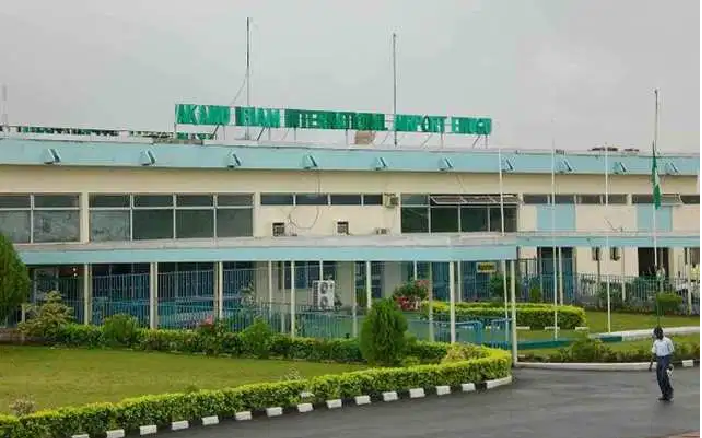
The Enugu State Government has announced that the concession process for the Akanu Ibiam International Airport in Enugu is now over 70 percent complete, with expectations that it will be finalized by the second quarter of 2025.
This was disclosed by the State Commissioner for Transportation, Dr. Obi Ozor, during a program on Afia TV.
According to Dr. Ozor, the process is being managed by the Federal Ministry of Aviation in collaboration with private investors. Once completed, the concessionaire will commence upgrades to the international wing of the airport, including the long-abandoned international terminal, the cargo terminal, aircraft maintenance, repair and overhaul (MRO) facilities, hangars, and runway extension.
Register for Tekedia Mini-MBA edition 20 (June 8 – Sept 5, 2026).
Register for Tekedia AI in Business Masterclass.
Join Tekedia Capital Syndicate and co-invest in great global startups.
Register for Tekedia AI Lab.
But while the state government is optimistic, the airport concession has sparked growing unease among citizens, particularly those from the Southeast where Akanu Ibiam remains the only functional international airport. Many believe that the current move might not be to make the airport more efficient but to weaken it through a calculated strategy masked as a concession deal.
Allegations of Sabotage and Lack of Transparency
The distrust is not new. For years, the Southeast has had to lobby for the reopening or rehabilitation of the Akanu Ibiam Airport, which has repeatedly suffered neglect and funding delays. Now that the Federal Government has approved its concession, critics argue that the manner of the process raises red flags.
Financial analyst and commentator, Kalu Aja, took the questions directly to Aviation Minister Festus Keyamo, demanding answers to what he describes as glaring omissions and a lack of transparency surrounding the deal.

“Who exactly is Aero Alliance Consortium?” Aja asked. “Are they registered in Nigeria? Who are their promoters?”
Despite being named as the preferred bidder, virtually no public information exists about the Aero Alliance Consortium—its history, its executives, or its financial and technical credentials. This opacity has fueled suspicions about the motives behind the concession and whether due process was followed.
Did the Concession Follow Nigeria’s PPP Guidelines?
Aja pointed to the guidelines under the Infrastructure Concession Regulatory Commission (ICRC) Act of 2005, which mandates that all public-private partnerships (PPPs) must follow a competitive bidding process. He raised issues of concern and questioned whether the process adhered to the key provisions of the law:

Competitive Bidding: There is no evidence that multiple bids were invited or evaluated in a competitive manner. The ICRC rules require the bidder with the most technically and economically sound proposal to be selected through a transparent process. Did that happen here?
Technical Expertise: According to the ICRC, any private sector firm vying for an airport concession must demonstrate strong technical capacity in managing international aviation facilities. Yet there are no publicly available records of Aero Alliance Consortium’s involvement in any airport management project, either within or outside Nigeria.
Financial Capacity: Bidders are required to show a net worth of at least N30 billion (around $72 million) and obtain support letters from credible financial institutions to prove they can manage airport infrastructure. Many believe there is no evidence that Aero Alliance has met this threshold.
The 80-Year Tenor: A New Precedent?
Another concern that’s drawn public outrage is the unprecedented length of the concession period—80 years. That is more than double the tenors given for the concessions of other Nigerian airports, most of which are under 30 years.
“What’s the rationale behind locking down a strategic infrastructure asset for 80 years?” Aja questioned. “That’s two generations. Airports in Lagos and Abuja have 20 to 30-year concessions. Why is the East different?”
As the unusually long tenor deepens fears that the aim may not be efficient management, but a calculated sidelining of the only international gateway in the region, some Southeast stakeholders are calling for the agreement to be published and scrutinized by the National Assembly or a public oversight body before it is allowed to proceed.
What Happens to the Free Trade Zone?
The uncertainty doesn’t end with the concession contract itself. There are also concerns about what parts of the airport complex fall under the deal. Aja raised a pointed question: “Is the Free Trade Zone at Akanu Ibiam International Airport covered under this concession?”
The Free Trade Zone, if included in the concession, would mean ceding a potentially lucrative economic zone to a private entity for the next 80 years, without input from the state government or even clarity on how such assets will be managed.
Revenue Guarantees and Risk Transfer
Perhaps the most worrying detail to emerge is that the Federal Government appears to have agreed to “guarantee” the concessionaire’s projected revenues over the 80-year period—an arrangement critics argue is reckless and places enormous financial risk on taxpayers.
“If the concessionaire fails to meet its revenue targets, will the government really cover those shortfalls with public funds?” Aja asked. “Why should Nigerian taxpayers be saddled with 80 years of projected revenue risk for a deal they had no say in?”
Such an arrangement, if true, would amount to privatizing the gains while socializing the risks—a model that has repeatedly failed in Nigeria, especially in power, rail, and telecoms concessions.
“This is the most outrageous agreement I have seen. According to the Enugu Airport concession, if this concession is terminated and the termination is a result of the FGN default, then the FGN must pay outstanding loans, third-party liabilities, equity investment, and projected returns,” Aja noted.
He went further to ask: “Have we gone mad in this nation? Nigeria will repay “equity investment” and PROJECTED returns? So if the concessionaires say they projected to make 500%, FGN will repay 500%? On whose authority is Keyamo signing this contingent liability on the Federation? Is the Debt Management Office (DMO) aware that a contingent liability is being created here? Is the ICRCNG going to really sign off on an 80 year lease? Is this in the public interest?”
Aja went further to liken the concession to the P&ID controversial deal. “This is how P&ID’s liability was created: You draft a nonsense contract, get it signed, you get paid, and if it’s cancelled you also get paid. The same method was used in Ajaokuta Steel Mill and Mambila Power; both projects are now dead.
“This is a tactic to burden Enugu airport with debt and kill it, making it inoperable. Why would any government agree to be liable for “projected returns”? This is a setup against the entire region.”
State Government Optimism
In contrast to the criticism, Enugu’s state government remains hopeful. Dr. Ozor insisted the Federal Government and private investors are working closely to ensure the airport becomes fully operational with modern facilities. He said the aim is to turn the airport into a regional hub for international travel, commerce, and logistics.
He also noted that the airport upgrades align with broader plans, including the upcoming launch of Enugu Air—a state-backed airline scheduled to commence operations in May 2025.
Against the backdrop of the questions being raised, the government has been urged to release more information about the Aero Alliance Consortium, the concession agreement, and the future governance structure of the airport if it hopes to regain public trust and secure buy-in for the project.