

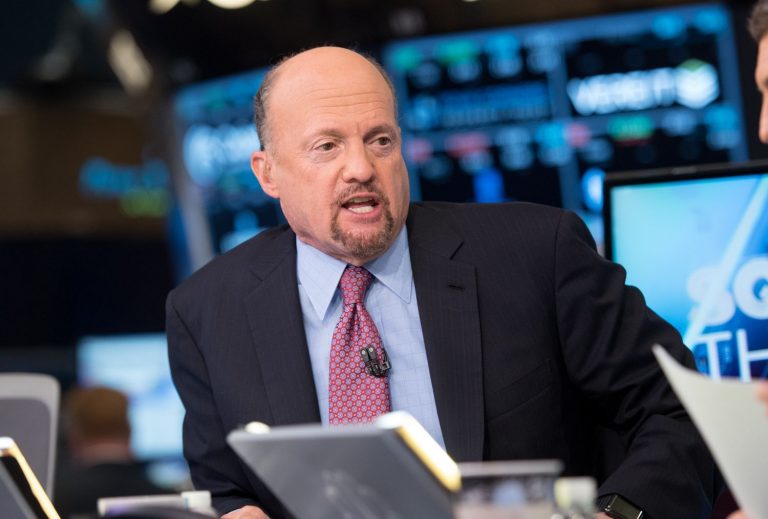
CNBC’s Jim Cramer said Thursday that rising bond yields, higher oil prices and concerns about the U.S. consumer are making it increasingly difficult for investors to reward companies with strong underlying businesses, creating what he described as an “incredibly jarring gulf between stock prices and reality.”
Cramer’s comments came after another difficult session for Wall Street, with the Dow Jones Industrial Average falling 1.3%, the S&P 500 declining nearly 0.9% and the Nasdaq Composite losing 1%.
The selloff reflected growing concerns that higher energy prices, driven by the conflict involving Iran, could keep inflation elevated and limit the Federal Reserve’s ability to ease monetary policy. Treasury yields also moved higher, reversing much of the decline that followed the Treasury Department’s announcement Wednesday of a plan to bring down longer-term borrowing costs.
Register for the next Tekedia Mini-MBA.
Register for Tekedia AI in Business Masterclass.
Join Tekedia Capital Syndicate and co-invest in great global startups.
The 30-year Treasury yield had climbed above 5.33% earlier in the week, reaching a level not seen in nearly two decades.
Cramer argued that the market environment is forcing investors to evaluate individual companies through a much broader macroeconomic lens, even when their businesses continue to perform well.
“There’s an incredibly jarring gulf between stock prices and reality,” Cramer said on “Mad Money.”

He made the comments from the construction site of Micron Technology’s massive semiconductor fabrication complex in Boise, Idaho, where thousands of workers are building facilities that will eventually manufacture memory chips used in artificial intelligence systems.
The project, Cramer said, illustrates the scale of investment taking place in U.S. manufacturing and AI infrastructure at a time when financial markets are increasingly focused on economic risks.
“Unfortunately, though, you can’t take your eye off the broader market even if you think, as I do, that Micron’s stock is radically undervalued,” he said. “In the end, we always have to look at stocks through the market’s prism.”

Micron shares rose about 4% Thursday, even though the stock remains roughly 20% below its June record high. Cramer’s Charitable Trust, the portfolio associated with CNBC’s Investing Club, owns Micron shares.
The performance stood in contrast to the broader market, where concerns about consumers, energy costs, and interest rates continued to dominate trading.
Walmart provided one of the clearest examples of how those pressures can affect a major company. Shares of the retail giant plunged about 9% Thursday after the company reported quarterly comparable sales below Wall Street expectations and issued sales guidance that also disappointed investors.
Cramer said the results were more complicated than the headline figures suggested. Walmart has continued to emphasize low prices and market-share gains rather than maximizing short-term profit, while higher gasoline prices have reduced the amount of money consumers have available for other purchases.
Gasoline prices above $4 a gallon could place additional pressure on household budgets, particularly if elevated oil prices persist as the conflict involving Iran continues. That creates a difficult backdrop for retailers and other consumer-facing businesses because higher fuel costs can simultaneously increase operating expenses and reduce consumers’ discretionary spending.
“Two-thirds of this country’s economy is service-based,” Cramer said, explaining that the strength of the American consumer remains more important to the broader economy than the manufacturing investment taking place at projects such as Micron’s Idaho facility.
The bond market represents another challenge.
Treasury Secretary Scott Bessent told CNBC Thursday that the Treasury’s planned purchases of longer-dated government debt could exceed the $4 billion upper limit discussed the previous day.
The proposed purchases are intended to help put downward pressure on longer-term Treasury yields, but Cramer questioned whether the intervention would be large enough to make a meaningful difference given the size of the U.S. government’s debt.
“When America has $40 trillion in debt, a $4 billion buyback has the Treasury Secretary looking like the Little Dutch boy with his finger plugging the dike,” Cramer said.
The comparison underscores the scale mismatch between the Treasury’s proposed intervention and the broader forces influencing the bond market. Investors are weighing government borrowing needs, inflation, monetary policy and geopolitical risks, all of which can exert upward pressure on long-term yields.
Higher yields have much bearing for equities because they increase the return investors can obtain from relatively lower-risk government securities while also raising the discount rate applied to future corporate earnings. That can place disproportionate pressure on growth and technology stocks whose valuations depend heavily on profits expected years into the future.
Cramer said Micron’s performance demonstrates the difficulty of separating individual corporate fundamentals from broader market sentiment. The company is benefiting from substantial investment in AI infrastructure and from efforts to expand U.S. semiconductor manufacturing, yet its valuation remains affected by changes in interest rates and overall risk appetite.
“Micron’s stock finished up 4%. That’s terrific American exceptionalism at work,” Cramer said. “The problem is there are another 499 stocks in the S&P 500 and the prism made a lot of them look downright awful today.”
This points to a growing divide within the U.S. stock market. Companies tied to AI, semiconductor manufacturing, and other areas of strategic investment can continue to experience strong underlying demand, while their shares remain vulnerable to macroeconomic shocks.