

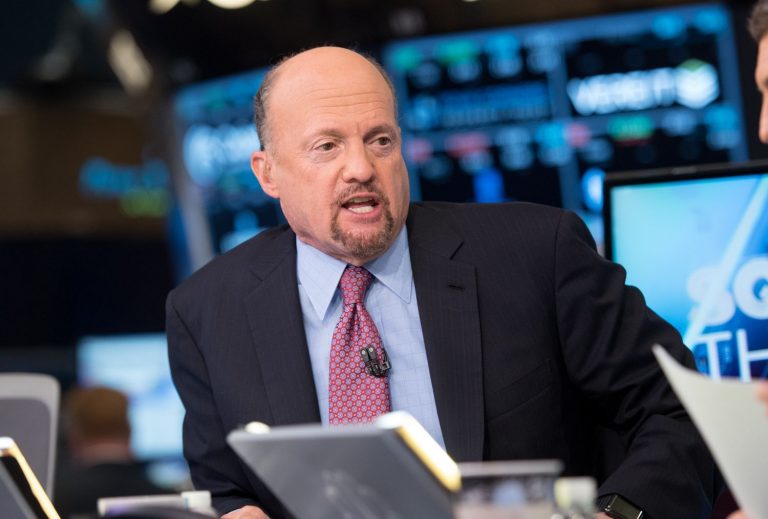
CNBC’s Jim Cramer on Monday urged investors not to abandon fundamentally strong stocks in the face of a market slide he says is being driven more by fear than by any real deterioration in corporate performance, warning that panic selling often creates some of the best buying opportunities.
Speaking on Mad Money, Cramer sought to push back against what he described as indiscriminate selling across high-quality names, particularly in the technology and cybersecurity sectors.
“Stocks go down for all sorts of reasons, some good, some bad. Lately we’ve had a lot of bad, and tonight I want to straighten some things out,” he said.
Register for Tekedia Mini-MBA edition 20 (June 8 – Sept 5, 2026).
Register for Tekedia AI in Business Masterclass.
Join Tekedia Capital Syndicate and co-invest in great global startups.
Register for Tekedia AI Lab.
“Because a bad tape causes individuals to dump great stocks, usually when they should be buying more.”
His remarks came after a weak session on Wall Street that saw the major indices surrender early gains despite an initial rebound. The S&P 500 closed 0.39 per cent lower, the Nasdaq Composite dropped 0.73 per cent, while the Dow Jones Industrial Average eked out a 0.11 per cent gain.
The market weakness is unfolding against a backdrop of heightened geopolitical tension, rising oil prices, and persistent uncertainty over how long inflationary pressures from energy markets could weigh on risk assets. Cramer has recently warned that geopolitical volatility, particularly around the Middle East, is making market moves increasingly fragile.

But his central argument on Monday was that investors are misreading the impact of artificial intelligence on certain sectors.
Cramer pointed specifically to cybersecurity, where stocks such as Palo Alto Networks and CrowdStrike have come under pressure amid concerns that AI systems developed by private companies such as Anthropic could eventually displace traditional cyber defense platforms.
He flatly rejected that thesis.

“That is just dead wrong,” he said.
“In reality, the rise of AI should be a tailwind … for Palo Alto and CrowdStrike, because these same AI agents can be programmed by hackers to take over your network very easily. They are the vulnerability. Without the help of traditional cybersecurity, you’re more vulnerable than ever.”
That view goes to the heart of a broader debate on Wall Street over whether AI is a disruptor or an accelerator for legacy enterprise software firms.
In Cramer’s telling, AI does not eliminate the need for cybersecurity. Instead, it raises the stakes. As companies deploy autonomous agents and AI-driven workflows, the attack surface widens, creating fresh demand for endpoint protection, cloud security, and threat intelligence.
Enterprise security analysts have increasingly warned that generative AI tools can be weaponized by malicious actors to automate phishing, malware development, and network intrusion attempts at scale. In that context, established cybersecurity vendors may stand to benefit from higher spending rather than obsolescence.
Cramer also cited insider confidence as evidence that the market’s reaction may be misplaced. He pointed to a recent stock purchase by Nikesh Arora, who bought $10 million worth of shares.
“I don’t think a CEO would buy 10 million dollars’ worth of stock if he thought AI was an existential threat to the business model,” Cramer said.
The remark is significant because insider buying, particularly by chief executives, is often interpreted by investors as a strong signal of management confidence in future earnings and valuation.
Cramer then turned to Meta Platforms, whose stock has come under renewed pressure following recent legal setbacks. He argued that the market’s response has been excessive.
“I thought that the sell-off based on these lawsuits was strange,” he said, adding that such rulings are frequently challenged and often overturned on appeal.
Here, too, his argument is that investors are focusing too heavily on headline risk without adequately pricing in the long-term earnings power of the company’s advertising and AI businesses.
Meta remains one of the market’s most closely watched technology stocks, particularly as it continues to invest aggressively in artificial intelligence infrastructure and large-scale compute capacity.
Cramer’s broader message was that in markets dominated by fear, the disconnect between price action and business fundamentals can widen sharply.
“Sometimes stocks sell off for bad reasons, or fully bogus reasons, and at those moments, I’d rather be a buyer than a seller of CrowdStrike or Meta,” he said.
That stance is consistent with his recent commentary, where he has repeatedly urged investors not to confuse short-term market sentiment with long-term value, particularly in quality technology names.
The situation has presented an immediate challenge of ‘separating genuine fundamental risk’ from ‘fear-driven selling to investors.’ Cramer’s view is that the current market tape is doing more of the latter, and that for long-term holders, this may be a moment to accumulate rather than retreat.