

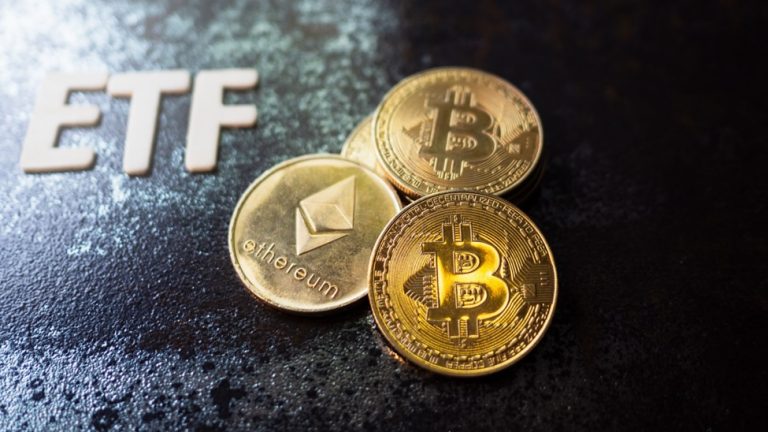
The global cryptocurrency market surged to new heights last week, with exchange-traded funds (ETFs) tracking digital assets attracting record inflows of $5.95 billion, signaling a renewed wave of investor confidence in crypto markets.
The boom, which propelled bitcoin to an all-time high of $126,223, underscores the shifting dynamics in global finance as traditional investors increasingly embrace digital currencies as part of their portfolios.
The data, released by CoinShares in its weekly report for the week ending October 4, showed that investment in digital asset products had never been higher — even during the bull runs of 2021 or 2023. The surge came amid growing concerns about the weakening U.S. dollar, trade uncertainty, and geopolitical instability, all of which are prompting investors to seek alternative stores of value.
Register for Tekedia Mini-MBA edition 20 (June 8 – Sept 5, 2026).
Register for Tekedia AI in Business Masterclass.
Join Tekedia Capital Syndicate and co-invest in great global startups.
Register for Tekedia AI Lab.
U.S. Leads the Charge as Institutional Interest Surges
The United States led global inflows with $5 billion, a record single-week figure, followed by Switzerland with $563 million and Germany with $312 million. Both European countries also set new national records for crypto ETF inflows. Analysts attribute this to the rapid expansion of regulated crypto investment products in both jurisdictions, which have offered investors exposure to digital assets without directly holding them.
Bitcoin remained the primary magnet for investor funds, attracting $3.55 billion of the total inflows, while ether followed with $1.48 billion. Solana and XRP also recorded significant gains, drawing $706.5 million and $219.4 million, respectively.
“This level of investment highlights the growing recognition of digital assets as an alternative in times of uncertainty,” said James Butterfill, head of research at CoinShares.

He added that the record-breaking week demonstrates how institutional demand is now the dominant force driving crypto markets, rather than retail speculation.
Bitcoin’s Dual Ascent with Gold
Bitcoin’s rally has coincided with a record climb in gold prices, as investors hedge against inflation and global economic headwinds. The rare simultaneous rise of both assets has reignited debate about whether bitcoin should now be considered a legitimate “digital gold” — a hedge against currency debasement and market volatility.
The underlying driver, analysts say, is the weakening U.S. dollar, which has fallen sharply since mid-year due to mounting trade tensions and concerns over the Federal Reserve’s policy outlook. As global investors seek safety, both gold and bitcoin have become preferred refuges, suggesting a growing acceptance of digital assets as mainstream financial instruments.

Policy Tailwinds and the Trump Factor
Under President Donald Trump’s administration, the tone toward digital assets has notably softened. His policies have emphasized innovation in blockchain technology and digital finance, signaling a departure from earlier regulatory skepticism. Trump has also hinted at the need for the U.S. to remain a global leader in crypto development — an acknowledgment that has resonated across Wall Street.
This more supportive environment has encouraged both institutional and retail investors to enter the market. Major asset managers, including BlackRock, Fidelity, and VanEck, have expanded their crypto-linked offerings, contributing to the surge in ETF volumes. Analysts note that these moves are helping integrate digital assets into traditional financial markets, reinforcing liquidity and stability in the sector.
Toward Monetary Integration: Bitcoin and Central Banks
A report by Deutsche Bank earlier this year predicted that bitcoin could appear on the balance sheets of most central banks by 2030, sitting alongside gold as part of official reserves. While the idea remains controversial, the ongoing institutionalization of digital assets makes such a prospect increasingly plausible.
In the same vein, a growing number of sovereign wealth funds — particularly in the Middle East and Asia — have begun exploring bitcoin-linked products as part of diversification strategies. The Monetary Authority of Singapore and the Abu Dhabi Investment Authority (ADIA) have both reportedly held exploratory discussions about expanding exposure to digital infrastructure.
Global Shift Toward Crypto Integration
Across major economies, the shift is already underway. In Europe, regulators have accelerated the rollout of the Markets in Crypto-Assets (MiCA) framework, which introduces uniform standards for digital asset trading across the bloc. Meanwhile, in Asia, countries like Japan and South Korea have implemented new rules allowing pension funds and investment trusts to allocate limited portions of their assets to bitcoin ETFs.
In the United States, analysts say the approval of spot bitcoin ETFs earlier this year marked the turning point. The inflows seen last week now confirm that those products have transformed bitcoin from a niche investment to a core component of institutional strategy.
“The inflows we’re witnessing are not speculative; they’re structural,” said Butterfill, emphasizing that the pattern reflects a long-term reallocation of capital rather than short-term trading activity.
The surge in crypto ETF investment mirrors a larger transformation in the global financial system. With traditional markets facing headwinds from inflation, trade restrictions, and slowing growth, digital assets have become a new frontier for capital preservation and wealth generation.
However, analysts warn that market volatility, unclear regulations in some jurisdictions, and potential monetary tightening could temper the pace of inflows. Yet the prevailing consensus among global financial institutions is that the role of digital assets — especially bitcoin — is no longer peripheral.