

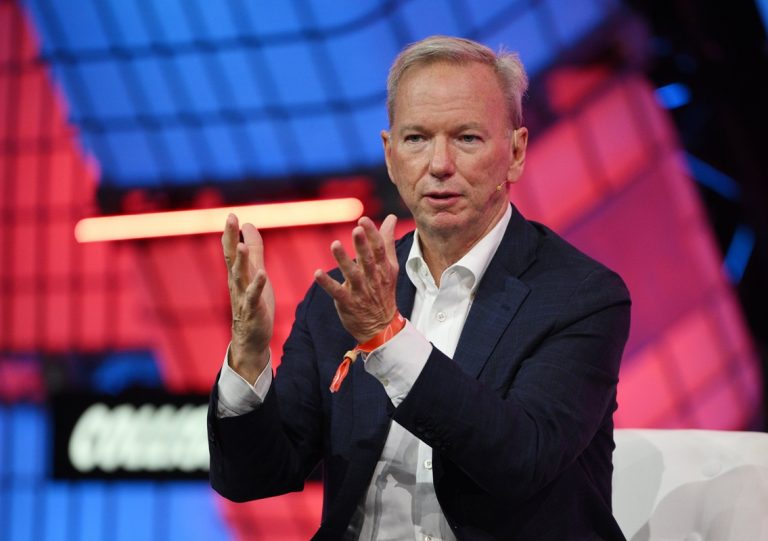
Former Google chief executive Eric Schmidt could see his fortune increase by as much as $20 billion if Anthropic reaches a $2 trillion valuation in a potential public listing, underscoring how early investors in leading artificial intelligence companies stand to benefit from the industry’s rapid growth.
Schmidt reportedly owns about 1% of Anthropic after investing tens of millions of dollars in the AI startup’s Series A funding round in 2021, according to Bloomberg. PitchBook data put Anthropic’s valuation at $461 million at the time, giving the investment a potentially substantial upside as the company expands its business and prepares for a possible initial public offering.
At a $2 trillion valuation, Schmidt’s reported stake would be worth approximately $20 billion, assuming his ownership remains at 1% and the valuation applies to the company’s equity. That would represent a significant addition to his estimated $57.5 billion fortune, according to Bloomberg.
Register for the next Tekedia Mini-MBA.
Register for Tekedia AI in Business Masterclass.
Join Tekedia Capital Syndicate and co-invest in great global startups.
However, the $2 trillion figure represents a top-end market estimate, not an established IPO valuation. Anthropic’s eventual market capitalization would depend on its financial performance, growth prospects, public-market conditions and investor appetite for AI businesses. Schmidt’s ultimate proceeds would also depend on any dilution, share-sale restrictions, taxes and the price at which the company’s shares trade after listing.
The reported size of Schmidt’s stake is notable relative to the ownership held by Anthropic’s co-founder and chief executive, Dario Amodei, who holds about 2% of the company, according to the report.
The comparison illustrates how outside investors who commit capital early in a startup’s development can accumulate valuable positions before a company reaches the scale that attracts public-market investors. Schmidt invested when Anthropic was valued at a fraction of the figures now being discussed ahead of a potential listing.

Such returns, however, remain contingent on the company’s ability to sustain growth and justify its valuation. A high private-market valuation does not automatically translate into an equivalent public-market price, particularly in a sector where expectations for future revenue and profitability can change quickly.
Anthropic has emerged as one of the leading companies developing advanced AI models and enterprise applications. Its commercial prospects have attracted investor interest as businesses increasingly explore AI tools for software development, research, customer service, and other professional tasks.
The company’s potential listing would give public-market investors a more direct opportunity to assess its financial performance and business model. It would also test whether the demand for advanced AI systems can support valuations comparable with those assigned to the technology industry’s largest companies.

A valuation approaching $2 trillion would place Anthropic among the world’s most valuable businesses. Reaching that level would require investors to attach substantial value to its expected future earnings, rather than simply its current position in the AI market.
Schmidt has remained an active technology investor since stepping down as Google’s chief executive in 2011. He deploys capital through several investment vehicles, including Tomorrow Ventures, Innovation Endeavors Management and his family office, Hillspire.
His other AI-related investments include French AI company Mistral, General Intuition and Reflection AI, giving him exposure to several businesses operating in the expanding market for advanced AI systems.
That portfolio reflects an investment approach centered on identifying technology companies that could become significant businesses as new computing capabilities create commercial opportunities. AI has attracted capital from established technology executives, venture capital firms, and institutional investors seeking exposure to potential productivity gains and new sources of revenue.
For early investors, the potential rewards can be considerable when a startup grows rapidly from a relatively modest initial valuation. But the risks are also significant: many emerging technology companies fail to achieve commercial scale, while even successful businesses can face valuation pressure when growth expectations exceed their financial results.
Anthropic’s expected public-market debut would therefore be important not only for Schmidt’s reported stake but also for investors assessing the value of private AI companies. The offering could provide a clearer benchmark for the market’s willingness to pay for advanced AI technology, although one company’s valuation would not necessarily establish the appropriate price for the wider sector.