

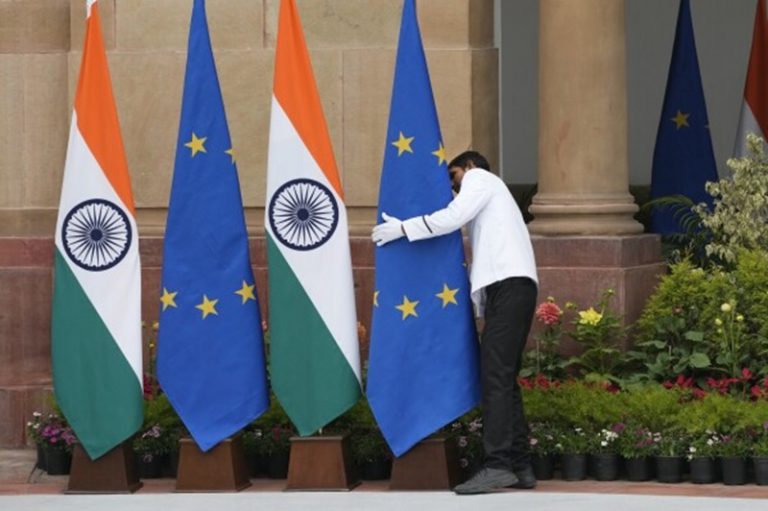
India and the European Union have concluded a sweeping free trade agreement that will remove or sharply reduce tariffs on more than 90% of goods traded between the two economies, creating what European Commission President Ursula von der Leyen described as a free trade zone of nearly two billion people.
The deal, branded “historic” by both sides, comes at a moment of acute global trade tension. New Delhi is under pressure from steep U.S. tariffs on key exports, while the EU is recalibrating its trade relationships amid growing uncertainty in its long-standing economic ties with Washington under President Donald Trump.
Under the agreement, India will lower tariffs on a wide range of European products, including automobiles, machinery, and agricultural goods, while the EU will open its market further to Indian exports such as textiles, apparel, leather goods, marine products, chemicals, plastics, and gems and jewelry. Many of these Indian sectors have been directly hit by recent U.S. tariff hikes of up to 50%, making preferential access to the European market particularly significant.
Register for Tekedia Mini-MBA edition 20 (June 8 – Sept 5, 2026).
Register for Tekedia AI in Business Masterclass.
Join Tekedia Capital Syndicate and co-invest in great global startups.
Register for Tekedia AI Lab.
“We have created a free trade zone of 2 billion people, with both sides set to gain economically,” von der Leyen said, adding that the agreement sends “a signal to the world that rules-based cooperation still delivers great outcomes.”
India’s Commerce and Industry Minister Piyush Goyal said the deal is expected to come into force in 2026, following ratification processes on both sides.
While India is only the EU’s ninth-largest trading partner—accounting for 2.4% of the bloc’s total goods trade in 2024—the EU is one of India’s most important commercial partners, alongside the U.S. and China. In financial year 2025, bilateral trade in goods between India and the EU reached 11.5 trillion rupees ($136.54 billion), with Indian exports at $75.85 billion and imports at $60.68 billion, according to India’s commerce ministry.

At the heart of the agreement are deep tariff concessions. The European Commission estimates that India will cut tariffs on European goods by around €4 billion ($4.7 billion) annually. More than 90% of EU exports to India—covering automobiles, machinery, chemicals, aircraft, and agri-food products—will face lower duties. Brussels said India has granted the EU tariff reductions that exceed those offered to any of its other trading partners.
One of the most striking elements of the deal is India’s willingness to ease protection in politically sensitive sectors. Tariffs on European cars will be reduced gradually from as high as 110% to 10%, while duties on car parts will be abolished over a period of five to ten years. European automakers with a presence in India include Renault, Volkswagen, BMW, and Mercedes-Benz.
India has also moved to nearly eliminate tariffs of up to 44% on machinery, 22% on chemicals, and 11% on pharmaceuticals. On agriculture, high duties on European exports such as wine, olive oil, spirits, and confectionery will be reduced or removed, giving EU producers preferential access to India’s fast-growing consumer market. At the same time, sensitive European agricultural sectors—beef, chicken meat, rice, and sugar—will remain protected from Indian imports.

Christophe Hansen, the EU’s commissioner for agriculture and food, said European wines, spirits, beers, and olive oil would enjoy preferential access to India under the agreement, calling it a major opportunity for European farmers and food producers.
Markets in India reacted nervously. Shares of major automakers fell on concerns about increased competition from European brands. Maruti Suzuki ended the day 1.5% lower, Hyundai Motor India closed down 3.6%, while Tata Motors and Mahindra & Mahindra fell 1.3% and 4.2%, respectively. Stocks of Indian alcoholic beverage companies also dropped, with Sula Vineyards sliding 4.1% and shares of United Breweries and United Spirits falling by more than 2%.
The Indian government sought to reassure investors, saying consumers would benefit from access to high-tech vehicles and greater competition, while Indian-made automobiles could also gain improved access to the EU market under reciprocal provisions.
But the gains could be substantial for India’s export sectors. Once the agreement takes effect, textiles, apparel, marine products, leather, footwear, chemicals, plastics, sports goods, toys, and gems and jewelry will face zero duties in the EU. These labor-intensive sectors account for about $33 billion in exports and were previously subject to EU tariffs ranging from 4% to 26%.
“This should boost India’s export competitiveness in these sectors, which are currently under strain due to higher U.S. tariffs,” said Sonal Varma, chief economist for India and Asia ex-Japan at Nomura.
The deal also carries major employment implications. Goyal said the agreement could generate six to seven million jobs in India’s textile sector alone, which is the country’s second-largest employer after agriculture. Beyond goods, the pact includes provisions allowing temporary entry and stay for professionals such as business visitors, intra-corporate transferees, contractual service suppliers, and independent professionals.
Analysts say India’s IT services, professional services, and education sectors are particularly well-positioned to benefit from these mobility clauses.
Geopolitically, the agreement is being closely watched in Washington. It is widely seen as a strategic hedge by both New Delhi and Brussels against increasingly unpredictable U.S. trade policy. Treasury Secretary Scott Bessent has already criticized the EU for pushing ahead with the deal, pointing out that Washington imposed 25% tariffs on India over its purchases of Russian oil, only for Europe to deepen trade ties with New Delhi.
President Trump has yet to comment publicly on the EU–India agreement, but the White House is unlikely to welcome a pact that reduces U.S. leverage over two major economic partners. India’s Petroleum and Natural Gas Minister Hardeep Singh Puri, however, struck a conciliatory tone, saying he expects U.S.–India relations to remain strong and expressing confidence that a bilateral trade deal with Washington would eventually be completed.
Indian Prime Minister Narendra Modi has praised the “landmark” agreement, echoing von der Leyen’s description of it as the “mother of all deals.” Both leaders are expected to highlight the pact at an EU–India summit, presenting it as a statement of commitment to open markets and multilateral trade at a time when global commerce is being reshaped by tariffs, geopolitics, and strategic rivalry.
With the ink barely dry, attention is now shifting from celebration to implementation—and to how the United States responds to a deal that signals India and Europe’s determination to diversify trade ties in an increasingly fragmented global economy.