

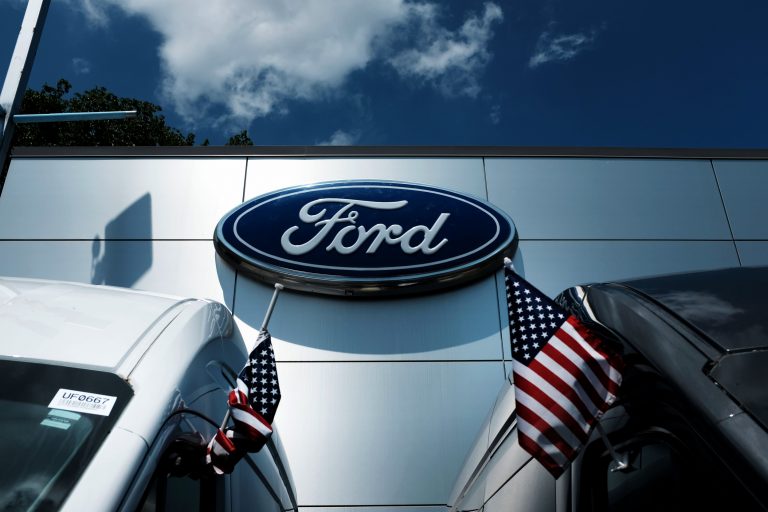
Ford Motor Co. is committing $5 billion to its next generation of all-electric vehicles, anchored by a 48-volt electrical architecture that Tesla pioneered on the Cybertruck in 2023, the company announced Tuesday.
The investment aims to achieve cost parity with gasoline vehicles by 2027, starting with a $30,000 small electric pickup truck, while dramatically reducing parts complexity, assembly time, and vehicle weight. CEO Jim Farley described the program—built around a new “Universal Electric Vehicle” (UEV) platform—as Ford’s “Model T moment,” referencing the mass-produced vehicle that revolutionized transportation in the early 1900s.
“It represents the most radical change in how we design and how we build vehicles at Ford since the Model T,” Farley said during an August 2025 event at the Kentucky plant that will produce the new truck. “Now is the time to change the game once again.”
Register for Tekedia Mini-MBA edition 20 (June 8 – Sept 5, 2026).
Register for Tekedia AI in Business Masterclass.
Join Tekedia Capital Syndicate and co-invest in great global startups.
Register for Tekedia AI Lab.
Core Innovations Driving Cost and Performance Gains
The 48-volt architecture replaces the traditional 12-volt system (powered by a lead-acid battery) with a setup that draws from the high-voltage traction battery to power all vehicle accessories.
Alan Clarke, Ford’s executive director of advanced EV development and a former Tesla executive, explained the advantages: lower cost, smaller and lighter wiring, greater electrical bandwidth, and future-proofing for more than a decade of evolution. Power can be “stepped down” to 12 volts via electronic control units (ECUs) that manage different vehicle subsystems.
Clarke noted that Ford had already decided on 48 volts before receiving a 2023 “how-to” guide from Tesla CEO Elon Musk, but the document “added fuel to the fire” and helped suppliers prepare. The wiring harness in the new midsize truck will be more than 4,000 feet shorter and 22 pounds lighter than in the current gas-powered Maverick.

Ford is also adopting Tesla-pioneered gigacastings—large-scale die-casting that replaces dozens of small stamped parts with single massive components. The new pickup will use just two structural front and rear castings compared with 146 on the Maverick. These aluminum castings are more than 27% lighter than those on a Tesla Model Y. Additional efficiency measures include aerodynamic optimization, internal “bounties” to reward teams for range and cost improvements, and a 20% overall parts reduction, 25% fewer fasteners, 40% fewer workstations dock-to-dock, and 15% faster assembly time.
Ford is racing to close the gap with Tesla and rapidly expanding Chinese EV brands in global markets. U.S. EV sales peaked at 10.3% market share in September 2025, ahead of federal incentives ending, then fell to an estimated 5.8% in Q4, reflecting slower adoption and policy shifts under the Trump administration.
Despite $19.5 billion in recent EV-related write-downs and a pullback in some plans, Ford is maintaining the $5 billion UEV commitment through 2027. The company believes the combination of lower costs, comparable pricing to gas vehicles, and desirable features will drive greater adoption. The 48-volt system addresses longstanding issues with 12-volt architecture in EVs, including recalls and accessory power limitations as electrical demands grow.

Industry-wide adoption is accelerating: Mercedes-Benz, Volkswagen, and others have announced or implemented 48-volt systems in recent years, but Tesla remains the first to bring it to mass-market consumers.
The Challenges
Ford’s strategy reflects a broader industry pivot toward system-level optimization to close the cost gap with internal combustion engines. The UEV platform’s flexibility could enable multiple body styles (pickup, SUV, crossover) on shared architecture, improving scale and cost efficiency. However, risks remain as U.S. EV demand has cooled amid high interest rates, range anxiety, charging infrastructure gaps, and policy uncertainty. Competition from Chinese brands (BYD, Nio, Xpeng) is intensifying globally, with lower prices and advanced features pressuring legacy automakers.
Gigacasting requires massive capital investment in very large die-casting machines and carries technical risks (e.g., porosity, heat treatment). Supply chain constraints—particularly for aluminum and batteries—could delay timelines or raise costs. Ford’s $30,000 electric pickup target is aggressive; achieving price parity with gas equivalents while delivering competitive range, performance, and features will be challenging.
Analysts believe the company’s success will depend on flawless execution of the UEV platform, supplier readiness for 48-volt components, and consumer acceptance of the new architecture’s benefits.
However, the announcement signals Ford’s determination to remain a major player in electrification despite recent setbacks. Also, the company aims to compete head-on with Tesla and Chinese rivals in the next phase of the EV transition – underlined by its adoption of proven Tesla innovations (48-volt, gigacasting) and pairing them with its own manufacturing strengths and brand loyalty.