

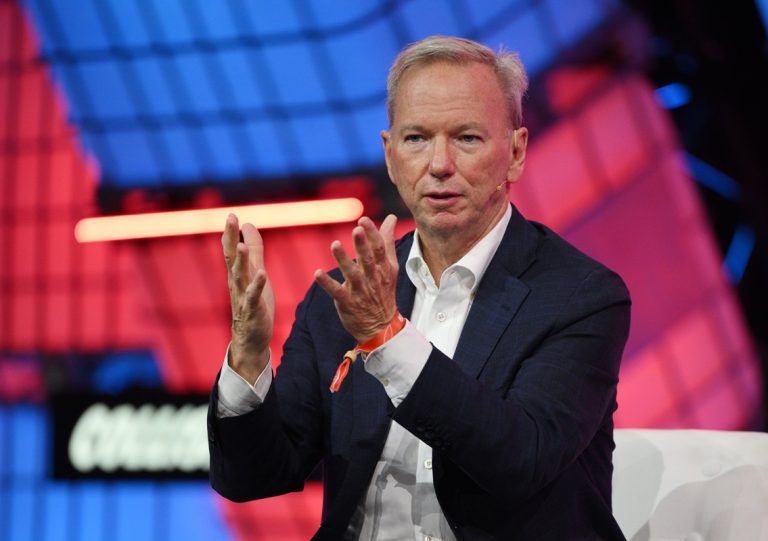
Former Google CEO Eric Schmidt, who steered the tech giant through the collapse of the dot-com bubble in the early 2000s, says the current artificial intelligence boom is fundamentally different and unlikely to suffer a similar fate.
Speaking at the RAISE Summit in Paris, Schmidt addressed growing concerns that AI could be heading toward bubble territory, especially as Wall Street voices caution and major tech firms pour billions into the sector.
“I think it’s unlikely, based on my experience, that this is a bubble,” Schmidt said. “It’s much more likely that you’re seeing a whole new industrial structure.”
Register for Tekedia Mini-MBA edition 20 (June 8 – Sept 5, 2026).
Register for Tekedia AI in Business Masterclass.
Join Tekedia Capital Syndicate and co-invest in great global startups.
Register for Tekedia AI Lab.
His comments come at a time when AI’s rapid expansion has drawn comparisons to the tech boom—and-bust of the 1990s. Since OpenAI’s ChatGPT broke into the mainstream, AI has been thrust into the center of global tech innovation, with major companies like Microsoft, Amazon, Google, Meta, and Nvidia investing heavily in AI infrastructure, talent, and startups.
According to market research cited during the summit, the AI sector was valued at $189 billion in 2023, with projections pointing to a meteoric rise to $4.8 trillion by 2033. But with that growth has come skepticism from financial circles.
Torsten Sløk, chief economist at Apollo Global Management, recently warned that the U.S. stock market is experiencing an even bigger bubble than during the dot-com boom. In a research note published Wednesday, Sløk blamed what he described as irrational exuberance around AI.

“The difference between the IT bubble in the 1990s and the AI bubble today is that the top 10 companies in the S&P 500 today are more overvalued than they were in the 1990s,” Sløk wrote, cautioning that soaring valuations risk disconnecting from underlying earnings.
Schmidt, however, pushed back against the idea that inflated valuations alone prove a bubble exists. He pointed to the AI industry’s investment in physical infrastructure—especially high-performance computing hardware—as a sign of long-term viability.
“You have these massive data centers, and Nvidia is quite happy to sell them all the chips,” Schmidt said. “I’ve never seen a situation where hardware capacity was not taken up by software.”

The former Google chief, who currently holds stakes in AI startups such as Anthropic, acknowledged that there are concerns inside the industry. Some executives have admitted to “overbuilding” data infrastructure and anticipate overcapacity within two to three years. Schmidt recounted conversations with leaders who privately say, “‘I’ll be fine and the other guys are going to lose all their money.’ That’s a classic bubble, right?”
Still, he argued that the dichotomy within the industry—between fears of overcapacity and beliefs in transformative breakthroughs—shows just how early and dynamic the AI landscape remains. Schmidt described some Bay Area AI pioneers who believe that technologies like reinforcement learning will fundamentally redefine human society.
“If you believe that those are going to be the defining aspects of humanity, then it’s under-hyped and we need even more,” he said.
Adding to the conversation, Nvidia, which has become the poster child of the AI boom with a 173% surge in share price in 2024 alone, also announced a 10-for-1 stock split and dividend hike earlier this year, moves that reflect investor demand. Its data center revenue crossed $22.6 billion last quarter, up over 400% year-over-year, driven by cloud providers and AI startups racing to expand computing capacity.
Yet for some, these are red flags. With Nvidia trading at around 40 times forward earnings—higher than most large-cap peers—some market watchers argue the company embodies the kind of runaway valuations reminiscent of the 1990s tech craze.
Despite those fears, Schmidt’s position indicates that while AI may be in a phase of frenzied investment and occasional irrational behavior, the underlying transformation is real and global. To him, the investments in hardware, software, and machine learning infrastructure point to a structural shift rather than a speculative spike.