

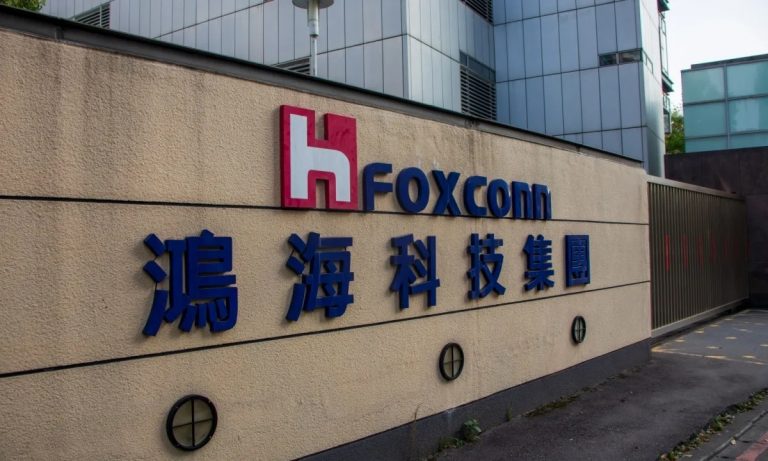
Foxconn expects third-quarter performance to exceed market expectations as surging demand for artificial intelligence infrastructure drives orders for servers and networking equipment, giving the world’s largest contract electronics manufacturer another strong quarter of growth.
The Taiwanese company, formerly known as Hon Hai Precision Industry, said on Saturday that its visibility into the third quarter had improved from the previous month, with AI demand continuing to expand and information and communications technology products entering their seasonal peak period.
“In the third quarter, as AI demand continues to grow, and ICT products also enter the peak season of the second half of the year, operations are expected to gradually gain momentum,” Foxconn said.
Register for the next Tekedia Mini-MBA.
Register for Tekedia AI in Business Masterclass.
Join Tekedia Capital Syndicate and co-invest in great global startups.
“Currently, the company’s visibility for the third quarter has improved compared to the previous month, with overall performance expected to outperform market expectations,” it added.
Foxconn does not issue numerical earnings forecasts, leaving investors to gauge the strength of its outlook through monthly revenue figures and comments on orders.
Those indicators have been increasingly strong.

Foxconn said August revenue rose 51.98% from a year earlier to NT$921.8 billion ($29.15 billion), the highest August revenue in the company’s history and the second consecutive month in which sales exceeded NT$900 billion.
The result follows a record July, when monthly revenue also surpassed NT$900 billion for the first time. Foxconn’s first-half performance was similarly strong, with second-quarter revenue, operating profit and net profit all reaching records for the period.
The latest figures point to a fundamental change in the composition of Foxconn’s growth.

For years, the company was best known as the principal assembler of Apple’s iPhones and a key supplier of consumer electronics. AI infrastructure is now becoming an important part of its business, with Foxconn serving as a major manufacturing partner for Nvidia’s data-center systems.
The shift matters because AI servers are substantially more valuable and complex products than many of the consumer devices Foxconn traditionally assembled. The rapid expansion of AI data centers has created a new source of demand for high-performance computing systems, networking equipment and associated components.
Foxconn’s second-quarter net profit rose 35% year on year to NT$59.97 billion, beating analysts’ expectations, as demand for AI-related products continued to strengthen.
The company said in August that it expected strong year-on-year growth and significant quarter-on-quarter improvement in its third quarter, while also forecasting that demand for AI production capacity would remain very strong into 2027. It has also outlined higher capital spending in the United States, including investments in Texas, Wisconsin, Ohio and California.
AI Is Reshaping Foxconn’s Business
The significance of Foxconn’s latest outlook extends beyond one quarterly earnings cycle. The company is taking a position as a manufacturing backbone for the AI industry, connecting chip designers such as Nvidia with the hyperscalers and technology companies building enormous computing clusters.
That gives Foxconn exposure to a broader AI infrastructure spending cycle rather than dependence solely on consumer product launches.
Smartphone and consumer-electronics demand tends to be driven by replacement cycles, product launches, and household spending. AI infrastructure is being driven by a much larger capital-spending race among cloud providers and AI developers seeking additional computing capacity.
Foxconn is therefore benefiting from the buildout of the physical infrastructure required to train and operate increasingly sophisticated AI models.
The strength of that market is visible across the semiconductor and computing supply chain. Broadcom, another major AI infrastructure supplier, recently raised its forecast for AI chip revenue to about $115 billion for fiscal 2027 and expects that figure to double to roughly $230 billion in fiscal 2028.
The broader spending cycle provides an important backdrop to Foxconn’s improving order visibility.
Nvidia Relationship Becomes More Important
Foxconn’s relationship with Nvidia has also come to play an integral role. As Nvidia continues to dominate the market for AI accelerators, demand for complete AI computing systems has expanded beyond individual GPUs to include servers, networking equipment, power systems and other components required to build large-scale AI clusters.
Foxconn is one of the companies positioned to manufacture those systems at scale. That makes the company’s fortunes largely tied to the capital expenditure plans of hyperscalers and AI developers. If those companies continue increasing AI infrastructure budgets, Foxconn can capture a portion of that spending through manufacturing contracts.
The reverse is also true. Any sharp slowdown in AI capital expenditure could expose Foxconn to excess manufacturing capacity and inventory risks. For now, there is little indication of such a slowdown. Foxconn’s own comments point to continued strength, including solid demand expected well into 2027.
Geopolitics Remains a Major Risk
Foxconn nevertheless warned that investors must monitor the “volatile global political and economic situation.” That caution is relevant for a company with one of the world’s most extensive electronics manufacturing networks.
The company has significant operations across Asia and is expanding its manufacturing footprint in the United States and other markets. Its customers and suppliers are also exposed to U.S.-China trade restrictions, semiconductor export controls, tariffs, and changing industrial policies.
The AI boom is adding another layer of geopolitical sensitivity because advanced computing infrastructure has become strategically important to governments.
For Foxconn, geographic diversification can reduce dependence on any single manufacturing location, but it also increases the complexity and cost of managing production across multiple jurisdictions. The company is consequently attempting to capture the AI boom while building a supply chain capable of navigating a more fragmented global trading system.
Foxconn shares rose 3.4% on Friday, ahead of the August revenue release, compared with a 1.5% gain in Taiwan’s broader market. The stock’s performance suggests investors are now treating Foxconn as an AI infrastructure beneficiary rather than solely as an Apple supplier.
That distinction could become more important as the company reports subsequent quarters.
The key question is no longer simply whether Foxconn’s revenue will grow. Analysts say investors will want to determine how much of that growth is coming from AI servers and cloud infrastructure, whether those businesses generate attractive margins, and how sustainable the current level of AI capital spending will be.
Foxconn’s challenge is to convert extraordinary AI-driven revenue growth into durable profitability while avoiding excessive dependence on a single investment cycle.