

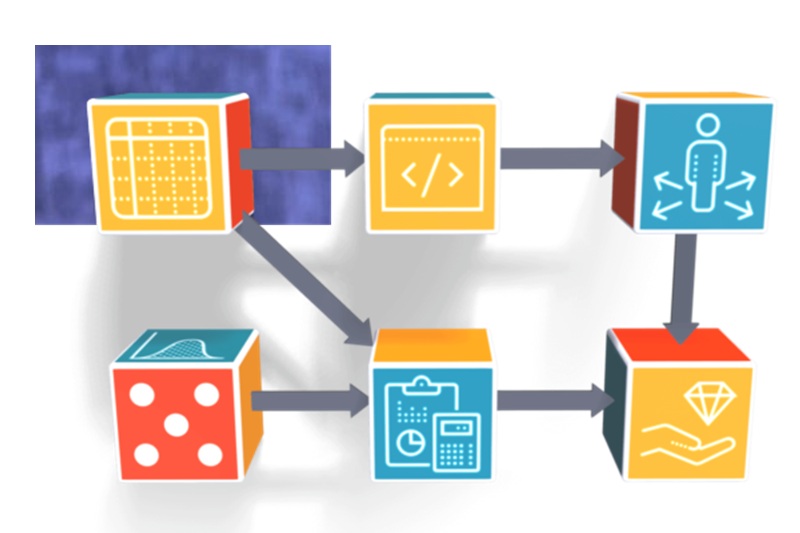
Scientific theories may contain complex concepts, unobservable phenomena, and relations that may be hard to convey using only written descriptions. By using visual models, it becomes possible to simplify the comprehension of such concepts for the learner in question. If developed properly, visuals can help link the theoretical information with observable objects, motions, relations, and processes. Such an approach may help students, scientists, healthcare workers, and lay people in understanding scientific theories without compromising their accuracy.
Define Theoretical Concepts Clearly
It is important to determine the aspect of the theory that will be depicted through the use of the visual before making the visualization itself. A single scientific theory is usually composed of various processes, relationships, or principles, and attempting to depict all of them within one visualization might make it hard for people to understand what is being represented. It is necessary to find out what will be understood by the audience after seeing the created visual model.
It is also vital to differentiate between scientific facts and the simplifications that will be depicted within the model. Visualization is helpful due to the ability to make things simpler, but the overuse of simplifications can lead to misunderstanding. It is essential to ensure that the relations and facts are true despite some of the simplifications made to make the concept clearer to visualize.
Show Relationships Through Visual Structure
An effective visual model should indicate the ways in which various aspects of the theory are related to each other. Position, size, arrows, transitions, and movement can indicate relationships that otherwise might take multiple sentences to explain. An example of such a model for a biological theory would show the way in which one stage results in the next stage, while an example for a physical theory would demonstrate interactions between the forces or objects involved in the theory.
The use of movement is especially useful when there is some sort of progression or change in the theory. In scientific animation, the processes can be presented in a progressive manner instead of all the aspects of the theory being shown at once. This enables learners to see cause and effect and see how one stage evolves into the next.
Use Appropriate Levels Of Detail
The amount of information presented in a visual model depends on the expertise level of its target audience. Beginners could need simple structures and relations, whereas advanced students might have a demand for more information layers. It is possible to include these features in a model by presenting basic information and adding new information as an explanation proceeds.
Good visual models can also involve various views when one perspective does not work. It is possible, for instance, to use 3D medical animations that show various views of a certain structure and its relation to a bigger picture at the same time. Such an approach can be used in any scientific field, such as chemistry, physics, biology, engineering, and environmental science. The purpose of a good visual model is not to look good; it is to offer valuable information through its elements.
Connect Models With Explanations
The best way to use visual models is in combination with explanatory instructional language. Through narration, captions, or other text, the learner can be made aware of the significance of each step being shown and the reasons for it. It will prevent students from having to try and make sense of visuals which they have no prior experience with. The explanation should introduce the concepts at the same speed as the visuals.
An example, or a comparison, can be used in order to relate the abstract theory to knowledge that the students may have already acquired. An analogy could be used at first, but not as the sole means of presenting the scientific theory.
These models transform complicated scientific theories into experiential learning experiences, which are more observable, understandable, and memorable. The success of such models is contingent upon correct information, deliberate design, suitable level of details, and relevance between the visual components and their explanations. Focusing on learners’ needs to know rather than on the creation of impressive graphics, one may apply visual models for conveying theories effectively.