

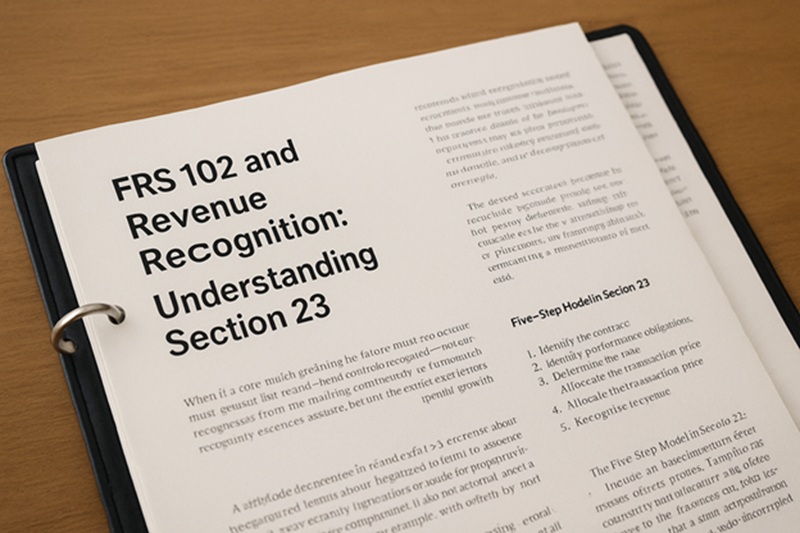
When it comes to financial reporting under FRS 102, few areas create as much confusion—or carry as much importance—as Section 23: Revenue Recognition. This section defines when and how income should be recognised, a fundamental element for presenting an accurate picture of business performance. With the 2024 amendments aligning FRS 102 more closely with IFRS 15, UK and Irish entities are now facing new expectations around timing, measurement, and disclosure.
The Core Principle: Recognising Revenue Correctly
At the heart of Section 23 is the idea that revenue must be recognised when control of goods or services passes to the customer—not simply when cash changes hands. This shift from “risks and rewards” to “transfer of control” marks a subtle but significant change for many SMEs. It means that judgment is now required to determine exactly when performance obligations are satisfied, which may differ from when invoices are raised or payments are received.
For example, a construction company that builds extensions over several months might recognise revenue over time, while a retailer selling physical goods will record revenue at a point in time. The challenge lies in determining where each transaction sits on that spectrum.
The Five-Step Model in Section 23
The revised Section 23 introduces a structured, five-step framework for recognising revenue, mirroring IFRS 15. Businesses must:
- Identify the contract with a customer.
- Identify the performance obligations within that contract.
- Determine the transaction price, including variable elements such as discounts or bonuses.
- Allocate the transaction price to each performance obligation.
- Recognise revenue when (or as) those obligations are satisfied.
This framework provides consistency across industries, but it also demands more granular analysis of contracts than before. For businesses with long-term projects, bundled services, or tiered pricing, these steps can become complex—but they also create opportunities for more transparent, meaningful reporting.
The Rise of FRS 102 Software
As FRS 102 requirements grow more complex, specialised accounting software has become an essential ally for finance teams. These tools streamline the management of leases, revenue recognition, and disclosures, ensuring accuracy while reducing manual workloads. Modern FRS 102 software—like Finquery, Sage Intacct, AccountsIQ, Trullion, and Silverfin—integrates directly with general ledger systems to automate journal entries, amortisation schedules, and compliance reports.
Beyond automation, these platforms provide real-time dashboards that give accountants and CFOs immediate insight into financial impacts under FRS 102. Many systems also feature built-in validation tools that check for compliance with the latest 2024 amendments, particularly around lease accounting and the new five-step revenue model. The result is fewer errors, faster closes, and cleaner audits.
For growing UK businesses, adopting FRS 102 software isn’t just about ticking compliance boxes—it’s about gaining efficiency, transparency, and confidence in financial reporting.
Real-World Impact: Who Feels the Change Most
Service-based industries, software providers, and construction firms are among those most affected by Section 23. These sectors often deal with contracts involving multiple deliverables or milestones, making the timing of revenue recognition less straightforward. Finance teams must now ensure that systems are capable of tracking and allocating revenue by obligation, rather than by invoice or project stage.
Technology as a Lifeline
Thankfully, the rise of modern accounting technology has made compliance far easier. Cloud-based systems like Xero, Sage Intacct, and AccountsIQ now include built-in tools for deferred revenue tracking and contract allocation. Automation ensures that adjustments happen seamlessly each month, minimising manual error and improving audit readiness. For larger entities, integrated ERP platforms can even connect accounting data directly to operational workflows, ensuring that revenue recognition aligns with project progress in real time.
The Bigger Picture: Why Section 23 Matters
Section 23 isn’t just about technical compliance—it’s about trust. Accurate revenue recognition builds credibility with investors, lenders, and regulators, while reducing the risk of misstated results. By embracing the new five-step model and the technology that supports it, businesses can achieve a more faithful reflection of performance.
FRS 102 may be evolving, but at its core, Section 23 reinforces an old truth: good accounting tells the real story behind the numbers.