

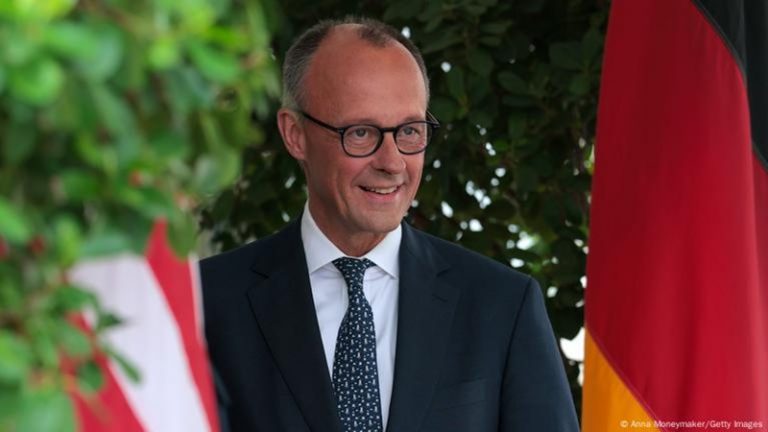
Germany’s economic outlook has taken a notable turn, with a leading economic institute forecasting that Europe’s largest economy could expand by as much as 1.4% this year.
The upgraded projection represents a sharp improvement from its previous estimate and offers a potentially important political boost for Chancellor Friedrich Merz’s government, which has faced pressure to revive growth and restore confidence in Germany’s economic model.
The revised forecast suggests that the prolonged period of stagnation affecting Germany may finally be giving way to a more meaningful recovery.
For much of the past several years, the German economy has struggled with weak industrial production, high energy costs, subdued investment and declining competitiveness in important manufacturing sectors.
Register for the next Tekedia Mini-MBA.
Register for Tekedia AI in Business Masterclass.
Join Tekedia Capital Syndicate and co-invest in great global startups.
Germany’s dependence on exports has also left its economy vulnerable to weaker global demand and geopolitical uncertainty. Against that backdrop, a forecast of 1.4% growth represents more than a statistical improvement; it signals the possibility of a broader economic turnaround.
One of the most important factors behind the improved outlook is likely to be stronger domestic activity. Germany’s economy has been constrained by weak consumer confidence and cautious household spending.
But improving purchasing power and more stable economic conditions could encourage consumers to spend more. If households become increasingly confident about employment and inflation, consumption could provide an important foundation for growth.

Investment is another critical component of the recovery. Germany needs substantial investment in infrastructure, energy systems, digital technology and industrial capacity if it is to remain competitive.
Increased public and private investment could stimulate economic activity in the short term while improving productivity over the longer term. For Merz’s government, encouraging this investment will be essential to converting a temporary rebound into sustainable growth.
The forecast also carries significant political implications. Merz took office promising to strengthen Germany’s economy and restore the country’s position as an industrial powerhouse.
A stronger-than-expected expansion would give his administration evidence that its economic policies are beginning to produce results.

It could also improve business confidence and provide greater political room for reforms aimed at reducing bureaucracy, supporting investment and strengthening German industry. However, the upgraded forecast does not mean Germany’s economic challenges have disappeared.
Structural problems remain substantial. The country continues to face demographic pressures, a shortage of skilled workers, high energy costs and intense competition from China and other manufacturing economies.
German companies are also navigating rapid technological changes, particularly in automobiles, artificial intelligence and advanced manufacturing. The transition toward electric vehicles illustrates the scale of the challenge.
Germany’s traditional automotive industry remains economically important, but global competition is intensifying as Chinese manufacturers expand their presence and technological capabilities.
Maintaining Germany’s industrial leadership will require significant investment and adaptation. Meanwhile, external risks could still undermine the recovery. Weak global trade, geopolitical tensions, energy-price shocks and uncertainty surrounding international economic policy could weigh on German exporters.
The forecast of 1.4% should therefore be viewed as an opportunity rather than a guarantee. The upgraded projection provides a welcome dose of optimism for Germany. After years of disappointing growth, even a moderate expansion could mark an important change in direction.
For Chancellor Merz, the challenge now is to ensure that improved economic momentum becomes durable. If Germany can combine stronger demand with investment, structural reforms and renewed industrial competitiveness, the country could begin moving from stagnation toward sustained growth.
Germany’s Electric Vehicle Push Gains Momentum With New Subsidies
Germany’s electric-car market is showing renewed momentum after the government rebooted its subsidy program, highlighting how strongly policy incentives can influence consumer demand and the country’s broader transition toward cleaner transportation.
Sales of battery-electric vehicles in August were significantly higher than during the same month a year earlier, suggesting that financial support is beginning to reverse some of the weakness that emerged after previous incentives were withdrawn.
The recovery is particularly important for Germany because the country remains Europe’s largest automotive economy.
Its manufacturers, including Volkswagen, BMW and Mercedes-Benz, are under pressure to accelerate their electric-vehicle strategies while competing against increasingly aggressive Chinese manufacturers and changing consumer preferences.
Stronger domestic EV demand could therefore provide an important boost not only to emissions targets but also to the competitiveness of Germany’s industrial base.
The renewed subsidy program appears to be addressing one of the biggest obstacles to EV adoption: price. Electric cars typically carry higher upfront costs than comparable combustion-engine vehicles, even though their operating and maintenance expenses can be lower.
For consumers who are sensitive to purchase prices, government incentives can make the difference between choosing an electric vehicle and remaining with a petrol or diesel model.
The August increase also demonstrates the difficulty of sustaining an energy transition when government policy changes abruptly. Germany previously reduced and eventually ended major EV purchase incentives.
Creating uncertainty for consumers and manufacturers. The subsequent slowdown raised concerns that the country could struggle to meet its electrification objectives.
Restarting financial support represents an attempt to restore confidence and encourage buyers who may have postponed purchases.
However, subsidies alone are unlikely to determine the long-term trajectory of Germany’s EV market.
Consumers also consider charging infrastructure, vehicle range, electricity prices, resale values and the availability of affordable models. Germany will need continued investment in charging networks and grid capacity if higher EV sales are to translate into a durable structural shift in transportation.
Competition is another critical factor. Chinese automakers have expanded rapidly across international EV markets, often competing on price, technology and features. European manufacturers therefore face a dual challenge.
Encouraging consumers to buy electric vehicles while ensuring that those vehicles remain competitive against imported alternatives.
The latest August figures nonetheless provide a positive signal. A year-on-year increase following the return of subsidies suggests that demand for electric mobility has not disappeared.
Instead, consumers may have been waiting for more favorable economic conditions. That distinction matters for policymakers because it indicates that incentives can unlock demand that remains latent in the market.
For Germany, the stakes extend beyond monthly registration statistics. The automotive industry supports millions of jobs directly and indirectly, making the transition to electric vehicles an economic transformation as much as an environmental one.
A sustained increase in EV sales could help manufacturers justify further investment in batteries, software, charging technology and electric platforms. The challenge now is maintaining momentum without creating another cycle of boom-and-bust demand whenever subsidies change.
If Berlin can combine targeted incentives with affordable vehicles, reliable charging infrastructure and stable long-term policy, Germany’s August rebound could become more than a temporary improvement.
It could mark another step toward rebuilding consumer confidence and establishing electric vehicles as a mainstream component of the German automobile market.