

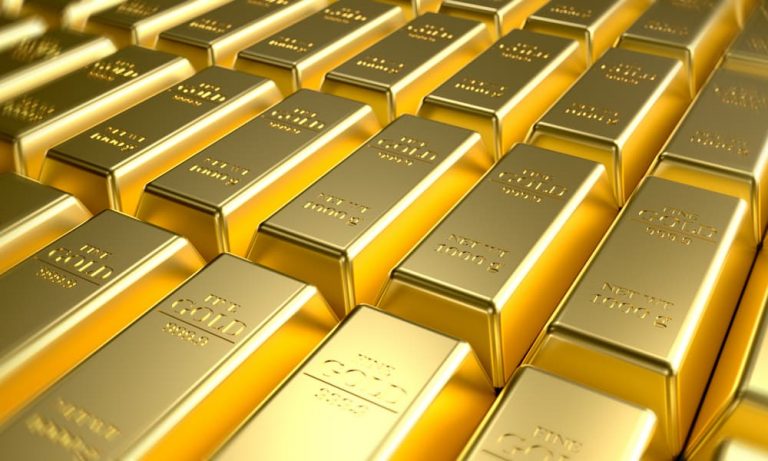
Gold prices remained largely stable on Friday, positioning the metal for its seventh straight month of gains amid persistent uncertainty surrounding U.S. tariff policies and ongoing diplomatic tensions between the United States and Iran.
The combination has reinforced gold’s traditional safe-haven appeal, with investors continuing to favor the non-yielding asset over riskier alternatives. Spot gold edged down 0.1% to $5,181.18 per ounce by 0837 GMT, while U.S. gold futures for April delivery rose 0.1% to $5,198.10. The metal has climbed 6.5% in February alone, contributing to a cumulative gain of 58% over the past seven months — one of the strongest multi-month rallies in recent history.
The benchmark 10-year U.S. Treasury yield fell to a three-month low on the day, further reducing the opportunity cost of holding non-interest-bearing gold. ANZ analyst Soni Kumari highlighted the dual drivers, noting: “There are two things supporting gold. First is the tariff uncertainty which is there in the market right now, and on the other hand, the Iran and the U.S. situation.”
Register for Tekedia Mini-MBA edition 20 (June 8 – Sept 5, 2026).
Register for Tekedia AI in Business Masterclass.
Join Tekedia Capital Syndicate and co-invest in great global startups.
Register for Tekedia AI Lab.
Geopolitical Tailwinds: U.S.-Iran Nuclear Talks, Tariffs
The United States and Iran held indirect talks in Geneva on Thursday, with Omani mediators reporting progress on the long-running nuclear dispute. Technical-level discussions are scheduled to resume next week in Vienna. While no breakthrough has emerged, the absence of escalation has kept geopolitical risks elevated but contained — a dynamic that has supported gold prices without triggering a full flight to safety.
Linh Tran, Senior Market Analyst at XS.com, noted: “The latest rounds of talks have not produced a clear outcome, leaving geopolitical risks present but not escalating. This has kept gold at elevated levels, though it has not yet provided sufficient momentum to establish a sustainable bullish trend.”
The U.S. began collecting a temporary new 10% global import tariff on Tuesday, with USTR Jamieson Greer indicating the rate will rise to 15% for some countries. The move follows the Supreme Court’s Friday ruling striking down Trump’s earlier IEEPA-based tariffs, prompting a swift pivot to Section 122 authority for the new levies. The tariff uncertainty has weighed on risk assets while bolstering gold, as investors seek protection against potential trade disruptions, inflation pass-through, and currency volatility.

The dollar’s recent weakness — down against major peers — has provided additional support for gold denominated in dollars.
Other Precious Metals Performance
Spot silver rose 1.7% to $89.87 per ounce, on track for a 6.2% monthly gain. Platinum climbed 4.1% to $2,365.33 per ounce — a four-week high — while palladium gained 2.1% to $1,821.28. Industrial demand for platinum and palladium (catalytic converters, electronics) has benefited from expectations of resilient global manufacturing, while silver’s dual role as both precious and industrial metal has amplified its upside.
U.S. initial jobless claims increased slightly last week, but the unemployment rate held steady in February, reflecting a resilient labor market despite cooling hiring momentum. The data has kept expectations for Federal Reserve rate cuts alive, with traders pricing in roughly 83% odds of a June reduction. Lower yields reduce the opportunity cost of holding gold, providing further tailwind.

Global sentiment remains cautious. European stocks opened mixed Thursday, weighed by mixed earnings from Airbus, Renault, and Nestlé, while U.S. futures traded near flat Wednesday night after Nvidia’s earnings beat. Oil prices rose more than 4% Wednesday after U.S. Vice President JD Vance said Iran had not addressed core demands in nuclear talks, reinforcing geopolitical risk premiums.
Outlook for Gold
Gold’s sustained seven-month rally is a sign of a confluence of supportive factors: tariff-driven uncertainty, geopolitical risks, moderating U.S. yields, and persistent inflation concerns despite recent cooling. While the metal has not yet broken decisively higher, the absence of major negative catalysts and ongoing safe-haven demand suggests continued upward bias in the near term.
Analysts remain divided on the sustainability of the move. Some view the current levels as reflecting legitimate risk premia, while others caution that a resolution to U.S.-Iran talks or tariff clarity could prompt profit-taking. However, gold’s resilience amid multiple headwinds underscores its enduring role as a hedge against policy uncertainty and geopolitical instability.
As markets await next week’s U.S. data (nonfarm payrolls Wednesday, CPI Friday) and further developments in U.S.-Iran negotiations, gold is likely to remain well-bid, with any pullbacks viewed as buying opportunities by many participants. The metal’s performance in February, on track for another strong monthly close, reinforces its status as one of the standout assets of 2026 so far.