

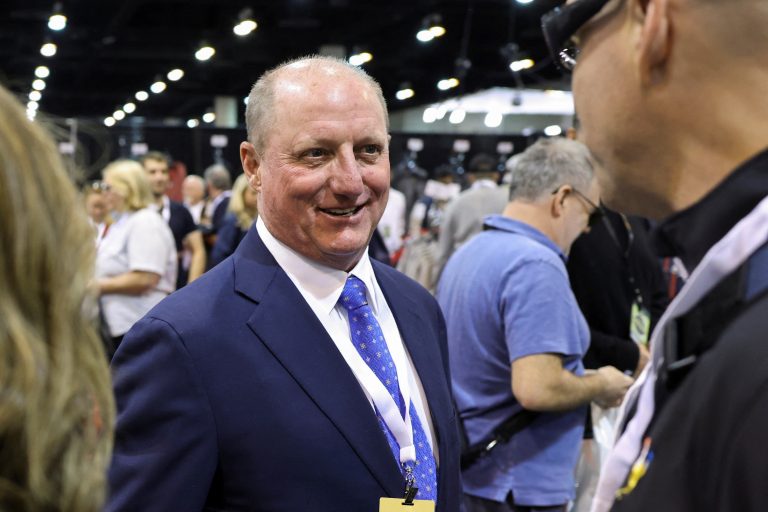
For decades, Berkshire Hathaway’s annual meeting revolved around a single gravitational force: Warren Buffett.
Investors traveled from around the world not only to hear the legendary investor dissect markets and business strategy, but also to absorb the culture, discipline, and personality that shaped one of the most successful conglomerates in corporate history.
This year marked the clearest indication yet that Berkshire is entering a fundamentally different phase.
Register for the next Tekedia Mini-MBA.
Register for Tekedia AI in Business Masterclass.
Join Tekedia Capital Syndicate and co-invest in great global startups.
In his first major appearance running the meeting, Greg Abel, who succeeded Buffet last year, presented shareholders with a version of Berkshire that appeared less centered on iconic stock-picking and more focused on operational scale, infrastructure dominance, disciplined execution, and long-term industrial positioning.
The transition was subtle in tone but profound in implication. While shareholders acknowledged the absence of Buffett’s humor, storytelling, and instinctive market wisdom, many emerged from the event increasingly convinced that Berkshire’s succession framework is stronger and more institutionalized than previously assumed.
“Greg and company delivered on content, examination of businesses and confidence in outlook,” said Macrae Sykes of Gabelli Funds.

The meeting effectively served as Abel’s first large-scale stress test before Berkshire’s intensely loyal investor base, many of whom have spent decades treating Buffett’s leadership as inseparable from the company itself. The result, according to investors and analysts, was not an attempt to imitate Buffett, but an effort to redefine Berkshire around its operational machinery.
Under Buffett and late vice chairman Charlie Munger, Berkshire became synonymous with capital allocation excellence. Investors viewed the conglomerate partly as a giant investment partnership wrapped inside a collection of operating businesses.
Abel’s Berkshire appears likely to lean more heavily on the strength of those businesses themselves.

Throughout the meeting, Abel repeatedly drilled into the economics and performance of Berkshire’s subsidiaries, including railroads, utilities, insurance operations, manufacturing units, and consumer businesses. Shareholders said the level of detail was unusually granular compared with previous meetings.
“The answers were really good as they gave granular insights,” said German investor Tilman Versch.
The shift suggested a deliberate repositioning: Berkshire increasingly wants investors to value the company not only as Buffett’s portfolio, but as one of the world’s most diversified industrial and infrastructure platforms.
That could prove increasingly important in the years ahead. Unlike many technology-focused conglomerates, Berkshire owns a vast network of real-economy assets tied to transportation, power generation, logistics, housing, manufacturing, and insurance. Those businesses are deeply embedded in the functioning of the U.S. economy and generate enormous recurring cash flow even during periods of market turbulence.
Analysts say Abel’s operational background may strengthen Berkshire’s positioning during a period when infrastructure, energy security, and industrial resilience are becoming central investment themes globally.
Artificial intelligence unexpectedly became one of the clearest examples of that shift. Rather than discussing AI primarily as a speculative technology boom, Abel framed it as an industrial and infrastructure opportunity for Berkshire’s core businesses. He spoke extensively about AI applications inside BNSF Railway and emphasized the enormous electricity demand being created by hyperscale data centers.
That demand surge could become a major growth engine for Berkshire Hathaway Energy, one of the conglomerate’s most strategically valuable assets.
In effect, Berkshire is positioning itself to profit from AI not by competing with Silicon Valley, but by owning the physical systems the AI economy depends on: rail networks, energy grids, utilities, and industrial infrastructure. That framing resonated with investors who increasingly see AI’s long-term winners extending beyond software companies into firms controlling electricity, logistics, and hard assets.
“He was clearly very comfortable with technology and AI,” said Adam Patti of VistaShares. “Perhaps that lends insight into how the portfolio may evolve over time.”
The comments also became a boost to the growing expectations that Berkshire’s investment style could evolve gradually under Abel. Buffett historically avoided many technology sectors because he preferred businesses with highly predictable economics. Abel appears more willing to engage with technological transformation, particularly where it intersects with Berkshire’s existing industrial footprint.
At the same time, shareholders appeared reassured by the visibility of Berkshire’s broader leadership structure. Executives, including insurance chief Ajit Jain and BNSF CEO Katie Farmer, played more visible roles, reinforcing the idea that Berkshire’s management depth extends far beyond Buffett himself.
That “deep bench” has become increasingly important to investor confidence because Berkshire’s scale now makes continuity critical. With hundreds of billions of dollars in assets and operations spanning nearly every major sector of the economy, the conglomerate can no longer function as a personality-driven enterprise alone.
Still, there are some unresolved concerns.
Shareholders expressed disappointment over Berkshire’s muted pace of share buybacks, with only $235 million repurchased during the quarter. Given Berkshire’s enormous cash reserves, some investors expected more aggressive repurchases, particularly as acquisition opportunities remain limited.
The hesitation may reflect management caution at a time when valuations across large-cap equities remain elevated and geopolitical risks are intensifying. But it is also seen as an indication of a broader challenge facing Berkshire itself: its immense size increasingly limits the universe of acquisitions capable of materially moving earnings growth.
That reality could gradually push Berkshire toward a more infrastructure-focused identity, emphasizing steady operational returns over blockbuster investment gains. The cultural transition underway at Berkshire may ultimately become one of the most closely watched succession stories in modern corporate history. Very few global companies have ever attempted to move beyond a founder figure as dominant as Buffett without suffering a crisis of identity or investor confidence.
What emerged from this year’s meeting, however, was the sense that Berkshire is trying to evolve from a company defined by one extraordinary investor into an institution defined by systems, operating discipline, and decentralized management strength.
For shareholders, the key takeaway was not that Abel resembles Buffett. It was that he may not need to.