

Honeywell is positioning artificial intelligence as the cornerstone of its next phase of growth, arguing that AI’s biggest commercial impact may not come from chatbots or consumer applications, but from transforming the physical infrastructure that underpins the global economy.
Speaking to CNBC’s Jim Cramer, Honeywell Chief Executive Officer Vimal Kapur said AI is set to fundamentally reshape industrial automation, creating a significant opportunity for the company as it prepares to become a pure-play automation business following the planned June 29 spin-off of its aerospace division.
“The power of AI is going to redefine automation,” Kapur said.
Register for the next Tekedia Mini-MBA.
Register for Tekedia AI in Business Masterclass.
Join Tekedia Capital Syndicate and co-invest in great global startups.
The comments offer insight into how one of the world’s largest industrial technology companies views the next stage of the AI revolution. While investor attention has largely focused on AI model developers, semiconductor companies, and hyperscale data center operators, Honeywell is making the case that the real long-term value may emerge from applying AI to industrial operations, critical infrastructure, and real-world assets.
The aerospace separation marks the latest step in a broader restructuring effort aimed at simplifying Honeywell’s portfolio and sharpening its focus on higher-growth technology segments.
The company has spent several years reshaping itself around automation, software, and digital industrial solutions. Last year, it spun off Solstice Advanced Materials, continuing a strategy designed to streamline operations and concentrate capital on businesses with stronger long-term growth prospects.

Once the aerospace business is separated, Honeywell will emerge as a company centered on automation technologies deployed across a wide range of industries, including hospitals, airports, semiconductor fabrication facilities, data centers, energy infrastructure, and liquefied natural gas plants.
“We are taking the opportunity to build a pure play automation company across multiple sectors, and opportunity is more compelling now, with AI coming in,” Kapur said.
The restructuring places Honeywell at the intersection of two of the fastest-growing investment themes in global markets: artificial intelligence and industrial digitization.

Why Honeywell Sees a Different AI Opportunity
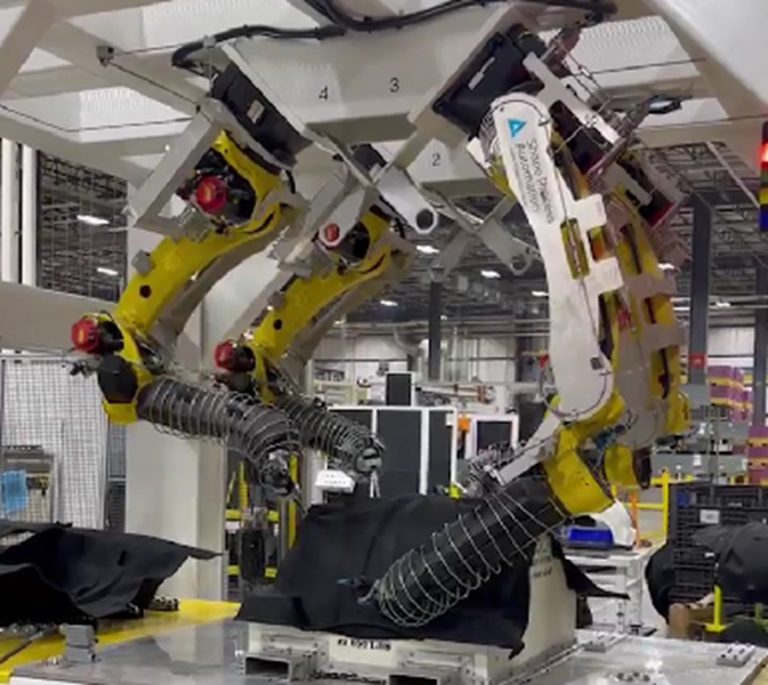
Unlike AI-focused companies competing to build ever more powerful large language models, Honeywell’s strategy revolves around what industry executives increasingly call “physical AI” — the application of artificial intelligence to machinery, industrial processes, and operational systems.
Honeywell’s automation platforms already collect enormous amounts of data from industrial equipment, sensors, and control systems. AI allows that information to be transformed into actionable intelligence that can improve efficiency, optimize operations, and automate complex decisions.
According to Kapur, this existing infrastructure gives Honeywell a competitive advantage.
“Physical AI for us is built on our domain knowledge,” he said. “It’s built upon the data which we possess in our system.”
That distinction is becoming increasingly important as investors look beyond generative AI applications and focus on how businesses can generate measurable returns from their AI investments.
While many enterprises are still experimenting with generative AI tools, industrial companies are increasingly exploring how AI can improve equipment reliability, energy efficiency, predictive maintenance, supply chain management, and operational performance.
For Honeywell, this creates an opportunity to monetize decades of expertise in industrial processes while layering AI capabilities onto existing customer relationships.
Labor Shortages Become a Major Tailwind
A key driver behind Honeywell’s optimism is a growing shortage of skilled labor across industrial sectors. Kapur said many of Honeywell’s customers are struggling to recruit and retain operators, technicians, and other specialized workers needed to run complex facilities.
The challenge is particularly acute in industries such as manufacturing, energy, transportation, and healthcare, where experienced workers are retiring faster than new workers are entering the labor force.
“Net workforce is not going to be increasing. It’s going to be decreasing over a period of time,” Kapur said.
Demographic trends support that assessment. Aging populations across North America, Europe, and parts of Asia are expected to place increasing pressure on labor markets over the coming decades. As a result, companies are investing heavily in automation technologies that can maintain productivity with fewer workers.
This trend is emerging as one of the strongest structural growth drivers for industrial automation providers, with businesses increasingly viewing AI-enabled systems as essential rather than optional.
One notable aspect of Kapur’s remarks is that customers are no longer viewing automation primarily as a cost-cutting exercise. Traditional automation investments were often justified through labor savings and efficiency gains. The emerging AI wave appears to be changing that equation.
“Our customers are looking at it not as a productivity opportunity,” Kapur said. “They are looking at it as a revenue-generation opportunity.”
In sectors such as semiconductor manufacturing, energy production, and logistics, even small improvements in operational performance can generate substantial financial returns.
However, much of the market’s focus has centered on AI model developers, chipmakers, and cloud computing providers. Honeywell is arguing that another major opportunity lies in applying AI to physical assets and industrial operations.
That thesis could become attractive as investors seek businesses capable of generating tangible returns from AI adoption rather than relying solely on future technological breakthroughs.
With its aerospace separation approaching, Honeywell is effectively making a strategic wager that the next phase of the AI revolution will occur not only inside data centers but also across factories, airports, hospitals, power plants, and industrial facilities worldwide.