

Identity fraud has become one of the most significant financial threats facing banks and lending institutions today. Criminals use forged passports, manipulated driver’s licenses, and stolen identity credentials to open fraudulent accounts, secure unauthorized loans, and bypass anti-money laundering controls. The financial sector loses billions of dollars annually to these schemes, and regulators are responding with increasingly strict Know Your Customer and Anti-Money Laundering requirements.
Manual document review, once a standard part of onboarding, can no longer keep pace with the speed and sophistication of modern fraud attacks. That’s why financial institutions are turning to document verification software as a core component of their identity verification infrastructure. These systems apply machine learning and computer vision to analyze identity documents at a level of precision that human reviewers cannot reliably achieve at scale.
What Is Document Verification Software?
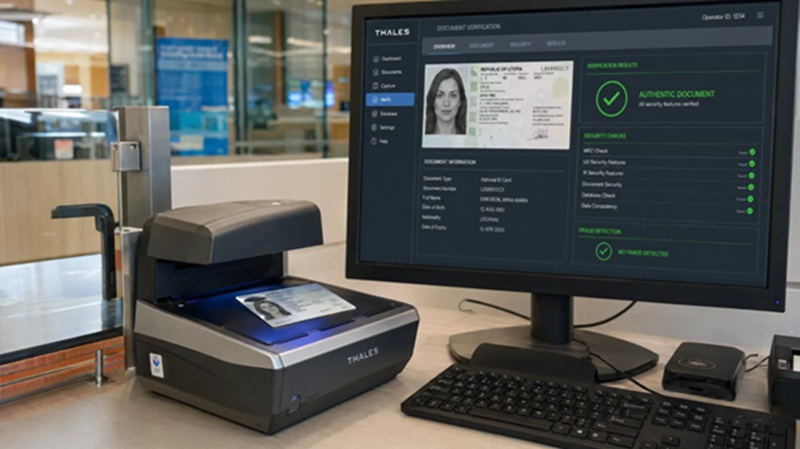
Document verification software is a category of technology that uses optical character recognition (OCR), computer vision, and AI-based classification to extract data from identity documents and assess their authenticity. In other words, it automates the process of reading a document, confirming that its structure and content match expected patterns, and flagging anomalies that may indicate forgery or tampering.
A complete verification pipeline typically covers several functions working in sequence:
- Document classification: identifying the document type and issuing country, for example distinguishing a German passport from a UK driver’s license.
- Data extraction: reading fields such as name, date of birth, document number, and expiry date using OCR and structured parsing.
- Machine Readable Zone (MRZ) validation: checking that the encoded data in the bottom strip of passports and ID cards matches the visible fields and conforms to international standards.
- Authenticity checks: analyzing fonts, microprint, security holograms, and document geometry to detect signs of physical or digital manipulation.
- Liveness and biometric matching: in more advanced deployments, cross-referencing the document photo with a real-time selfie to confirm the person presenting the document is its legitimate holder.
What is also important here is that modern solutions handle documents from dozens of countries out of the box, which is essential for banks serving international customers or operating across multiple jurisdictions.
Where Document Verification Makes the Greatest Difference in Banking
Financial institutions encounter identity fraud risk at several distinct points in the customer lifecycle. The following scenarios represent the highest-value applications of automated verification.
Customer Onboarding and KYC Compliance
Opening a new account requires confirming the applicant’s identity against a government-issued document. Given this requirement, any gap in the verification process creates an entry point for fraud. Automated document verification enables banks to complete this check in seconds, with consistent accuracy across every application. This positively affects both the customer experience and the institution’s compliance posture.
Loan and Credit Application Processing
Fraudsters frequently submit applications using stolen or fabricated identity documents to obtain credit they have no intention of repaying. Document verification software can detect inconsistencies in document formatting, check that data fields are internally consistent, and flag documents that do not match the expected template for the claimed country and document type. Thanks to this layer of screening, banks can reject fraudulent applications before they reach a human reviewer.
Branch and Remote Identity Verification
Banks need to verify identity both in person at branches and through remote digital channels such as mobile apps and web portals. A well-designed solution should support both scenarios from a single platform, allowing consistent standards to be applied regardless of the channel. Here is when unified document verification infrastructure becomes particularly valuable, as it eliminates inconsistencies between in-branch and digital onboarding processes.
Transaction Monitoring and Re-Verification
High-value transactions, changes to account credentials, and unusual activity patterns may trigger re-verification requirements. Document verification software can support these workflows by enabling rapid identity re-checks without requiring the customer to visit a branch, which reduces friction while maintaining security.

What Reliable Document Verification Software Should Have
Not all solutions deliver the same capabilities or reliability in a banking environment. When evaluating options, financial institutions should look for the following characteristics.
- High accuracy across document types and conditions. The system should perform well on documents that are worn, photographed under poor lighting, or partially obscured. You should attentively analyze published accuracy benchmarks and request testing on your actual document mix.
- Support for a broad document library. The most highly demanded options are those that cover passports, national ID cards, driver’s licenses, and residence permits from at least 150 countries, with regular updates as new document versions are issued.
- MRZ and chip data validation. For passports and newer ID cards, the solution needs to read and validate the MRZ and, where applicable, the embedded NFC chip data.
- Fraud detection capabilities. Look for software that checks security features specific to each document type, including UV-visible elements, font consistency, and edge geometry, rather than relying solely on OCR data matching.
- Audit trail and reporting. Banking regulators require evidence that verification checks were performed. The solution should generate structured logs for every verification event, including the document type, extracted fields, check results, and timestamp.
- Integration flexibility. Typical integrations include core banking systems, CRM platforms, KYC orchestration layers, and risk scoring engines. The solution should offer REST APIs and SDKs compatible with the bank’s technology stack.
How to Implement Document Verification in a Banking Context
Deploying document verification software effectively requires more than selecting a capable product. The following steps will help financial institutions achieve a successful implementation.
- Define the verification scope before evaluating vendors. Determine which customer touchpoints require document verification, what document types are most common in your customer base, and what regulatory standards apply. This scoping exercise will clarify which product features are essential and which are optional.
- Run a proof of concept with your own data. We recommend testing candidate solutions against a sample of real documents representative of your customer population, including edge cases such as older documents, non-Latin character sets, and documents with visible wear. Vendor-provided benchmarks may not reflect your specific conditions.
- Assess deployment model requirements. If your compliance framework requires that identity data not leave your infrastructure, you will need a solution that supports on-premise or private cloud deployment. Pay attention to licensing models that require ongoing internet connectivity, as these may not be compatible with strict data localization requirements.
- Plan the integration architecture. Map the data flows between the document verification system and downstream platforms. It will be helpful to involve your compliance, IT security, and operations teams at this stage to identify any data handling requirements that need to be addressed in the integration design.
- Establish exception handling and human review workflows. Automated verification will not achieve 100% certainty on every document. Define clear thresholds for when a case should be escalated to a human reviewer and ensure those reviewers have access to the full verification output, including flagged anomalies and confidence scores.
Compliance and Risk Considerations
Deploying document verification software in a regulated banking environment requires attention to several compliance dimensions. Apart from the accuracy and fraud detection capabilities of the software itself, institutions need to address the following areas.
- Data protection compliance. Identity document data is classified as sensitive personal data under GDPR and equivalent regulations. Data minimization principles should be applied, and retention periods for document images and extracted fields should be defined and enforced.
- Regulatory audit readiness. Verification logs should be structured to support regulatory examination. This includes recording the basis for acceptance or rejection decisions, not just the final outcome.
- Model governance. AI-based verification systems should be subject to the same model risk management practices as other AI tools used in credit and compliance decisions, including periodic performance reviews and bias assessments.
From a financial perspective, the cost of implementing document verification software should be weighed against the cost of fraud losses, regulatory fines for KYC failures, and the operational expense of manual review. The majority of financial institutions that have conducted this analysis find that automated verification delivers a measurable return within the first year of deployment.
Conclusion
Document verification software addresses one of the most persistent vulnerabilities in banking security: the gap between the volume and sophistication of identity fraud and the capacity of manual review processes to detect it. By automating the analysis of identity documents at the point of onboarding and throughout the customer lifecycle, banks can significantly reduce their exposure to fraud while improving compliance outcomes and customer experience.
Successful deployment requires selecting a solution with strong accuracy, broad document coverage, and meaningful fraud detection capabilities, then integrating it thoughtfully into existing compliance and operational workflows. With the right implementation, document verification becomes a reliable, scalable defense against identity fraud rather than a procedural checkbox.