

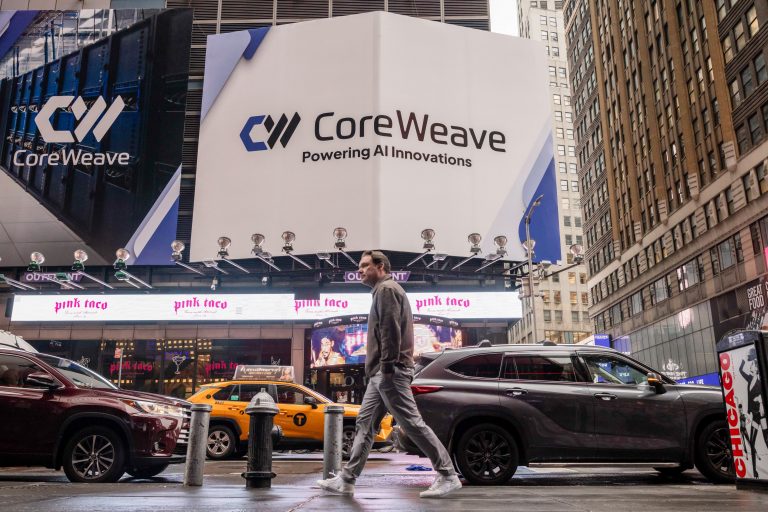
The foundation of Jensen Huang and his wife, Lori Huang, is purchasing artificial intelligence computing capacity from CoreWeave and donating it to universities and nonprofit research institutions.
The move is expected to simultaneously expand access to high-end AI infrastructure and deepen Nvidia’s already extensive ties to one of the fastest-growing cloud-computing companies in the industry.
According to a regulatory filing released Tuesday, the donated computing resources have already been valued at approximately $108.3 million. The filing said the resources will support scientific and artificial intelligence research, while Nvidia plans to provide free engineering services to some of the grant recipients.
Register for the next Tekedia Mini-MBA.
Register for Tekedia AI in Business Masterclass.
Join Tekedia Capital Syndicate and co-invest in great global startups.
The initiative highlights how rapidly the economics of research are changing in the AI era, where access to computing power is becoming as strategically important as funding, laboratory equipment, or academic talent. As AI systems grow more sophisticated and computationally demanding, universities and nonprofit laboratories are increasingly struggling to compete with large technology companies that spend billions of dollars building vast GPU clusters and AI data centers.
Training advanced AI models now requires enormous processing power, advanced networking infrastructure, and huge electricity consumption. For many research institutions, the costs have become prohibitive.
The Huang Foundation’s initiative, therefore, represents more than a philanthropic gesture. It is largely seen as a transformation in which access to AI infrastructure itself is emerging as one of the most valuable resources in science and technology.

CoreWeave, a company that has become one of the defining infrastructure players of the generative AI boom, is at the center of the initiative. Originally founded as a cryptocurrency-mining operation, CoreWeave pivoted aggressively into artificial intelligence cloud services as demand for Nvidia’s graphics processing units exploded following the emergence of generative AI platforms such as OpenAI’s ChatGPT.
Today, CoreWeave rents high-performance GPU computing capacity to startups, enterprises, and research groups seeking access to advanced AI infrastructure without building massive data centers themselves. The company specializes in cloud services optimized around Nvidia chips, making the relationship between the two firms unusually close even by Silicon Valley standards.
That relationship has deepened rapidly over the past two years as Nvidia expanded beyond semiconductor design into a broader strategy of shaping the AI ecosystem itself. In January, Nvidia invested $2 billion in CoreWeave, becoming at the time the company’s second-largest shareholder. The investment reinforced Nvidia’s growing role not only as a supplier of AI chips, but also as a backer of AI cloud providers, model developers, and computing platforms.

The ties between the companies extend far beyond equity ownership. Last year, Nvidia signed a $6.3 billion agreement for cloud computing capacity with CoreWeave. The arrangement included a provision guaranteeing Nvidia would purchase any unused cloud capacity not sold to external customers.
That structure effectively reduced commercial risk for CoreWeave while ensuring Nvidia retained access to large-scale computing infrastructure at a time when AI demand was overwhelming supply across the technology industry.
The Huang Foundation’s latest initiative now adds another layer to that interconnected relationship. While the donation supports scientific and nonprofit research, it also channels substantial business toward CoreWeave, further reinforcing the company’s position within the Nvidia-centered AI infrastructure ecosystem.
The arrangement is likely to intensify scrutiny already building around Nvidia’s expanding financial relationships across the AI industry.
Nvidia’s Expanding AI Ecosystem
Nvidia’s rise during the AI boom has transformed the company from a dominant semiconductor designer into arguably the most influential infrastructure player in global technology. Its GPUs power much of the world’s advanced AI development, from large language models and cloud computing systems to autonomous driving platforms and scientific simulations.
But Nvidia has increasingly gone beyond simply selling chips. The company has invested heavily in AI startups, cloud providers, and model developers, creating a broad commercial ecosystem tightly connected to Nvidia hardware and software. That strategy has helped cement Nvidia’s dominance as AI adoption accelerates worldwide. Yet it has also raised growing concerns among investors and analysts about potential circular financing dynamics within the industry.
Some critics argue Nvidia’s investments in AI firms that simultaneously purchase Nvidia hardware or rely on Nvidia-backed infrastructure may blur the distinction between organic market demand and ecosystem-supported growth.
The issue has become more sensitive because many AI infrastructure companies are spending extraordinary amounts of money to expand capacity, often before achieving stable profitability.
CoreWeave has become one of the clearest examples of the enormous capital intensity shaping the AI economy. The company recently raised the lower end of its capital spending forecast after reporting earnings, citing rising costs for critical infrastructure components.
Those expenditures paint the staggering financial demands involved in building AI cloud infrastructure. Modern AI data centers require vast quantities of GPUs, high-speed networking systems, advanced cooling equipment, and huge electricity supplies. The cost of building and operating those systems has surged as global demand for AI computing continues to accelerate.
For many AI infrastructure companies, securing access to Nvidia’s chips remains the single most important competitive advantage.
Computing Power Becomes a Strategic Asset
The Huang Foundation’s donation also underscores how computing capacity itself is evolving into a strategic resource. Historically, large philanthropic contributions to universities focused on scholarships, laboratories, medical research, or academic buildings. In the AI era, however, access to advanced computing infrastructure may be equally valuable.
Researchers increasingly warn that AI innovation risks becoming concentrated among a small number of corporations capable of financing hyperscale computing systems. This is because academic institutions often lack the financial resources necessary to compete directly with major technology firms in acquiring cutting-edge GPUs and operating large AI clusters. That imbalance has created concerns that independent research could weaken as AI development becomes dominated by private-sector companies controlling the most advanced infrastructure.
By donating cloud-computing resources rather than simply cash, the Huang Foundation is addressing one of the most immediate barriers facing universities and nonprofit research institutions.
Nvidia’s offer to provide engineering services to some recipients further strengthens the initiative because many research groups also lack the specialized expertise needed to optimize large-scale AI systems effectively.