

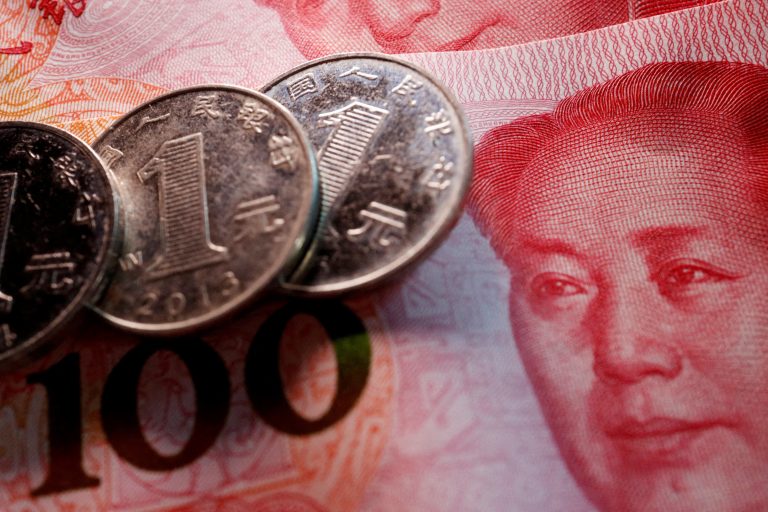
China’s yuan climbed to its strongest level against the dollar in more than three years on Thursday as investors interpreted the summit between Xi Jinping and Donald Trump as a sign that both powers are seeking to prevent another major escalation in economic tensions.
Yet while the currency rallied sharply, Chinese equities moved in the opposite direction, with investors locking in profits after recent gains pushed major benchmarks to multi-year highs.
The divergence between foreign exchange and equity markets points to a broader shift in investor psychology toward China. Currency traders are increasingly focusing on China’s strong export position and improving external balances, while stock investors are becoming more selective after a powerful rally driven largely by artificial intelligence and technology optimism.
Register for the next Tekedia Mini-MBA.
Register for Tekedia AI in Business Masterclass.
Join Tekedia Capital Syndicate and co-invest in great global startups.
Chinese state broadcaster CCTV reported that Xi described relations with the United States as entering a “new positioning” following talks with Trump in Beijing. According to the report, both leaders agreed that building a constructive and strategically stable relationship would guide bilateral ties over the next several years.
Details of the discussions remained limited, but markets had entered the summit with extremely modest expectations. Investors were primarily hoping for reassurance that the fragile tariff truce between the world’s two largest economies would remain intact and that no unexpected confrontation would emerge from the meeting.
That low-expectation environment may itself have helped calm markets.

Larry Hu said Beijing’s objective appeared less focused on concrete agreements and more on projecting stability at a time when China’s economy is showing signs of resilience.
“Beijing is adopting a wait-and-see mode, given the ‘better than expected’ first-quarter growth,” Hu said, adding that China’s priority was to signal “stability and predictability to both international and domestic audiences.”
The yuan strengthened in both onshore and offshore markets after the People’s Bank of China set its daily midpoint fixing at 6.8401 per dollar, the strongest official guidance level since March 2023. The onshore yuan traded around 6.7877 per dollar, while the offshore yuan hovered near 6.7871, both reaching levels not seen in more than three years.

However, the central bank’s fixing mechanism also revealed Beijing’s caution. The official midpoint was significantly weaker than market estimates, marking the largest deviation since early March. Analysts interpreted the move as another indication that Chinese authorities are trying to prevent excessively rapid appreciation of the currency, which could eventually hurt exporters and tighten domestic financial conditions.
Since late last year, the PBOC has repeatedly leaned against strong yuan rallies by setting fixings weaker than market expectations. The strategy marks a delicate balancing act. Beijing wants currency stability and confidence in China’s economy, but it also wants to avoid destabilizing export competitiveness at a time when global demand remains uncertain.
The yuan’s rise this year has been underpinned largely by China’s powerful export machine and widening trade surplus. The currency has appreciated roughly 3% against the dollar in 2026 and gained more than 2% against a basket of major trading partners.
China’s exports have remained surprisingly resilient even amid trade tensions and Western efforts to reduce dependence on Chinese supply chains. Strong overseas demand for electric vehicles, solar products, batteries, and increasingly AI-related hardware has helped support external balances.
Equity markets, however, paused after an extended rally. The benchmark Shanghai Composite Index fell 1.52%, its sharpest one-day decline in nearly two months, after touching an 11-year high a day earlier. The blue-chip CSI300 index dropped 1.68%.
Where It is Headed
Investors largely viewed the decline as technical profit-taking rather than a negative reaction to the Trump-Xi summit itself. Market participants said investor attention is increasingly shifting away from headline trade tensions and toward China’s rapid advances in artificial intelligence and semiconductor development.
Richard Pan said markets are becoming “less and less sensitive” to developments in U.S.-China trade relations.
“The development of the trade war shows that China and the U.S. cannot afford to enter a real big conflict,” Pan said.
His comments reflect a growing market belief that both Washington and Beijing now recognize the economic costs of sustained confrontation, especially as slowing global growth and financial market volatility increase pressure for stability.
Pan also argued that China’s economic resilience has insulated domestic markets from geopolitical shocks more effectively than in previous years. Rather than focusing exclusively on tariffs, investors are increasingly concentrating on the global AI race and China’s efforts to build technological self-sufficiency.
“The competition between China and the U.S. in AI big models will stimulate each other and eventually improve AI capabilities for both,” he said.
That means technology competition remains central to the broader relationship. Reuters reported that Washington has approved around 10 Chinese companies to purchase Nvidia’s H200 AI chips, although deliveries have not yet begun. The development has placed attention on whether the U.S. may selectively ease certain technology restrictions while still maintaining broader strategic controls.
The H200 chip is among Nvidia’s most advanced AI processors and remains highly sought after by Chinese cloud-computing firms and hyperscalers trying to scale large language models and AI inference infrastructure.
The uncertainty around those shipments highlights the contradictory nature of the current U.S.-China relationship. Strategic rivalry continues to intensify, particularly around semiconductors and AI, yet both economies remain deeply interconnected in trade, manufacturing, and capital flows.
Ritesh Ganeriwal said market expectations for the summit were intentionally conservative.
“Investors aren’t positioned for a positive surprise,” Ganeriwal said, adding that even modest progress could improve sentiment.
He noted that the next major deadline in the trade relationship is expected in November, when temporary pauses on tariffs and rare earth restrictions are due to expire.
Analysts say both governments are now increasingly moving toward a “managed competition” framework rather than outright economic decoupling. Under that model, trade in strategically sensitive sectors such as advanced semiconductors and defense technology remains restricted, while lower-risk commercial exchanges continue.
Sources told Reuters that negotiators may discuss reducing tariffs on roughly $30 billion worth of non-sensitive goods without crossing national security red lines. If achieved, such an arrangement could provide markets with a temporary stability window and reduce fears of another destabilizing trade confrontation ahead of the U.S. election cycle and China’s next major economic planning phase.
The market response suggests investors see the Trump-Xi summit less as a breakthrough moment and more as confirmation that both sides are attempting to contain rivalry rather than escalate it uncontrollably. That alone, after years of tariff wars, export controls, and technology sanctions, may be enough to support Chinese assets in the near term.