

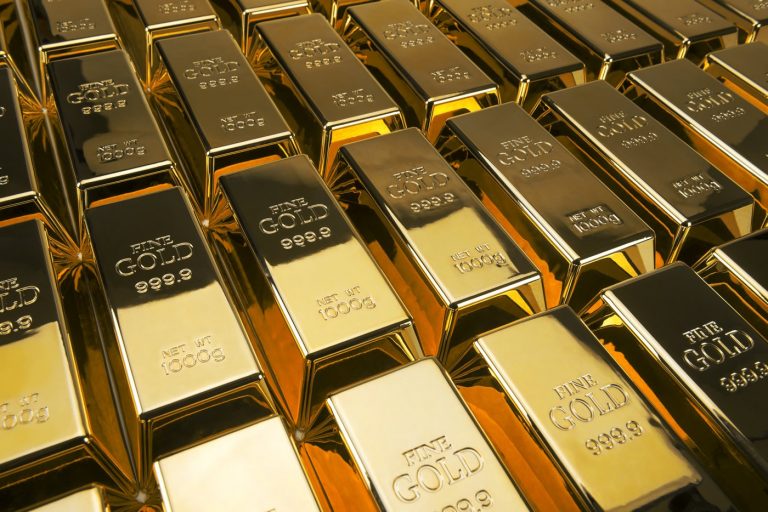
Gold is having the kind of year that has left even the most seasoned traders blinking at their screens. The metal has surged 58.6% so far, tearing through record after record and finally punching above the once-unthinkable $4,000 threshold on Oct. 8.
That milestone now looks almost small in the rearview mirror, because a new Goldman Sachs survey, published by CNBC, shows many investors think the rally’s not only alive but barreling toward another all-time high: $5,000 by the end of 2026.
The latest sentiment check from Goldman Sachs’ Marquee platform, which polled more than 900 institutional investors between Nov. 12 and 14, captures the mood. The largest bloc, 36%, predicted that gold will extend its climb and top $5,000 per troy ounce by the close of next year. Another 33% think it will trade between $4,500 and $5,000. In total, more than 70% of institutional investors expect gold to keep rising through 2025, showing how broad the bullishness has become. Only a little over 5% see any room for a pullback toward the $3,500 to $4,000 range.
Register for Tekedia Mini-MBA edition 20 (June 8 – Sept 5, 2026).
Register for Tekedia AI in Business Masterclass.
Join Tekedia Capital Syndicate and co-invest in great global startups.
Register for Tekedia AI Lab.
This bullish wave was already visible in live market action. Spot gold rose to a two-week high on Friday, gaining 0.45% to settle at $4,175.50. Futures rose 0.53% to $4,187.40. Traders tied the move to growing expectations that the Federal Reserve may lean toward rate cuts, a shift that tends to weaken the dollar and enhance gold’s appeal.
Why the Market Is So Buoyant
The survey shows consensus around the main forces powering gold’s surge. A hefty 38% of respondents pointed to central bank accumulation as the biggest driver, while 27% cited rising fiscal concerns. And it’s hard to ignore how synchronized this buying has been. Global central banks have snapped up gold this year at a pace that underscores its role as a reserve asset with unique qualities: deep liquidity, no default risk, and a politically neutral profile that neither aligns nor antagonizes major blocs.
This central bank appetite sits alongside a broad wave of private-sector demand that stretches from retail investors trying to shelter savings from inflation to hedge funds positioning for geopolitical uncertainty and a weakening dollar. Gold’s traditional status as a crisis hedge has been pulled into service again, and the backdrop of overlapping global tensions has made the metal feel almost like a compulsory holding.

Phil Streible, chief market strategist at Blue Line Futures, said on CNBC’s “Power Lunch” on Nov. 20 that the trend still has room to run. He pointed out that many countries are wrestling with slowing growth while inflation remains stubborn. In his words, “The global economic outlook continues to support gold.”
The Rush Into Mining Stocks
Investors who don’t want to buy the metal directly are looking at miners as a leveraged bet on the rally. Blue Whale Capital’s Stephen Yiu told CNBC’s “Europe Early Edition” earlier this month that he is backing Newmont, the world’s largest gold miner, as part of his strategy.
Even in corners of the market where skepticism normally dominates, the mood is shifting. Muddy Waters founder Carson Block, known for his short-selling campaigns, surprised the Sohn London investment conference crowd with a rare long call — a public endorsement of Canadian junior miner Snowline Gold. Block argued that Snowline was emerging as an attractive takeover target at a time when consolidation in the sector was picking up.

What a $5,000 Outlook Really Says
A price target like $5,000 is bold, but the conviction behind it has grown out of a multi-layered global environment: jittery fiscal positions in major economies, expectations of easier monetary policy, cross-border tensions that have reshaped commodity flows, and a renewed appetite from central banks that are treating gold as insurance rather than an optional reserve.
The metal’s rise has drawn in a wider mix of investors than at any point since the early 2010s. Hedge funds are positioning around macro risk. Middle-class savers are buying small quantities as a store of value. Governments are adding to vaults as they balance currency exposure. And miners are back in the headlines.
The rally is not just about price action. It is becoming a story about confidence, caution, and the shifting architecture of the global economy. And judging by the survey numbers, investors believe the story will continue into 2026, possibly all the way up to that $5,000 mark now hanging in the distance like an inevitability rather than a long shot.