

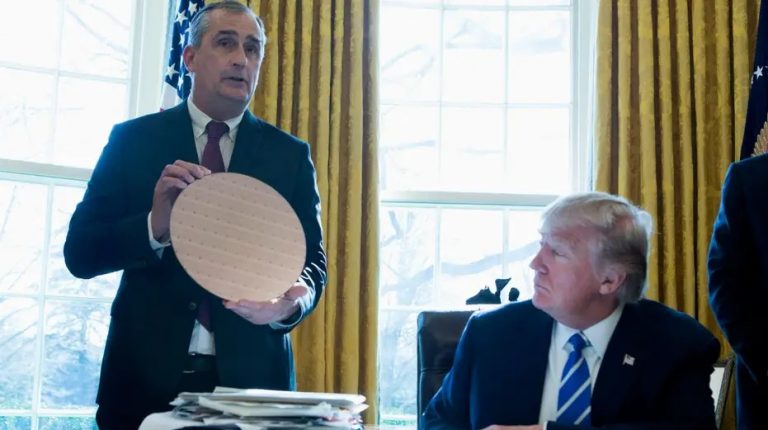
President Donald Trump’s dealings with semiconductor giants Intel and Nvidia amount to a “scattershot method of crony capitalism,” Walter Isaacson said on Thursday.
“That state capitalism often evolves into crony capitalism, where you have favored companies and industries that pay tribute to the leader, and that is a recipe for not only disaster, but just sort of a corrupt sense of messiness,” Isaacson told CNBC’s Squawk Box.
The Tulane University professor, best known for his biographies of influential figures including Steve Jobs, Leonardo da Vinci, and, more recently, Elon Musk, argued that Trump’s approach will fail to revive American manufacturing in any sustainable way.
Register for Tekedia Mini-MBA edition 20 (June 8 – Sept 5, 2026).
Register for Tekedia AI in Business Masterclass.
Join Tekedia Capital Syndicate and co-invest in great global startups.
Register for Tekedia AI Lab.
Isaacson’s criticism comes as the Trump administration takes deeper steps to influence corporate decision-making in critical industries. In recent weeks, the White House has intensified its intervention in the semiconductor sector, a battleground not only for economic competitiveness but also for national security.
The Trump team is pushing for the U.S. government to take a direct stake in Intel, the long-struggling chipmaker whose technology has lagged behind rivals. The push follows Trump’s public criticism of Intel’s CEO Lip-Bu Tan, whom he described as “highly CONFLICTED” while calling for his resignation. The unusual intervention highlights the administration’s willingness to pressure companies in ways that blur the line between free-market operations and government directives.
At the same time, Trump has leveraged the U.S.–China technology rivalry to impose new financial obligations on chip firms. Earlier this month, both Nvidia and Advanced Micro Devices (AMD) agreed to pay 15% of their China revenues to the U.S. government as part of securing export licenses for certain high-end chips destined for the Chinese market. The agreement represents one of the boldest attempts by Washington to extract revenue from private companies in exchange for access to foreign sales, underscoring the administration’s aggressive use of trade and security policies as economic tools.

Isaacson, however, suggested that such interventions are less about long-term industrial policy and more about short-term favoritism. He said he has always been dubious of public-private partnerships, noting that Trump’s moves fit into a pattern of personalistic policymaking.
As an example, he pointed to Trump’s earlier push for Coca-Cola to shift its soda formula back to using cane sugar instead of high-fructose corn syrup — a directive that, like the Intel and Nvidia moves, raised eyebrows for its suddenness and lack of clear economic rationale.
Critics argue that Trump’s approach, while aiming to bolster domestic industries, risks distorting markets and creating a business environment where corporate success depends less on competitiveness and innovation than on staying in the administration’s good graces. The semiconductor industry, already under strain from global supply chain disruptions and fierce competition with Asian manufacturers, could face additional uncertainty if government favoritism overshadows long-term strategic planning.

Still, Trump’s defenders say the president is pushing companies to align more closely with America’s national interests, particularly in sectors as vital as semiconductors. They argue that traditional free-market strategies have failed to keep U.S. chipmaking at the forefront, making more assertive measures necessary.
Isaacson, however, left little doubt about where he stands. His stance suggests that what is happening is not a coherent industrial strategy, but a corrupt sense of messiness that’s unlikely to deliver the manufacturing revival Americans have been promised.