

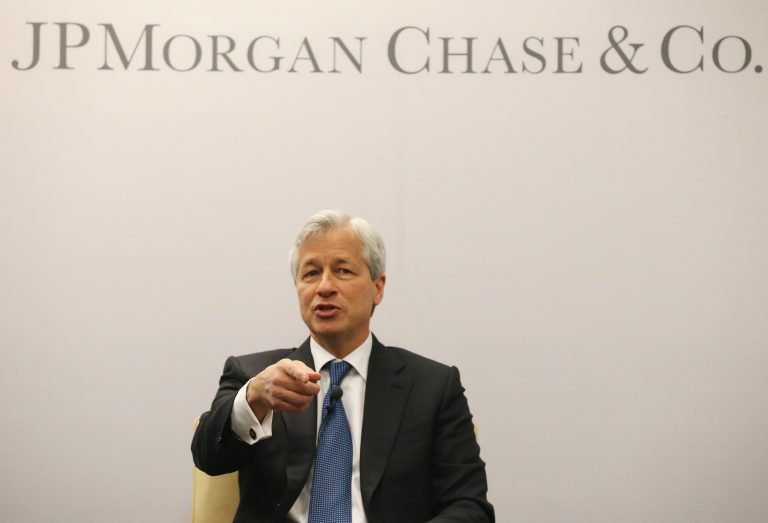
Jamie Dimon has issued one of the clearest warnings yet from a top Wall Street executive about the social risks of artificial intelligence, arguing that the technology could move faster than societies can absorb, with destabilizing consequences unless governments and companies act together to protect displaced workers.
His warning in Davos landed at a moment when enthusiasm about artificial intelligence is colliding with anxiety about its social consequences, and his remarks captured the unease felt well beyond Wall Street boardrooms.
The JPMorgan Chase chief executive framed AI as both inevitable and transformative, but also as a force that could strain the social fabric if its rollout is driven purely by efficiency and competitive pressure. In Dimon’s telling, the danger is not the technology itself, but the speed at which it is being deployed relative to society’s capacity to absorb disruption.
Register for Tekedia Mini-MBA edition 20 (June 8 – Sept 5, 2026).
Register for Tekedia AI in Business Masterclass.
Join Tekedia Capital Syndicate and co-invest in great global startups.
Register for Tekedia AI Lab.
“Your competitors are going to use it and countries are going to use it,” he said. “However, it may go too fast for society and if it goes too fast for society that’s where governments and businesses [need to] in a collaborative way step in together and come up with a way to retrain people and move it over time.”
AI, he said, promises sweeping gains: faster economic growth, dramatic productivity improvements, and breakthroughs in medicine that could change how diseases are diagnosed and treated. Yet those gains come with a cost that markets alone cannot manage. If millions of workers are displaced faster than they can be retrained or absorbed into new roles, the political and social consequences could be severe.
Dimon made clear that large employers like JPMorgan are already planning for a future with fewer staff as AI automates tasks across finance, operations, and customer service. That acknowledgement matters because it strips away the idea that job losses are speculative or confined to low-skilled work. In banking, law, consulting, and technology, AI systems are increasingly capable of performing tasks once handled by well-paid professionals.

His call for governments and businesses to act “in a collaborative way” reflects a view that the private sector cannot simply adopt AI and leave the fallout to public authorities. Wage support, retraining programmes, relocation assistance, and early retirement options, he argued, may all be needed to smooth the transition.
These are not abstract policy ideas but tools that were widely used in past industrial shifts, from the decline of heavy manufacturing to the restructuring of coal and steel industries.
The example of US truck drivers was particularly telling. Long-haul trucking has been a source of stable, high-paying work for decades, often supporting entire communities. Autonomous driving technology threatens to upend that model. Dimon’s warning was blunt: a sudden collapse in incomes on that scale would not just hurt individuals, it would destabilize communities and fuel unrest. Phasing in automation, even if it slows short-term efficiency gains, could be the difference between orderly adjustment and social backlash.

“Should you do it all at once, if 2 million people go from driving a truck and making $150,000 a year to a next job [that] might be $25,000? No. You will have civil unrest. So phase it in,” Dimon said.
“If we have to do that to save society … Society will have more production, we are going to cure a lot of cancers, you’re not going to slow it down. How do you have plans in place if it does something terrible?”
Underlying Dimon’s remarks is a broader concern about political legitimacy. If large sections of the population feel that technological progress benefits only companies and investors, public trust in institutions could erode further. His reference to “saving society” was not a rhetorical flourish but a recognition that economic dislocation has historically fed populism, anger, and political volatility.
That concern spilled into his comments on geopolitics and immigration. On Europe, Dimon struck a careful balance, acknowledging Washington’s desire to push allies to take more responsibility for their own security while warning against approaches that risk fragmentation. His emphasis on persuasion rather than coercion echoed his broader theme: pressure without consent can provoke resistance rather than reform.
On immigration, Dimon’s remarks revealed discomfort with the tone and optics of enforcement under President Donald Trump. While supporting the removal of criminals, he called for transparency and restraint, stressing the economic reality that migrants underpin key sectors of the US economy. Healthcare systems, farms, and hospitality businesses, he said, rely heavily on migrant labor, and treating those workers as disposable undermines both economic performance and social cohesion.
“I don’t like what I’m seeing with five grown men beating up little women,” Dimon said, referring to scenes of violence involving Immigration and Customs Enforcement (ICE) officers.
Rounding up criminals was one thing, Dimon added, but he would like to see data showing who had been rounded up and whether they had broken the law.
Set against Dimon’s caution was a more optimistic narrative from Nvidia chief executive Jensen Huang, who argued that fears of mass unemployment risk missing the bigger picture. From his perspective, AI is triggering an unprecedented wave of investment in physical infrastructure: power generation, semiconductor fabrication, data centers, and networks. Each of these requires large numbers of skilled workers, many in trades that have struggled to attract talent in recent years.
“This is the largest infrastructure buildout in human history, this is going to create a lot of jobs,” he said.
Huang’s emphasis on plumbers, electricians, construction workers, and technicians reframed the AI boom as an industrial story rather than a purely digital one. In regions hosting new chip plants or data centers, demand for these skills is already driving wages higher, suggesting that AI could tighten labor markets rather than hollow them out, at least in certain sectors.
His argument also carried a geopolitical edge. By highlighting robotics as a “once-in-a-generation” opportunity for Europe, Huang pointed to a path that plays to the region’s strengths in advanced manufacturing. Rather than chasing US-style software dominance, Europe could integrate AI into factories, logistics, and industrial processes, potentially reshaping global supply chains.
“This is your opportunity to now leap past the era of software,” he argued, an area where Silicon Valley has long outperformed Europe.
Taken together, the Davos exchanges underscored a central tension in the AI debate. On one side is the race to deploy powerful technologies in order to stay competitive, boost growth, and secure geopolitical advantage. On the other is the risk that societies move too slowly to adapt, leaving workers and communities exposed.
Dimon’s message was not to slow innovation, but to plan for its consequences with the same seriousness that companies apply to capital investment or risk management. Huang’s optimism, meanwhile, suggested that AI could generate new forms of work on a scale that offsets displacement, provided governments and businesses invest in skills and infrastructure.
The gap between those two visions may ultimately determine whether AI deepens existing inequalities or becomes a broadly shared engine of prosperity. What Davos made clear is that the debate has moved beyond technology and into the realm of social contracts, labor markets, and political stability.