

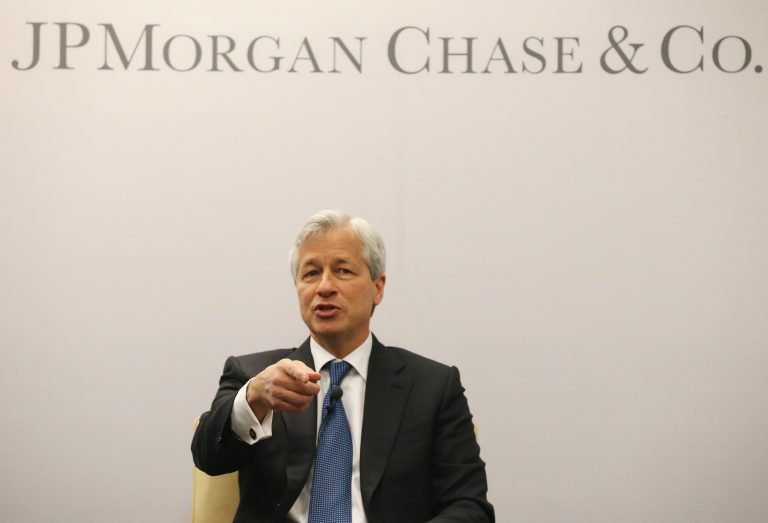
JPMorgan Chase CEO Jamie Dimon has issued a stark warning about the future of the U.S. dollar, arguing that its position as the world’s dominant reserve currency cannot be separated from America’s broader economic and military strength.
According to Dimon, if the United States loses its economic and military edge, the dollar could eventually lose its privileged position in the global financial system.
The warning is significant because the dollar’s reserve status provides the United States with enormous economic and geopolitical advantages.
Central banks around the world hold dollars as foreign-exchange reserves, while international trade, commodities and financial markets continue to rely heavily on dollar-denominated transactions. The dollar currently represents roughly 57% of global foreign-exchange reserves, although that share has declined from about 70% in 2000.
Register for the next Tekedia Mini-MBA.
Register for Tekedia AI in Business Masterclass.
Join Tekedia Capital Syndicate and co-invest in great global startups.
Dimon’s argument goes beyond currency markets. He views monetary dominance as a consequence of national power. A country with a large, productive economy, deep financial markets, strong institutions and credible military capabilities is more likely to have its currency trusted internationally.
In this framework, preserving the dollar’s position requires the United States to remain economically competitive while maintaining the capacity to protect its interests and allies. That creates a major challenge for Washington.
America faces rising competition from China, increasing geopolitical fragmentation, high government debt and concerns about its industrial capacity.
Dimon has repeatedly argued that the United States needs stronger economic growth and greater investment in strategic industries. In a May policy essay, he said better policies could have lifted U.S. growth significantly while strengthening national security and reducing fiscal pressures.

The connection between industrial capacity and national security has become particularly important. Dimon has warned about U.S. dependence on foreign sources for critical materials and manufacturing, including rare-earth elements, aluminum and steel.
He has also argued that America needs greater investment in defense, infrastructure, artificial intelligence, quantum computing and other strategic technologies. JPMorgan has committed to a multitrillion-dollar initiative aimed at strengthening U.S. security and economic resilience.
Losing reserve-currency dominance would not necessarily mean an overnight collapse of the dollar. The global financial system is deeply integrated with U.S. markets, Treasury securities and dollar-based payment infrastructure.

Alternatives face significant limitations. China has capital controls, while the euro lacks a unified fiscal and political structure comparable to the United States. As a result, analysts increasingly view the future not simply as a choice between the dollar and another currency, but as a potentially more fragmented monetary system.
The Federal Reserve has emphasized that the dollar’s international position rests on more than military power. Cleveland Fed President Beth Hammack identified the rule of law, deep and liquid capital markets and central-bank independence as fundamental qualities supporting the dollar’s status.
Dimon’s warning therefore represents a broader message: reserve-currency privilege must be continuously earned. Economic productivity, technological leadership, institutional credibility, military strength and political stability all reinforce one another.
Protecting the dollar may require more than defending its currency. It may require rebuilding productive capacity, maintaining technological leadership, strengthening institutions and preserving confidence among allies and investors.
If those foundations weaken substantially, the world may not immediately replace the dollar with another dominant currency. Instead, global finance could become increasingly multipolar, with countries diversifying reserves across dollars, euros, gold and other assets.
The dollar’s future, in other words, may depend less on what rival currencies do than on whether America continues to provide the economic and geopolitical foundation that made the dollar indispensable in the first place.