

The Japanese government relies on new energy technologies and advanced materials science to secure its industrial future and address what it sees as national security vulnerabilities.
A Japanese research team has successfully collected seabed samples containing rare earth elements at a depth of 6000 meters in the Pacific Ocean, near Minamitorishima Island. And if this initiative comes to fruition, we could see another big player in the rare earths sector, with potential repercussions on the USDJPY chart.
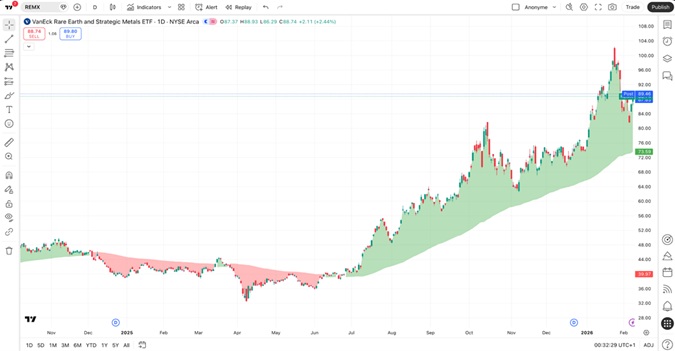
The dispute over rare earths has become far more serious amid escalating geopolitical tensions, as indicated by some charts, such as REMX, which has been rising sharply since mid-2025.
The Japan Agency for Marine-Earth Science and Technology (JAMSTEC) team used the deep-sea scientific drill ship Chikyu to achieve their first successful continuous lift operation, which involved retrieving material from extreme ocean depths.
The samples will undergo analysis to determine their total volume and mineral content, which will be conducted before the 2027 full-scale testing phase. Many advanced industries, such as electric vehicles, renewable energy, robotics, computing, and defense technology, whose companies are frequently featured on the premarket movers list, require rare earths, including dysprosium, neodymium, terbium, and gadolinium.
Rare earth elements are not as rare as they seem. Their extraction is just economically draining, because those elements exist in nature at very low concentrations. For the moment, China largely dominates global production, with more than 90% of refined rare earths worldwide.
Japanese industries (like those in many other countries) have been highly dependent on Chinese suppliers. In 2024, more than 60% of Japan’s imported rare hearts were from China. This is a disadvantage, especially in tense moments.
China imposed restrictions on rare-earth material exports to Japanese businesses from late 2025 to early 2026 as part of a diplomatic dispute, following Tokyo’s statements on regional security matters. The new controls created supply chain disruptions, impacting TDK and other major manufacturers, and TDK indeed reported difficulties obtaining materials after export restrictions took effect.
In February 2026, China granted Japan a small number of rare-earth export permits, despite strict export controls. Japan’s deep-sea mining effort — if successfully commercialized — could substantially reduce this dependency, and erode one of China’s most significant geopolitical levers.
Japan can achieve greater economic self-protection and international market strength by developing its own domestic mineral supply chain. The United States and other allies could easily form international partnerships to support Japan’s efforts to diversify its supply sources in line with the country’s broader strategic plan.
Toward a new Industrial Paradigm?
With the deep-sea rare-earth mining project (and the space-based solar power initiative), Japan demonstrates its determination toward technological independence — securing diverse resource security.
The success of these frontier technologies could weaken China’s longstanding dominance of critical rare earths and make Japan a new leader in sustainable energy innovation. But from what we know so far, the path to commercial viability on deep-sea extraction requires long-term investments and key international partnerships.
Geopolitical uncertainty is likely the foundation for those strategic decisions, as Japan bases its supply chain and energy system renovations on cutting-edge technological developments. This might be a way to boost its future economic performance and its positions in international markets.