

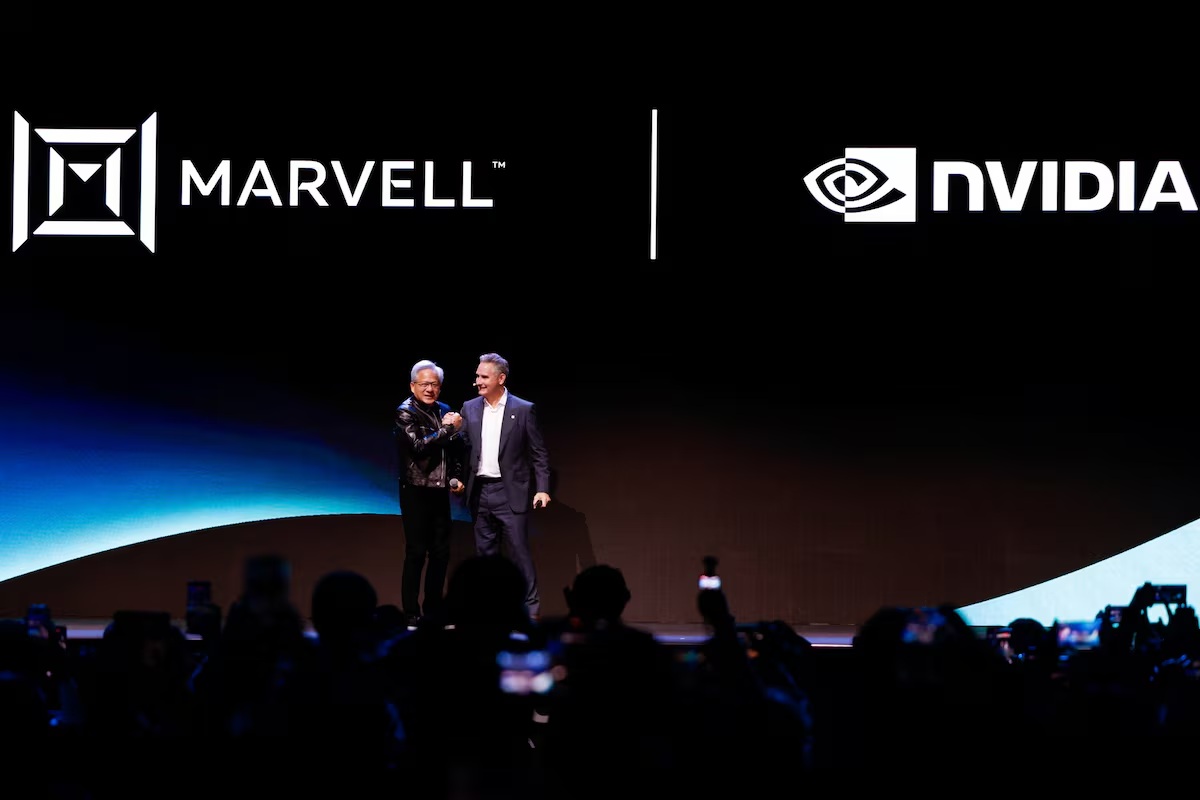
Marvell Technology’s rise as one of the biggest beneficiaries of the artificial intelligence boom received a powerful endorsement this week from Nvidia chief executive officer Jensen Huang, who declared that the semiconductor company could become the next trillion-dollar enterprise.
The remarks, delivered during an onstage discussion with Matthew Murphy at the Computex technology conference in Taipei, immediately boosted investor confidence in Marvell’s long-term prospects. Shares of the company climbed sharply in premarket trading after Huang highlighted Marvell’s growing importance in the infrastructure powering the AI revolution.
Huang’s comments carry significant weight in the semiconductor industry. Nvidia has become the dominant force in AI computing, and its chief executive is widely regarded as one of the most influential voices shaping the future direction of the sector. His endorsement suggests that the next phase of AI growth will not be driven solely by companies building processors, but also by firms providing the networking technologies that connect vast computing systems together.
Register for the next Tekedia Mini-MBA.
Register for Tekedia AI in Business Masterclass.
Join Tekedia Capital Syndicate and co-invest in great global startups.
“When you take a computing problem, and you disaggregate it into a lot of parts, and you distribute it across the entire data center, what’s necessary is connectivity,” Huang said. “That’s the reason why Matt’s doing so well. That’s the reason why Marvell is so essential.”
He added: “We’ve distributed and disaggregated computing so that it runs across these enormous clusters, so that we could get aggregating the total compute, the total memory, the total bandwidth that we have, and what makes it possible is connectivity.”
While attention has largely focused on Nvidia’s graphics processing units, powerful AI models are placing enormous demands on the networks that link thousands, and sometimes tens of thousands, of chips together inside modern data centers.

Why Huang is Betting on Marvel
As AI workloads scale, moving data efficiently between processors has become almost as important as the processors themselves. Industry executives describe networking as one of the most critical bottlenecks in the development of next-generation AI systems.
That trend has placed Marvell in an enviable position.
The company designs a range of high-performance semiconductors that enable data to move rapidly across cloud computing systems, AI clusters, enterprise networks, telecommunications infrastructure, and automotive platforms. Its portfolio includes networking chips, custom silicon, optical interconnects, and data-center connectivity solutions that are becoming increasingly essential as AI systems grow larger and more complex.

Marvell has emerged as one of the leading suppliers of custom AI chips and networking technology at a time when hyperscale cloud providers are pouring unprecedented sums into AI infrastructure.
The scale of that spending is staggering. Technology giants, including Microsoft, Amazon, Alphabet, and Meta, are collectively investing hundreds of billions of dollars to build AI data centers. Nvidia executives have repeatedly estimated that annual AI infrastructure spending could approach or exceed $1 trillion in the coming years.
For Marvell, that spending cycle is creating a substantial growth opportunity. The company delivered stronger-than-expected results in its fiscal 2027 first quarter, reporting revenue of $2.4 billion and projecting continued growth driven largely by its data-center business. Demand for AI-related products has become the primary engine of expansion, helping offset weakness in some traditional semiconductor markets.
Another significant vote of confidence has come from Nvidia itself. The AI chip leader recently committed a $2 billion investment in Marvell, deepening ties between the two companies as they seek to address one of the industry’s most pressing challenges: moving ever-larger volumes of data across AI systems.
The investment also aligns with a broader industry push toward photonics, a technology that uses light rather than electrical signals to transmit information. Photonic systems are viewed as a potential breakthrough for AI infrastructure because they can deliver higher speeds, lower power consumption, and greater efficiency than conventional networking technologies.
As AI models become more sophisticated and computationally demanding, photonics is increasingly seen as a critical technology for overcoming bandwidth and energy constraints inside future data centers.
Marvell’s networking and connectivity products are already widely deployed across cloud and telecommunications infrastructure. As data-center operators search for ways to improve performance while managing soaring energy consumption, Marvell’s expertise in high-speed interconnect technologies could become increasingly valuable.
Huang’s trillion-dollar prediction may sound ambitious, but it reflects a broader market belief that AI infrastructure winners will extend well beyond chip manufacturers themselves.
Nvidia has already crossed the trillion-dollar threshold and remains one of the world’s most valuable companies. Other firms tied to AI infrastructure, including memory-chip producers, networking specialists, and data-center equipment suppliers, have also seen their valuations surge as investors bet on years of sustained AI spending.
Marvell is now increasingly viewed as part of that group.
The company occupies a strategic position between AI processors and the networks that connect them, giving it exposure to one of the fastest-growing segments of the semiconductor industry. If AI investment continues at its current pace, demand for advanced networking, connectivity, and custom silicon solutions could rise alongside demand for computing power itself.
That is the future Huang was pointing to in Taipei: a world where the success of AI depends not only on the chips performing calculations, but also on the technologies enabling those chips to communicate at unprecedented speed and scale.
In that environment, Marvell’s role becomes much larger than supplying components. It becomes part of the foundational infrastructure of the AI economy, a position that explains why Nvidia’s chief executive believes the company could eventually join the trillion-dollar club.