

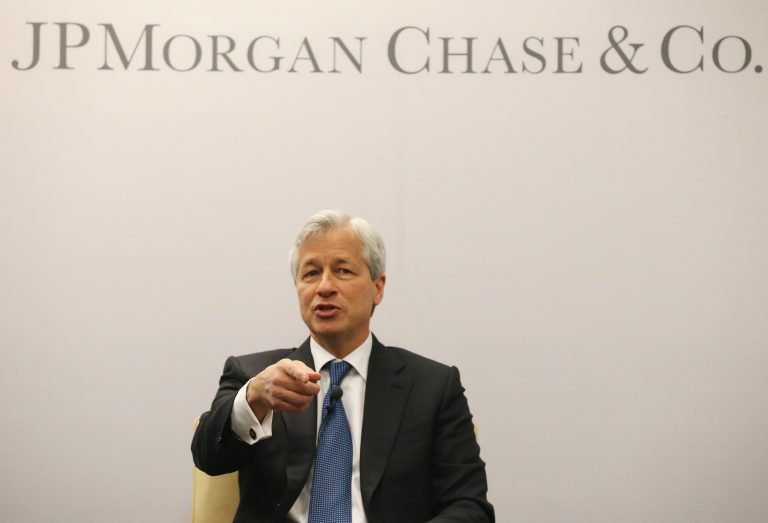
JPMorgan Chase chief executive Jamie Dimon on Wednesday delivered a rare public disagreement with President Donald Trump’s immigration agenda, warning that the administration’s enforcement-heavy approach risks harming both the U.S. economy and the social fabric.
Speaking on a panel at the World Economic Forum in Davos, Switzerland, Dimon opened by crediting Trump for tightening border controls, a priority that has long resonated with parts of the business community. Illegal crossings at the U.S.-Mexico border fell to their lowest level in 50 years between October 2024 and September 2025, according to federal data cited by the BBC, an outcome the administration has repeatedly pointed to as evidence that its strategy is working.
But Dimon drew a clear line between border control and the way immigration enforcement is now being carried out inside the United States. His sharpest comments appeared to reference widely circulated videos and reports of Immigration and Customs Enforcement operations targeting alleged undocumented immigrants.
Register for Tekedia Mini-MBA edition 20 (June 8 – Sept 5, 2026).
Register for Tekedia AI in Business Masterclass.
Join Tekedia Capital Syndicate and co-invest in great global startups.
Register for Tekedia AI Lab.
“I don’t like what I’m seeing, five grown men beating up a little old lady,” Dimon said. “So I think we should calm down a little bit on the internal anger about immigration.”
He did not specify a particular incident, and it remains unclear whether he was referring to a single case or speaking more generally about ICE confrontations. Still, the comment marked one of the bluntest critiques of Trump’s immigration tactics from a sitting chief executive of a major U.S. corporation during the president’s second term.
Since returning to office, Trump has moved swiftly to overhaul immigration policy. His administration has prioritized mass deportations, narrowed access to asylum, and significantly expanded funding for ICE personnel and detention facilities. It has also rescinded previous guidance that limited where immigration arrests could occur, opening the door to enforcement actions at schools, hospitals, and places of worship.

Supporters say the measures restore the rule of law; business groups and immigrant advocates argue they have fueled fear across entire communities.
Dimon’s comments highlighted the economic dimension of that debate. He pressed for clarity on who is being swept up in raids, asking whether those detained are in the country legally, whether they are criminals, and whether they have broken U.S. law.
“We need these people,” he said. “They work in our hospitals and hotels and restaurants and agriculture, and they’re good people… They should be treated that way.”

That argument has been a consistent feature of Dimon’s public positions for years. As the head of the world’s largest bank by market capitalization, he has repeatedly described immigration reform as one of the most effective ways to lift U.S. growth, ease labor shortages, and strengthen long-term competitiveness.
In shareholder letters and interviews, he has supported a merit-based green card system, citizenship for immigrants brought to the U.S. as children, and a more flexible approach to skilled-worker visas such as the H-1B programme.
On Wednesday, he returned to those themes, urging Trump to pair enforcement with pathways to legality and citizenship for “hardworking people” and to preserve access to asylum for those who qualify.
“I think he can, because he controlled the borders,” Dimon said, suggesting that the administration now has political room to soften its stance without losing credibility on security.
The remarks stood out in a corporate environment where public criticism of Trump has been muted. Unlike during his first term, when executives openly challenged policies ranging from trade to climate change, many CEOs have largely stayed silent this time around. Wall Street analysts and political observers say business leaders are wary of retaliation from an administration that has sued media organizations, universities, and law firms, and has shown a willingness to use regulatory and legal pressure against perceived opponents.
That dynamic surfaced directly during the Davos discussion. Zanny Minton Beddoes, editor-in-chief of The Economist, told Dimon she was struck by how careful he and other executives had been when discussing Trump.
“You are one of the more outspoken business leaders,” she said. “I’m genuinely struck by the unwillingness of CEOs in America to say anything critical. There is a climate of fear in your country.”
Dimon pushed back, arguing that he had been clear about his disagreements with the president on immigration, tariffs, and relations with European allies.
“I think they should change their approach to immigration,” he said. “I’ve said it. What the hell else do you want me to say?”
Even so, his intervention underscored how unusual such candor has become. Although for Trump, immigration remains a core political issue and a defining feature of his presidency, it is something different for corporate America. The tension between enforcement, labor needs, and economic growth is becoming harder to ignore. Dimon’s comments suggest that, at least for some business leaders, the cost of staying silent may now rival the risks of speaking out.