

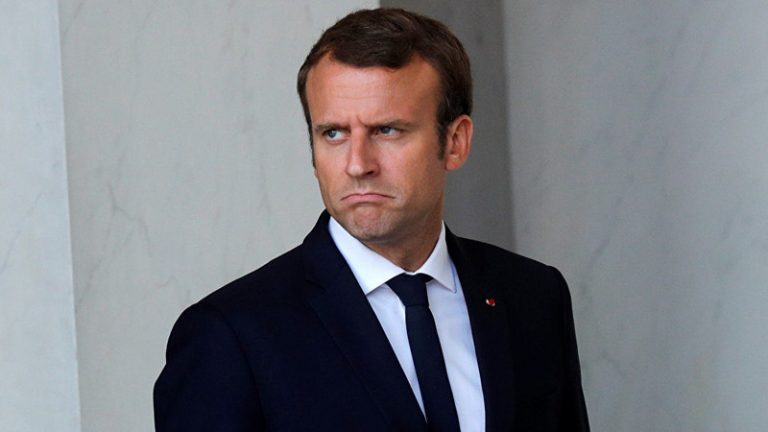
French President Emmanuel Macron has urged his ministers to weigh retaliatory measures targeting the U.S. digital sector after President Donald Trump threatened new tariffs on countries with digital regulations and taxes affecting American technology giants.
At a Cabinet meeting on Wednesday, Macron said Europe “should not exclude taking a look at the digital sector” in its response, according to a senior French official who spoke to Politico on anonymity due to the sensitivity of the discussions. Macron cited the EU’s negative trade balance in services with the U.S., while noting that Washington has pressed to reduce Europe’s trade surplus in goods, particularly automobiles, pharmaceuticals, and food.
A source close to Macron confirmed that exploring retaliation against U.S. digital players aligns with his current stance. The French president is expected to raise the matter with German Chancellor Friedrich Merz during bilateral talks this week at Fort Brégançon and Toulon.
Register for Tekedia Mini-MBA edition 20 (June 8 – Sept 5, 2026).
Register for Tekedia AI in Business Masterclass.
Join Tekedia Capital Syndicate and co-invest in great global startups.
Register for Tekedia AI Lab.
Trump, who has long criticized Europe’s regulatory regime, threatened Monday to impose substantial tariffs and export restrictions on countries that maintain digital taxes or rules he says “discriminate” against U.S. technology companies such as Google, Meta, Amazon, and Apple.
“Digital taxes, legislation, rules or regulations are all designed to harm, or discriminate against, American technology,” Trump wrote on Truth Social. He argued that while Europe and the UK impose levies such as the 2% digital services tax, China’s tech giants are “outrageously given a complete pass.”
He added: “Unless these discriminatory actions are removed, I, as president of the United States, will impose substantial additional tariffs on that country’s exports to the USA, and institute export restrictions on our highly protected technology and chips.”

The comments came just weeks after Washington and Brussels finalized a trade deal setting a baseline 15% tariff on EU exports to the U.S. The agreement was published in a joint statement last week, making Trump’s latest outburst a jolt for EU officials who thought a temporary truce had been reached.
Trump has repeatedly blasted Europe’s Digital Services Act (DSA) and Digital Markets Act (DMA), arguing they censor U.S. citizens and unfairly target American companies. France, Italy, and Spain have also introduced national digital services taxes, which Washington has labeled protectionist.
In the UK, the Trump administration has criticized the digital services tax introduced in 2020. Earlier this year, reports surfaced that Prime Minister Keir Starmer privately offered U.S. tech companies a reduction in the DST headline rate to ease tensions, while continuing to apply the levy to firms from other countries.

Despite Trump’s aggressive posture, many EU governments remain reluctant to enter a trade war. Brussels has so far held back from activating its Anti-Coercion Instrument — a legal “trade bazooka” that could restrict intellectual property rights or investment access for U.S. tech firms. European Commission President Ursula von der Leyen has previously said “all instruments are on the table” but has stopped short of direct retaliation, wary of jeopardizing U.S. cooperation on Ukraine.
Macron, however, has been consistently vocal about Europe’s need to assert itself. He has hinted that the EU failed to project enough strength in the last trade negotiations, saying Europe “was not feared enough” to secure better terms.
In the UK, Liberal Democrat leader Ed Davey urged the government not to “kowtow” to Trump’s “bullying” by weakening Britain’s DST.
“The prime minister must rule out giving in to Donald Trump’s bullying by watering down Britain’s digital services tax,” Davey said. “Tech tycoons like Elon Musk rake in millions off our online data and couldn’t care less about keeping kids safe online. The last thing they need is a tax break. The way to respond to Trump’s destructive trade war is to work with our allies to stand up to him.”
The standoff underscores how digital regulation, once a niche area of policy, has become a frontline issue in transatlantic trade relations.