

When Seyi Makinde assumed office in 2019, Oyo State’s electorate demanded more than campaign promises, they wanted fairness. Long-standing sentiment held that governance tilted toward Ibadan, leaving agrarian belts underdeveloped. Makinde’s rhetoric, and later, his spending choices, suggested an intent to move beyond purely urban bias. Instead of chasing arithmetical equality, his approach leaned toward functional equity, matching investment to both need and growth potential.
Infrastructure as Equalizer
Roads became the administration’s loudest statement. In Oyo North, projects such as the Moniya–Ijaiye–Iseyin (65 km) reconstruction and the Iseyin–Fapote–Ogbomoso Highway (76 km) dismantled decades of isolation in Oke Ogun, while the Saki Township dual carriageway and Oyo–Iseyin Road revitalized farm-to-market channels. Oyo Central saw the Airport–Ajia–New Ife (21 km) corridor modernised and the Gedu–Oroki–Sabo–Asipa (5.25 km) road improved, ensuring that the old Oyo axis was no longer a transit afterthought. In Oyo South, where density and congestion dominate, the Ibadan Circular Road and multiple feeder arteries absorbed urban traffic and opened new logistics spines. Each zone received at least one signature highway or interchange; the kilometres differ, but the impact logic is consistent.
Energy and Urban Mobility
Urban infrastructure dominated headlines with the 11-megawatt Independent Power Project in Ibadan. At first glance, this looks like urban privilege, yet the plant energises government facilities—secretariats, hospitals, courts, that serve the entire state. Parallel to this, the “Light Up Oyo” program stretched solar-powered streetlighting across 240 km, including markets and corridors far beyond Ibadan. Transport investments—Iwo Road, Challenge, Ojoo, and New Ife Road bus terminals plus a bike terminal at Agodi Gate—centralise transit but deliberately link peri-urban riders to city routes. Solar mini-grids at Ajia, Otefon, and Orisunbare temper the sense that energy progress stops at the ring road.
Register for Tekedia Mini-MBA edition 20 (June 8 – Sept 5, 2026).
Register for Tekedia AI in Business Masterclass.
Join Tekedia Capital Syndicate and co-invest in great global startups.
Register for Tekedia AI Lab.
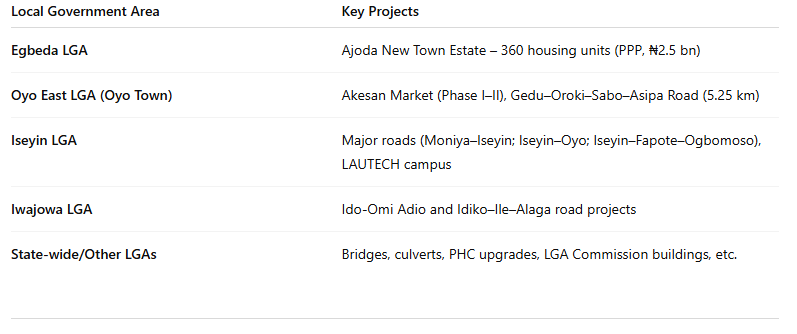
Exhibit 1: Selected LGA-Based Projects
Education as Redistribution
Makinde’s strategy in education makes a stronger equity case. Oyo North gained the LAUTECH Iseyin Campus, turning an agrarian town into an academic hub. The upgrade of Emmanuel Alayande College into a full-fledged university secured a decades-long demand from Oyo Central district. Oyo South retained flagship institutions but also benefitted from extensive school renovations and fleet support, with over 130 classrooms rehabilitated, 60 model schools built, and buses supplied to special and tertiary institutions. Policy shifts, abolition of secondary school fees, fresh teacher recruitment, and the return of 54,000 out-of-school children, indicate an argument that talent is evenly distributed while opportunity must be delivered.
Agribusiness and Industrial Logic
Economic geography steered heavy agribusiness spend into rural belts. The Fasola Agribusiness Hub and the 3,000-hectare Eruwa Special Agro-Processing Zone attract processing plants, residential layouts, and agro-tourism. OYSADA’s relocation to Saki aligns bureaucratic oversight with farmland realities, while youth initiatives like YEAP and the Start Them Early Program embed agribusiness culture in schools. Investor interest, topping ?35 billion in private commitments, shows that equity is more than token: it seeks income parity by raising rural productivity.

Health, Welfare, and Social Balance
Healthcare reform followed a one-ward-one-PHC blueprint: 351 primary centres have been refurbished or newly equipped. Teaching hospitals received PSA oxygen plants, and over 1,500 health professionals were recruited. Fiscal welfare complements service delivery—N25,000 stipends for workers, N15,000 for pensioners, consistent 13th-month salaries, and reduced pension backlogs. On security, Amotekun patrols, new vehicles for agencies, and CCTV-linked control rooms distribute safety nets across LGAs.
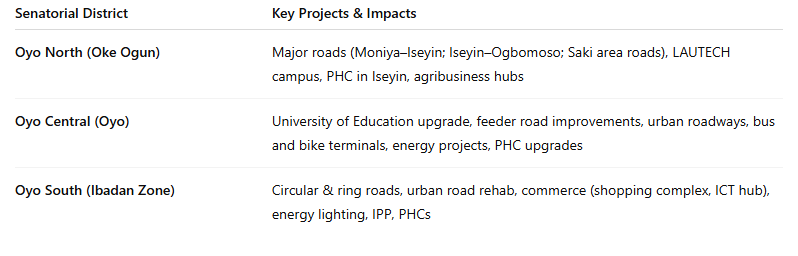
Exhibit 2: Selected key projects by senatorial district
Allocation or Justice?
Critiques persist that Ibadan still claims the costliest assets. Yet historical neglect of Oke Ogun is now offset by dual carriage highways, an agricultural university campus, and market-linked hubs. Numerical equality in spending may never align with justice measured in opportunity. Makinde’s blueprint interprets fairness as correcting legacy deficits, not simply splitting naira three ways.
