

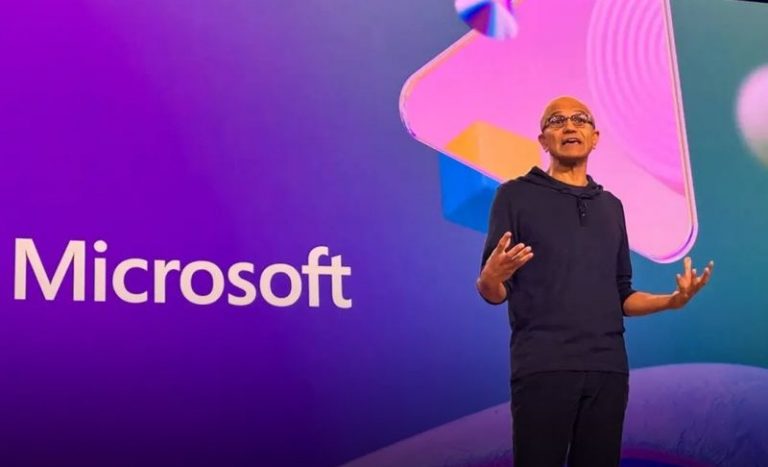
Satya Nadella chose his moment carefully. Just weeks after Merriam-Webster crowned “slop” its word of the year — a shorthand for the flood of low-effort, AI-generated content clogging feeds and search results — the Microsoft chief executive stepped in with a counter-narrative for 2026.
His message was not delivered through a keynote or earnings call, but through a reflective blog post that sought to reframe how the public, policymakers, and the tech industry itself should think about artificial intelligence.
Nadella urged readers to abandon the idea of AI as slop and instead see it as “bicycles for the mind,” borrowing and extending Steve Jobs’ famous metaphor for personal computing. In his telling, AI should not be framed as a replacement for human capability, but as scaffolding that amplifies it.
Register for Tekedia Mini-MBA edition 20 (June 8 – Sept 5, 2026).
Register for Tekedia AI in Business Masterclass.
Join Tekedia Capital Syndicate and co-invest in great global startups.
Register for Tekedia AI Lab.
“A new concept that evolves ‘bicycles for the mind’ such that we always think of AI as a scaffolding for human potential vs a substitute,” he wrote, before calling for a new equilibrium in how humans relate to one another when equipped with “cognitive amplifier tools.”
Strip away the philosophical language, and Nadella’s core argument is that he wants the debate to move away from whether AI output is crude or sophisticated, and away from the more existential fear that machines are here to replace people. Instead, he is pushing the idea of AI as a productivity companion — a tool that works with humans, not instead of them.
The problem is that this framing sits uneasily with how AI is being sold, deployed, and discussed elsewhere in the industry. Much of the marketing around AI agents and automation tools leans heavily on the promise of replacing human labor. That promise is not just rhetorical; it is central to how these tools are priced and how companies justify the cost of deploying them at scale. Savings are often calculated in headcount terms, not in abstract notions of “human potential.”

At the same time, some of the most influential voices in AI have been sounding increasingly stark warnings about job losses. In May, Anthropic chief executive Dario Amodei said AI could wipe out half of all entry-level white-collar jobs within five years, potentially pushing unemployment to between 10% and 20%. He reiterated that concern in a subsequent interview on CBS’s 60 Minutes. Such statements have helped entrench the idea that AI is not just a helper, but an imminent labor-market disruptor.
Yet the empirical picture remains far murkier than the rhetoric suggests. As Nadella implicitly acknowledges, most AI tools today are not replacing workers outright. They are being used by workers — often cautiously, and usually with a human still responsible for checking accuracy, tone, and judgement. The fear is loud; the evidence is mixed.
One of the most frequently cited attempts to quantify AI’s impact is MIT’s ongoing Project Iceberg, which tracks how much of human labor can be offloaded to machines. The project estimates that AI is currently capable of performing about 11.7% of paid human labor. That figure has often been interpreted, and reported, as meaning AI can replace nearly 12% of jobs.

The researchers themselves stress that this is not what the number represents. What they are measuring is the share of tasks within jobs that can be automated, and then attaching wages to those tasks. Their examples — automated paperwork for nurses, or AI-generated code assisting programmers — are less about replacement and more about redistribution of effort within roles.
That nuance is often lost in public debate, particularly as some professions do feel sharper pain than others. Corporate graphic designers and marketing bloggers have seen demand erode as companies turn to generative tools, according to analysis from the Substack Blood in the Machine. New-graduate junior programmers are also facing a tougher market, with fewer entry-level roles and higher expectations. These are real pressures, not abstract fears.
At the same time, evidence is emerging that those who already have strong skills often become more productive — and more valuable — when they use AI effectively. Highly skilled writers, artists, and programmers consistently outperform less experienced peers when armed with AI tools. For now, creativity, judgement, and context still belong firmly to humans, even if machines can accelerate parts of the process.
This helps explain a striking finding in Vanguard’s 2026 economic outlook. The investment firm reported that the roughly 100 occupations most exposed to AI automation are actually outperforming the rest of the labor market in both job growth and real wage increases. In other words, the jobs most often cited as “at risk” are, so far, doing better than average. Vanguard bluntly concluded that workers who master AI are making themselves more valuable, not obsolete.
There is an irony here that Nadella cannot entirely escape. Microsoft itself played a role in fueling the AI-jobs anxiety he is now trying to soften. The company laid off more than 15,000 employees in 2025, even as it posted record revenues and profits for its fiscal year ending in June. AI success was cited as part of the broader context. Nadella later wrote a public memo acknowledging the layoffs, saying Microsoft needed to “reimagine our mission for a new era,” with AI transformation named alongside security and quality as a core strategic pillar.
He did not explicitly say that internal AI efficiency caused the job cuts. Still, the juxtaposition of mass layoffs and booming AI investment was hard to miss, and it reinforced the perception that automation was directly displacing workers.
The reality, as Vanguard and other analysts point out, is more prosaic. Many of the layoffs attributed to AI in 2025 had less to do with machines replacing people and more to do with familiar corporate behavior: cutting back on slower-growing businesses to redeploy capital into areas with higher expected returns. AI was the destination for that capital, but not necessarily the direct cause of each job lost.
Microsoft was far from alone. Challenger, Gray & Christmas estimated that AI was linked to nearly 55,000 layoffs in the United States in 2025, a figure cited by CNBC. The cuts spanned much of big tech, including Amazon, Salesforce, and Microsoft itself, as companies reshaped their workforces to chase growth in AI-related businesses.
Against that backdrop, Nadella’s plea to stop calling AI “slop” reads as both aspirational and defensive. He is trying to steer the conversation toward augmentation at a moment when public trust is being tested by layoffs, misinformation, and a deluge of low-quality content. And yet, even as he argues for a higher-minded view of AI, the internet continues to embrace slop in its own way.
Memes, absurdist videos, and intentionally low-effort AI creations remain wildly popular, suggesting that, for better or worse, slop is also one of AI’s most entertaining outputs.