


MTN Nigeria’s campaign inviting customers to exchange old branded memorabilia for prizes has generated widespread enthusiasm online, but the response has also highlighted growing concerns over transparency, accessibility and the practical cost of participation.
The telecommunications company recently encouraged customers to contribute historical MTN items to a “Memory Wall”, asking people to submit memorabilia such as old SIM packs, recharge cards, branded wallets, booster cards, dongles and legacy MTN mobile phones. In return, participants were promised “exciting prizes” and invited to deliver their items to designated collection centres.
The initiative quickly attracted hundreds of responses from customers who described preserving pieces of MTN’s history dating back more than two decades. Many shared memories of the company’s early years in Nigeria, demonstrating the emotional attachment that long-term customers continue to have with one of the country’s largest telecommunications providers.
Register for the next Tekedia Mini-MBA.
Register for Tekedia AI in Business Masterclass.
Join Tekedia Capital Syndicate and co-invest in great global startups.
Several commenters said they still possessed original MTN SIM card packs purchased in the early 2000s. One respondent said his father had kept the SIM pack bought in 2000, while others reported owning branded wallets, small bags, old recharge cards, booster cards and first-generation modems that had remained untouched for years.
Others said they still owned MTN-branded phones and dongles that had once represented the cutting edge of mobile communication in Nigeria. Some customers added that they had continued using the same MTN telephone number since purchasing their first SIM card more than 20 years ago.
The campaign therefore succeeded in prompting users to reflect on the evolution of mobile communication in Nigeria and their personal relationship with the brand. Several comments celebrated MTN’s longevity, with one customer describing the company as “our love network today, tomorrow and forever everywhere you go”, reflecting the enduring recognition of one of the firm’s long-standing marketing slogans.

Yet beneath the nostalgic responses lay a more critical conversation centred on what customers would actually receive in exchange for their memorabilia.
A recurring theme throughout the discussion was uncertainty over the prizes being offered. Numerous commenters asked MTN to specify the rewards before participants invested time and money in travelling to collection centres.
One customer asked directly whether the reward could be a television or even a car, while others simply requested clarity on what qualified as an “exciting prize”. Several respondents argued that the incentive should be publicly disclosed before customers made arrangements to participate.

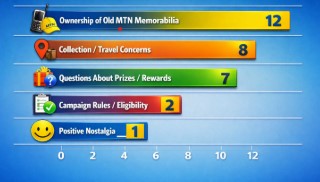
The absence of clear information about the prizes became closely linked to another issue that dominated the conversation: geographical accessibility.
Many respondents said they lived in states where no collection centres had been announced. Customers from Kogi, Taraba, Bauchi, Edo, Imo and Kwara states all questioned how they could participate when the nearest collection point was located hundreds of kilometres away.
One commenter from Osogbo noted that participating would require travelling to Ibadan and questioned whether the reward would justify the expense. Another asked where residents of Ilorin and neighbouring communities were expected to submit their items, while a customer from the south-east sarcastically wondered whether participants would need to board a flight to Lagos simply to contribute to the campaign.
The responses suggest that, while the campaign successfully engaged customers emotionally, many viewed participation through a practical lens. Travelling across states in exchange for an unspecified reward appeared difficult to justify for many respondents, particularly against the backdrop of rising transportation costs.
Questions also emerged about eligibility. Some customers asked whether those still using their original MTN SIM cards could participate without surrendering an active telephone line. Others wanted clarification on whether keeping the SIM card while submitting only the packaging would qualify for the campaign.
These requests point to a broader expectation among consumers that promotional campaigns should be accompanied by detailed guidance on participation requirements, eligibility criteria and reward structures.
The discussion also reflects changing consumer expectations in the social media era. Rather than responding only with expressions of excitement, many users sought immediate clarification, questioned the value proposition and evaluated whether participation represented a worthwhile exchange.
Such reactions illustrate the increasingly transactional nature of online engagement between brands and consumers. While nostalgia remains a powerful marketing tool capable of generating significant public interest, audiences also expect campaigns to demonstrate fairness, transparency and convenience.
For MTN, the campaign appears to have achieved one of its central objectives by encouraging customers to revisit the company’s history and share personal memories spanning more than two decades. The volume of responses suggests that many Nigerians have retained branded materials that document the country’s transition from limited telephone access to widespread mobile connectivity.
However, the conversation equally demonstrates that emotional attachment alone may not be sufficient to drive participation. For many respondents, the willingness to contribute cherished memorabilia depends on knowing what they will receive in return and whether participation is realistically accessible regardless of where they live.
The campaign therefore presents a familiar challenge for brands seeking to combine heritage marketing with customer engagement. While nostalgia can capture public attention, sustaining participation often depends on transparent communication, inclusive logistics and rewards that consumers perceive as proportionate to the effort required.