

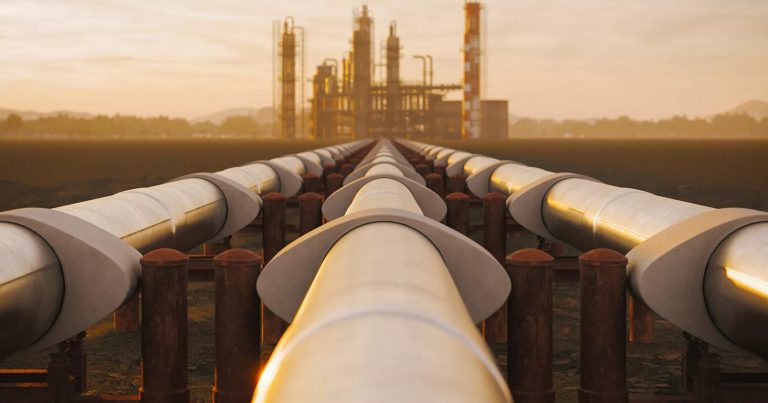
In a renewed bid to link Africa’s vast gas reserves to European markets, Nigeria, Algeria, and the Republic of Niger have signed key agreements to advance the Trans-Saharan Gas Pipeline (TSGP). The agreements, signed in Algiers on February 11, 2025, represent a significant step toward actualizing a project that has been in discussions for decades.
According to Dada Olusegun, Special Assistant on Social Media to President Bola Tinubu, the newly signed agreements involve energy companies from the three countries. The agreements include an update to the project’s feasibility study, a compensation agreement, and a non-disclosure agreement (NDA).
“The TSGP represents a strategic initiative designed to establish a continental pipeline for transporting natural gas from Nigeria, through Niger, to Algeria, facilitating exports to European markets and other international destinations,” the statement said.
Register for Tekedia Mini-MBA edition 20 (June 8 – Sept 5, 2026).
Register for Tekedia AI in Business Masterclass.
Join Tekedia Capital Syndicate and co-invest in great global startups.
Register for Tekedia AI Lab.
The TSGP, estimated to cost $13 billion, is expected to transport Nigerian gas through Niger to Algeria and then to Europe, where energy demand remains high following supply disruptions from Russia.
The project gained renewed importance after the United States and its allies imposed economic sanctions on Russia following its invasion of Ukraine. In response, the European Union placed an embargo on Russian gas, leading to a severe energy crisis across the continent.
Countries like Germany, which previously depended on Russia for over 50% of its gas supply, were forced to seek alternative sources to cushion the impact of soaring energy costs. Europe turned to the United States for liquefied natural gas (LNG) imports, but logistical challenges and high prices have made diversification of supply a priority. The TSGP is now seen as a potential solution, allowing Europe to tap into Africa’s gas reserves while reducing its dependency on traditional suppliers.

For Nigeria, the project offers an opportunity to harness its vast gas reserves, which are among the largest in the world. Despite holding over 206 trillion cubic feet (tcf) of proven gas, much of Nigeria’s reserves remain untapped due to infrastructure deficits and underinvestment in the sector.
While Nigeria currently exports liquefied natural gas (LNG) to Europe through the Nigeria LNG Limited (NLNG) facility in Bonny, its market share remains small. President Bola Tinubu had, in December 2023, expressed his administration’s commitment to positioning Nigeria as a major competitor to Russia in energy exports to Europe. Advancing the TSGP aligns with this vision and could significantly boost Nigeria’s foreign exchange earnings, attract investment into the gas sector, and strengthen diplomatic ties with Algeria and Niger.
However, analysts warn that the success of the TSGP is not guaranteed. US President Donald Trump is leading a move to broker peace between Russia and Ukraine, a move that, if successful, could pave the way for the European Union to reconsider its embargo on Russian gas. The peace negotiation is expected to be held in Saudi Arabia soon, according to Trump.

If peace is brokered between Russia and Ukraine, the embargo might be lifted and European countries will likely prioritize Russian gas over alternatives from Africa due to its lower cost and well-established infrastructure.
Russian gas has historically been cheaper for Europe compared to LNG imports from the United States or pipeline gas from Africa, making a potential shift back to Moscow’s supply a significant risk for the viability of the TSGP.
The project also faces other hurdles, including the challenge of securing the necessary $13 billion investment needed for construction and gas-gathering infrastructure. Security risks in the Sahel region remain another concern, as parts of Niger and Algeria have experienced instability and militant activity, which could threaten the pipeline’s operations.
Additionally, Nigeria is simultaneously working on another major gas project, the Nigeria-Morocco Gas Pipeline (NMGP), which aims to transport gas along the West African coast to Europe. The competition between the two projects raises questions about which one will receive priority funding.
However, the agreements signed in Algiers underlines a renewed commitment from Nigeria, Algeria, and Niger to push the Trans-Saharan Gas Pipeline forward. If successful, the project could unlock Africa’s gas potential and offer Europe a stable alternative to Russian energy supplies.