

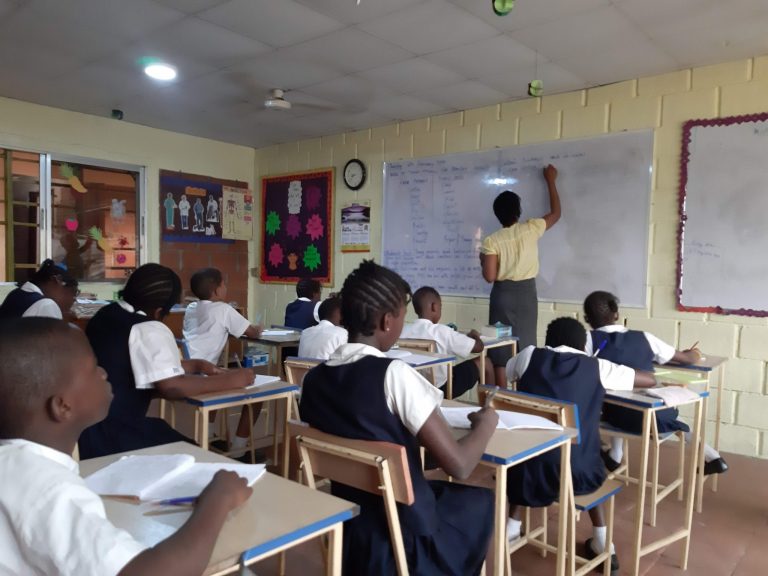
Amid mounting concern over Nigeria’s deteriorating basic education system, the federal government has rolled out a comprehensive reform program aimed at reversing years of underperformance in public schooling.
Known as HOPE for Quality Basic Education for All (HOPE-EDU), the initiative is backed by $552.18 million in secured funding from the World Bank and the Global Partnership for Education (GPE). The launch was announced on Saturday by the Minister of State for Education, Dr. Tunji Alausa, via his verified social media handle.
Described by Alausa as a “landmark achievement” in Nigeria’s journey to rebuild its education sector, the HOPE-EDU program is being projected as a transformational reform designed to close learning gaps, modernize outdated teaching structures, and bring measurable improvements to basic education across the country.
Register for Tekedia Mini-MBA edition 20 (June 8 – Sept 5, 2026).
Register for Tekedia AI in Business Masterclass.
Join Tekedia Capital Syndicate and co-invest in great global startups.
Register for Tekedia AI Lab.
“This is not just another project,” Alausa said. “It is a new model of how government can work — with performance-based financing, equity at the core, and results as the measure.”
According to the Minister, the program is set to directly impact over 29 million Nigerian children, 500,000 teachers, and more than 65,000 public schools across all 36 states and the Federal Capital Territory. The aim is to establish a performance-driven system that rewards progress, supports underserved communities, and reshapes public education delivery with greater accountability.
A Country in Crisis — and a Sector Long Neglected
For decades, Nigeria’s education system has been crippled by systemic neglect, poor funding, infrastructure decay, and a chronic shortage of qualified teachers. Though basic education is officially free and compulsory under the Universal Basic Education Act, millions of Nigerian children remain out of school, and for those in school, the quality of instruction has often been alarmingly low. The result is a generation of students who, even after six years of primary education, often lack foundational literacy and numeracy skills.

“Too many children in school, but not learning; too many classrooms under-resourced; too many teachers unsupported,” Alausa pointed to this crisis bluntly.
By tying funding to measurable improvements, HOPE-EDU represents a sharp departure from the traditional model in which federal funds were disbursed with limited tracking and little linkage to learning outcomes. The new system will empower state governments to lead program delivery, with federal coordination and international oversight ensuring that funds go where they’re most needed—and only when targets are met.
The Architecture of Reform
Central to the HOPE-EDU model is a performance-based financing framework that evaluates and releases funding based on clearly defined outcomes. States that improve student learning results, close gender and regional gaps, enhance infrastructure, and support teacher development will be better positioned to receive continued funding support.

The program also emphasizes the inclusion of communities, parents, and local leaders in driving school accountability and promoting enrollment and attendance. The federal government hopes to restore a sense of shared ownership to public education, one that has long been absent from Nigeria’s fractured system, by aligning these actors with national goals.
“This program will redefine how we deliver public education in Nigeria—transparently, measurably, and sustainably,” Alausa said.
As a sign of the administration’s commitment, Tinubu’s government allocated N3.5 trillion to the education sector in the 2025 budget, marking one of the highest single-year investments in recent Nigerian history. Of that amount, N826.9 billion has been earmarked for infrastructure development across primary, secondary, and tertiary institutions.
Building Momentum Through Multilateral Support
In addition to local funding, Nigeria has secured international backing to strengthen its educational foundations. The World Bank recently approved a $1.08 billion loan package for Nigeria, with nearly half—$500 million—dedicated to improving education quality, boosting household and community resilience, and enhancing nutrition outcomes for vulnerable children.
Saturday’s launch of HOPE-EDU follows months of negotiations and coordination between the federal government, sub-national entities, and international education donors. The Ministry of Education, alongside the Universal Basic Education Commission (UBEC), was instrumental in designing the new framework in partnership with technical teams from the World Bank and GPE.
Stakeholders familiar with the program say its real value may lie in its ability to enforce discipline within the delivery chain, a consistent weakness in past reform attempts. HOPE-EDU introduces a feedback mechanism that rewards performance and penalizes complacency, by conditioning disbursements on verified results.
An Education Loan Scheme for Higher Institutions
Beyond basic education, the federal government has also moved to ease access to tertiary education by establishing the Nigerian Education Loan Fund (NELFUND), aimed at supporting students from low-income backgrounds who would otherwise struggle to afford university or polytechnic tuition.
With the education system facing pressure from all angles—economic instability, ballooning youth population, and increasing demand for digital and technical skills—the combination of reforms at both the basic and tertiary levels appears to be part of a broader recalibration of Nigeria’s development strategy.
A Long Road To Success
Despite the ambitious scope and funding, implementation remains the most formidable challenge. Against this backdrop, education experts have pointed to many well-intentioned reforms that have collapsed under the weight of poor governance, inadequate oversight, and political interference.
What sets HOPE-EDU apart, for now, is its insistence on metrics, transparency, and community participation. If these principles hold firm, the program could serve as a long-overdue blueprint for restoring confidence in Nigeria’s battered education system. But if mismanaged, the consequences could deepen inequality, widen regional disparities, and derail the administration’s reform agenda.