

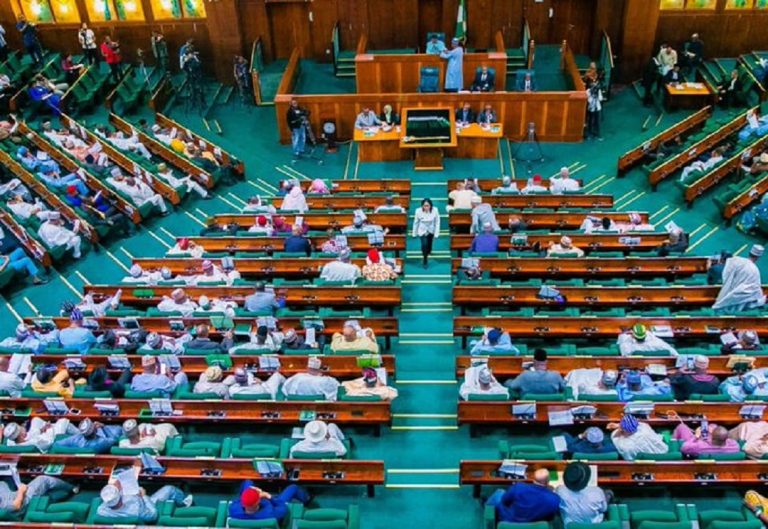
The House of Representatives has taken a significant step toward strengthening Nigeria’s financial technology ecosystem, as lawmakers passed the Bill for an Act to Establish the Nigerian Fintech Regulatory Commission through its second reading during Tuesday’s plenary session.
Sponsored by Hon. Fuad Kayode Laguda, member representing Surulere I Federal Constituency, the proposed legislation seeks to create a comprehensive regulatory framework for the nation’s rapidly expanding fintech sector. The bill’s primary objective is to establish a Regulatory Commission responsible for licensing, supervising, and regulating fintech companies and their business activities across Nigeria.
The bill establishes two main categories of operating permission: individual licences and class licences. The Commission will maintain registers of every licence issued, suspended, revoked, surrendered, or amended. Also, it will have a governing board consisting of a chairman, a Director-General, executive and non-executive commissioners, and other members appointed by the President, subject to confirmation by the National Assembly.
Register for Tekedia Mini-MBA edition 20 (June 8 – Sept 5, 2026).
Register for Tekedia AI in Business Masterclass.
Join Tekedia Capital Syndicate and co-invest in great global startups.
Register for Tekedia AI Lab.
Notably, it will have offices in all geopolitical zones and develop its own staff structure, conditions of service, and administrative systems. Funding will be through appropriations by the National Assembly and other sources, such as fees, charges, fines, and gifts.
Some Nigerians have expressed skepticism about the proposed Fintech Regulatory Commission Bill, questioning the need to establish a new agency. They argue that the creation of another regulatory body could lead to duplication of roles and bureaucratic inefficiency, given that the Central Bank of Nigeria (CBN) already oversees many aspects of the fintech industry.
One concerned user on X, remarked that lawmakers seem “too eager to create new agencies instead of strengthening existing ones,” adding that the CBN has been “doing a commendable job regulating fintech operations.” This sentiment reflects a broader concern among stakeholders that the bill, rather than streamlining regulation, might complicate Nigeria’s fintech regulatory landscape with overlapping mandates and increased administrative costs.

Currently, Nigeria lacks a single, unified regulatory body overseeing the practices and operations of fintech operators and service providers, despite their growing role in national development and digital transformation. The country’s fintech space is regulated by multiple agencies, such as the Central Bank of Nigeria (CBN), the Securities and Exchange Commission (SEC), and NITDA each overseeing specific aspects.
According to the bill’s sponsor, the establishment of the commission will foster public trust and industry growth by enhancing consumer protection, improving financial stability, encouraging innovation, increasing competition, and promoting collaboration among stakeholders. The creation of a central Fintech Regulatory Commission would unify oversight, reducing regulatory overlap, confusion, and compliance burdens for fintech operators.
The fintech industry has been instrumental in reaching unbanked and underbanked populations. With stronger regulation, the Commission can coordinate efforts between fintechs, banks, and regulators to deepen financial inclusion initiatives, especially in rural and underserved areas.

With more fintech products entering the market, incidents of fraud, misuse of personal data, and service failures have become growing concerns. The Commission would likely introduce standards for transparency, dispute resolution, and data privacy, protecting consumers from unethical practices and improving trust in digital financial services
By working alongside existing institutions such as the CBN, SEC, and NCC, the Commission could facilitate inter-agency coordination to create a more coherent and forward-looking regulatory ecosystem that reflects Nigeria’s growing digital economy
The bill has been referred to the House Committees on Banking Regulations, Digital & Electronic Banking, Science & Technology, and Communications for further legislative consideration and refinement.